
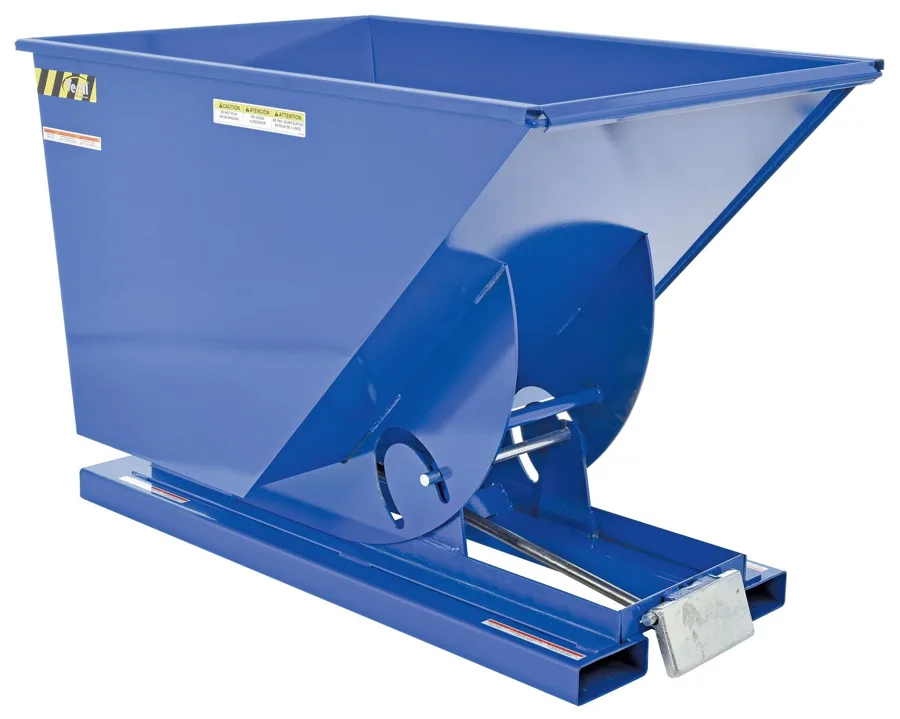
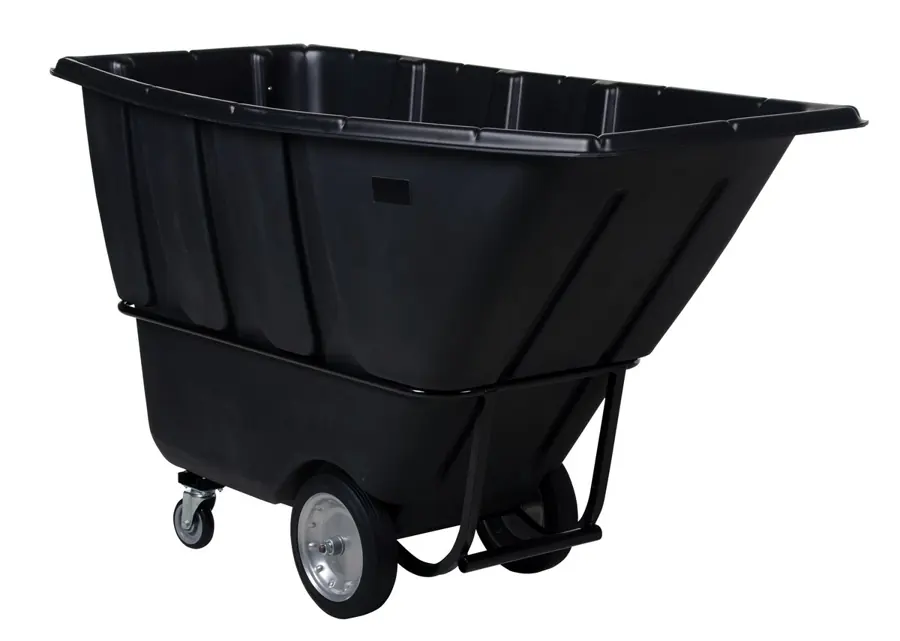





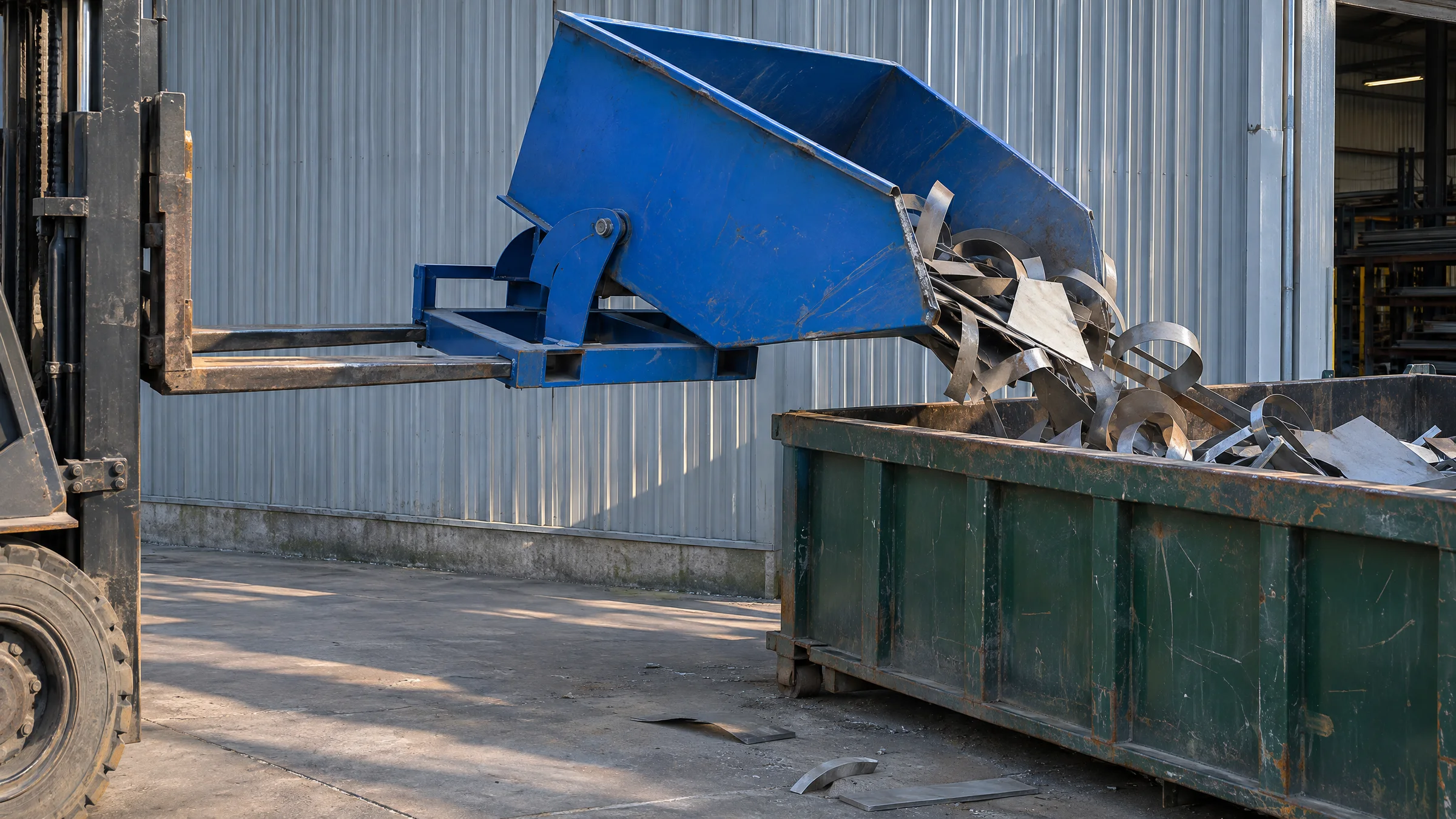
A self-dumping hopper is a steel bin that rides on a forklift's forks and tips to empty itself. Three numbers size it: volume in cubic yards, rated load in pounds, and its own weight, which the forklift carries on top of the fill.[1]
Sizes
1/4 to 5 cu ydTwelve volumes in Vestil's D-series manual tables; 3 1/2, 4 and 5 cu yd are heavy duty only.[1]
Rated loads
2,000 / 4,000 / 6,000 lbLight, medium and heavy duty: the same volumes in heavier steel.[1]
Hopper weight
341 to 1,332 lbNet weight, which the forklift carries on top of the fill. 940 lb at 3 cu yd, 1,332 lb at 5.[1]
Fork pocket centers
18 in or 28 in18 in up to 1 cu yd, 28 in from 1 1/2 cu yd.[1]
Try it
What does your material put in each hopper size?
Type what a cubic yard of your own material weighs, pick one of the light wastes the EPA lists, or weigh a level 5 gallon pail of it and the calculator scales that up (a cubic yard is 40.4 five-gallon pails). Add the rated capacity on your forklift's data plate. For each size we list, it multiplies volume by weight, names the lightest D-series rating at or above that load, and adds the hopper's own weight from the manual's table.[1][5][6]
A hopper size is a volume, a rated load and a weight
The model number carries the first two. In the tables of Vestil's D-series manual, D-100-LD is a 1 cubic yard hopper rated for 2,000 lb and D-200-HD is a 2 cubic yard hopper rated for 6,000 lb. The letters are the duty.[1]
Duty is the rated load, not the size. LD, MD and HD are 2,000, 4,000 and 6,000 lb at every volume, and the steel gets heavier with the rating: the manual gives 12 gauge for light duty and 8 gauge for heavy duty, and Vestil's data sheets list 10 gauge for medium duty.[1][2]
The third number is the hopper's own weight, 341 lb for the smallest light-duty hopper and 940 lb for the 3 cubic yard ones. It matters because the forklift lifts the hopper and the fill together.[1]
Vestil D-style hopper sizes
These are the manual's specification tables for the D-series with bumper release, in inches and pounds, with the dimensions in the order the manual prints them: width, length, height. The manual also covers larger heavy-duty hoppers above 3 cubic yards, which are not in this table.[1]
Vestil's web data sheets list slightly different net weights for some of these models: a D-100-LD is 478 lb in the manual and 460 lb on its data sheet. This table uses the manual, revised October 23, 2025. Vestil's site shows some of these sizes as unavailable at the moment; the ones we list are on the hopper product pages.[1][2]
Width is what grows with volume. In the table the 3/4 and 1 cubic yard hoppers share one length, 61 1/8 in, and are 42 11/16 or 42 3/4 in high. The 1 1/2 to 3 cubic yard hoppers are all 68 5/16 to 68 5/8 in long and 51 3/16 to 51 13/16 in high, while the width goes from 42 9/16 in to 81 3/4 in.[1]
Scroll across to see every column →
| Model | Cu yd | Rated load (lb) | Width x length x height (in) | Fork pocket centers (in) | Net weight (lb) |
|---|---|---|---|---|---|
| D-25-LD | 1/4 | 2,000 | 26 x 51 7/8 x 38 | 18 | 341 |
| D-25-MD | 1/4 | 4,000 | 26 x 51 3/8 x 38 1/16 | 18 | 396 |
| D-25-HD | 1/4 | 6,000 | 26 x 51 7/8 x 38 1/16 | 18 | 396 |
| D-33-LD | 1/3 | 2,000 | 26 x 51 7/8 x 38 | 18 | 341 |
| D-33-MD | 1/3 | 4,000 | 26 x 51 3/8 x 38 1/16 | 18 | 396 |
| D-33-HD | 1/3 | 6,000 | 26 x 51 7/8 x 38 1/16 | 18 | 396 |
| D-50-LD | 1/2 | 2,000 | 32 9/16 x 51 3/4 x 38 | 18 | 364 |
| D-50-MD | 1/2 | 4,000 | 32 9/16 x 51 7/8 x 38 1/16 | 18 | 435 |
| D-50-HD | 1/2 | 6,000 | 32 9/16 x 51 7/8 x 38 1/16 | 18 | 435 |
| D-75-LD | 3/4 | 2,000 | 32 9/16 x 61 1/8 x 42 11/16 | 18 | 448 |
| D-75-MD | 3/4 | 4,000 | 32 9/16 x 61 1/8 x 42 3/4 | 18 | 542 |
| D-75-HD | 3/4 | 6,000 | 32 9/16 x 61 1/8 x 42 3/4 | 18 | 542 |
| D-100-LD | 1 | 2,000 | 42 9/16 x 61 1/8 x 42 11/16 | 18 | 478 |
| D-100-MD | 1 | 4,000 | 42 9/16 x 61 1/8 x 42 3/4 | 18 | 590 |
| D-100-HD | 1 | 6,000 | 42 9/16 x 61 1/8 x 42 3/4 | 18 | 590 |
| D-150-LD | 1 1/2 | 2,000 | 42 9/16 x 68 5/16 x 51 13/16 | 28 | 565 |
| D-150-MD | 1 1/2 | 4,000 | 42 9/16 x 68 3/8 x 51 13/16 | 28 | 714 |
| D-150-HD | 1 1/2 | 6,000 | 42 9/16 x 68 3/8 x 51 13/16 | 28 | 714 |
| D-200-LD | 2 | 2,000 | 56 11/16 x 68 5/16 x 51 3/16 | 28 | 612 |
| D-200-MD | 2 | 4,000 | 56 5/8 x 68 5/16 x 51 13/16 | 28 | 700 |
| D-200-HD | 2 | 6,000 | 56 9/16 x 68 5/16 x 51 13/16 | 28 | 788 |
| D-250-LD | 2 1/2 | 2,000 | 69 9/16 x 68 3/8 x 51 3/4 | 28 | 863 |
| D-250-MD | 2 1/2 | 4,000 | 69 9/16 x 68 3/8 x 51 3/4 | 28 | 863 |
| D-250-HD | 2 1/2 | 6,000 | 69 9/16 x 68 3/8 x 51 3/4 | 28 | 863 |
| D-300-LD | 3 | 2,000 | 81 3/4 x 68 5/8 x 51 3/16 | 28 | 940 |
| D-300-MD | 3 | 4,000 | 81 3/4 x 68 5/8 x 51 13/16 | 28 | 940 |
| D-300-HD | 3 | 6,000 | 81 3/4 x 68 5/8 x 51 13/16 | 28 | 940 |
Source: [1]
Above 3 cubic yards: 3 1/2, 4 and 5
Vestil's manual lists three larger volumes, 3 1/2, 4 and 5 cubic yards, and a narrow 3 cubic yard hopper, the D-300-HD-NA. All four are heavy duty only: rated 6,000 lb, with fork pocket centers 28 in apart.[1]
The four share one length and height, 79 3/8 in and 64 3/8 in. The D-300-HD-NA is 55 5/16 in wide against 81 3/4 in for the standard D-300-HD, and it is 10 3/4 in longer and 12 9/16 in higher.[1]
Vestil's web data sheets list lower weights for these four than the manual does: 1,016 lb, 1,076 lb, 1,140 lb and 1,250 lb in the same order as the table. This table uses the manual.[1][8]
Scroll across to see every column →
| Model | Cu yd | Rated load (lb) | Width x length x height (in) | Fork pocket centers (in) | Net weight (lb) |
|---|---|---|---|---|---|
D-300-HD-NA | 3, narrow | 6,000 | 55 5/16 x 79 3/8 x 64 3/8 | 28 | 1,115 |
D-350-HD | 3 1/2 | 6,000 | 64 x 79 3/8 x 64 3/8 | 28 | 1,169 |
D-400-HD | 4 | 6,000 | 72 11/16 x 79 3/8 x 64 3/8 | 28 | 1,224 |
D-500-HD | 5 | 6,000 | 90 x 79 3/8 x 64 3/8 | 28 | 1,332 |
Source: [1]
Work out the load before you pick the rating
The load is the hopper's volume times what a cubic yard of your material weighs. To get that number for your own material, fill a container of known volume, weigh it and scale the result up to a cubic yard.
For light, bulky waste the EPA publishes volume-to-weight factors, which it compiled for estimating the tonnage of collected waste and recyclables. On those factors a cubic yard of flattened corrugated boxes is 106 lb, pallets and crates 169 lb, and construction and demolition debris in bulk 484 lb.[6]
The EPA compiled those factors for comparing waste and recycling data, so they describe collected waste. They are not offered as the weight of dense material such as metal scrap, castings, stone, sand or concrete, and this page gives no figure for those.[6]
Vestil's manual sets two limits that both apply: do not fill the hopper beyond its maximum rated load, and do not fill it above the side walls.[1]
Scroll across to see every column →
| Material | Lb per cu yd | In 1 cu yd (lb) | In 2 cu yd (lb) |
|---|---|---|---|
| Flattened corrugated boxes | 106 | 106 | 212 |
| Pallets and crates | 169 | 169 | 338 |
| Clean dimensional lumber | 169 | 169 | 338 |
| Clean gypsum board | 467 | 467 | 934 |
| Green wood chips | 473 | 473 | 946 |
| Construction and demolition debris, bulk | 484 | 484 | 968 |
Source: [6]
The weight per cubic yard that reaches each rated load
Divide a hopper's rated load by its volume and you get the weight per cubic yard at which the hopper, filled level with its side walls, sits exactly at its rating. Lighter material fills the hopper before it reaches the rated load. Heavier material reaches the rated load before the hopper is full.
A 3 cubic yard light-duty hopper reaches its 2,000 lb rating at 667 lb per cubic yard. The heaviest EPA factor in the table above, 484 lb for construction and demolition debris in bulk, puts 1,452 lb in it. A 1/4 cubic yard heavy-duty hopper reaches 6,000 lb only at 24,000 lb per cubic yard.[1][6]
The forklift carries the rated load and the hopper together. At their rated loads a D-100-LD and its fill come to 2,478 lb, a D-300-HD to 6,940 lb and a D-500-HD to 7,332 lb, using the manual's net weights.[1]
The table also gives each volume in cubic feet and in cubic meters, for comparing listings that size hoppers that way. A cubic yard is 27 cubic feet; the cubic meter figures are the manual's.[1]
Scroll across to see every column →
| Cu yd | Cu ft | Cu m | 2,000 lb rating (lb per cu yd) | 4,000 lb rating (lb per cu yd) | 6,000 lb rating (lb per cu yd) |
|---|---|---|---|---|---|
| 1/4 | 6.75 | 0.19 | 8,000 | 16,000 | 24,000 |
| 1/3 | 9 | 0.25 | 6,000 | 12,000 | 18,000 |
| 1/2 | 13.5 | 0.38 | 4,000 | 8,000 | 12,000 |
| 3/4 | 20.25 | 0.57 | 2,667 | 5,333 | 8,000 |
| 1 | 27 | 0.76 | 2,000 | 4,000 | 6,000 |
| 1 1/2 | 40.5 | 1.15 | 1,333 | 2,667 | 4,000 |
| 2 | 54 | 1.53 | 1,000 | 2,000 | 3,000 |
| 2 1/2 | 67.5 | 1.91 | 800 | 1,600 | 2,400 |
| 3 | 81 | 2.29 | 667 | 1,333 | 2,000 |
| 3 1/2 | 94.5 | 2.69 | Not in the manual | Not in the manual | 1,714 |
| 4 | 108 | 3.08 | Not in the manual | Not in the manual | 1,500 |
| 5 | 135 | 3.85 | Not in the manual | Not in the manual | 1,200 |
Source: [1]
The forklift carries the hopper and the fill
A D-100-LD weighs 478 lb before anything is put in it, and a D-300-HD weighs 940 lb. Whatever the fill weighs is added to that on the forks.[1]
OSHA's rule for powered industrial trucks, 29 CFR 1910.178(o)(2), says only loads within the rated capacity of the truck shall be handled.[5]
Paragraph (a)(4) of the same rule says modifications and additions which affect capacity and safe operation shall not be performed by the customer or user without the manufacturer's prior written approval, and that capacity, operation and maintenance plates, tags or decals shall be changed accordingly. Under paragraph (a)(5), for front-end attachments that were not factory installed, the user shall request that the truck be marked to identify the attachment and show the approximate weight of the truck and attachment combination at maximum elevation with the load laterally centered.[5]
Vestil's manual states that the rule classifies the hopper as a front-end attachment whenever it is mounted on a lift truck, and tells the owner to obtain that written approval from the maker of each forklift, or from a professional engineer, before the hopper is used. The same paragraphs apply to fork extensions, which our fork extension guide covers with the length limit and load center.[1]
Fork pockets: 18 inches or 28 inches apart
The forks slide into two tubes in the base. In the D-series the tube centers are 18 in apart on hoppers up to 1 cubic yard and 28 in apart from 1 1/2 cubic yards up.[1]
Vestil's data sheets give the usable opening of each fork pocket as 7 1/2 in wide and 2 1/2 in high on the D-series models listed here. Compare both with your forks' width, thickness and spread before you order.[2]
The manual has the hopper held to the truck two ways: optional tine lock pins at the end of each fork tube, and a chain wrapped around the fork carriage with as little slack as possible. It says not to lift the hopper until it is secured to the carriage with the chain.[1]
How a D-series hopper dumps
Vestil's manual gives two ways to dump a D-series hopper: manually, by pulling the release cable, or remotely, by pressing the bumper plate against an object. It says the chute rotates through a 70 degree dump angle. The D-100-LD data sheet lists a 48 in cable.[1][7]
Vestil's data sheets say self-dumping hoppers "facilitate compliance with OSHA general industry rule 29 CFR 1910.178(m)(5)(iii) by allowing lift truck operators to remain at the controls of their truck throughout the dumping process." That paragraph is about leaving the seat, not about the chain. It reads: "When the operator of an industrial truck is dismounted and within 25 ft. of the truck still in his view, the load engaging means shall be fully lowered, controls neutralized, and the brakes set to prevent movement."[5][7]
The same data sheet says an empty hopper is stackable "if you stack the top hopper turned ninety (90) degrees from the bottom."[7]
Dumped height, reach and load center, from the approval drawings
A specification table gives a hopper upright. Vestil's approval drawing for each model also draws it in the dumped position, with the height and length it takes up there. We read the drawings for eight models, one at each volume from 1/3 to 3 cubic yards.[9][10][11][12][13][14][15][16]
A D-100-LD is 42 11/16 in high upright and 52 1/2 in to the top of the chute when dumped, 9 13/16 in more. Dumped, it measures 80 7/8 in from the fork-entry end of the base to the tip of the chute, 19 3/4 in past its 61 1/8 in upright length.[12]
The 1 1/2 to 3 cubic yard hoppers are 61 5/8 to 62 in high when dumped and 94 1/8 to 94 11/16 in long, about 26 in past their upright length. Those figures are the hopper alone: the forklift's lift height is on top of them.[13][14][15][16]
Each drawing marks a load center. On the D-100-LD it is 28 3/16 in from the fork-entry end of the base and 22 3/4 in above the floor; on the 1 1/2 to 3 cubic yard drawings it is 29 9/16 to 30 1/16 in from that end. The note beside it reads: "NEVER EXCEED LOAD CENTER RATING PER FORK TRUCK MANUFACTURER'S GUIDELINES."[9][10][11][12][13][14][15][16]
Vestil's documents do not agree on the dump angle. The manual gives 70 degrees for the series. These drawings show 76 degrees on the 1/3 to 1 cubic yard hoppers and 67 degrees from 1 1/2 cubic yards up. Each drawing carries a tolerance of plus or minus 1/4 in and says its graphics are for reference only.[1][9][10][11][12][13][14][15][16]
Scroll across to see every column →
| Model | Cu yd | Height, upright / dumped (in) | Length, upright / dumped (in) | Dumped reach past the upright length (in) | Load center, from fork-entry end / above floor (in) | Dump angle |
|---|---|---|---|---|---|---|
D-33-LD | 1/3 | 38 / 42 3/16 | 51 7/8 / 66 3/8 | 14 1/2 | 22 5/8 / 20 7/16 | 76° |
D-50-LD | 1/2 | 38 / 42 1/4 | 51 3/4 / 66 1/4 | 14 1/2 | 22 1/2 / 20 3/4 | 76° |
D-75-LD | 3/4 | 42 11/16 / 52 3/16 | 61 1/8 / 80 7/8 | 19 3/4 | 28 3/8 / 22 11/16 | 76° |
D-100-LD | 1 | 42 11/16 / 52 1/2 | 61 1/8 / 80 7/8 | 19 3/4 | 28 3/16 / 22 3/4 | 76° |
D-150-LD | 1 1/2 | 51 13/16 / 62 | 68 5/16 / 94 7/16 | 26 1/8 | 30 1/16 / 27 3/16 | 67° |
D-200-LD | 2 | 51 13/16 / 61 3/4 | 68 5/16 / 94 3/8 | 26 1/16 | 29 7/8 / 27 1/4 | 67° |
D-250-HD | 2 1/2 | 51 3/4 / 61 5/8 | 68 3/8 / 94 1/8 | 25 3/4 | 29 9/16 / 28 1/4 | 67° |
D-300-HD | 3 | 51 13/16 / 61 13/16 | 68 5/8 / 94 11/16 | 26 1/16 | 29 13/16 / 28 1/4 | 67° |
Low-profile hoppers
Vestil's H-style hoppers are the low-profile version. A 1 cubic yard H-100-LD is 28 1/8 in high against 42 11/16 in for a D-100-LD, and it is wider and shorter front to back: 51 in wide and 51 3/16 in long. Its fork pocket centers are 21 5/8 in apart.[1][3]
The H-series comes in the same 2,000, 4,000 and 6,000 lb ratings, from 1/4 cubic yard up to a 2 cubic yard heavy-duty model on Vestil's family page, and its chute rotates through a 90 degree dump angle.[3][4]
What the maker says about where a hopper may be used
Vestil's manual limits these hoppers to high-lift fork trucks with a vertical mast and carriage. It says not to use them with rough terrain lift trucks or telehandlers, and not to mount them on stackers or manually propelled lift trucks.[1]
It also says to run the truck only on concrete or asphalt while it carries a hopper, to dump only with the forklift on an even, level surface, and that no one should be under the hopper while it is raised.[1]
Casters are sold as kits of four. The manual's note is to select a caster kit whose capacity equals or exceeds the maximum rated load of the hopper.[1]
The manual lists nine caster kits, each of four casters with 6 in or 8 in wheels. Their listed uniform capacities are 2,400 lb for the two mold-on rubber kits, 4,800 or 5,000 lb for the semi-steel, polyurethane and glass-filled nylon kits, and 8,000 lb for the ductile steel kit. The approval drawings add: "ADDITION OF CASTERS MAY CHANGE WEIGHT CAPACITY BASED ON CASTER RATING."[1][12]
Options add to the hopper's weight. In the manual a polyethylene lid is 16 lb for the 1/4 cubic yard hoppers and 61 lb for the 3 cubic yard ones, four welded lifting lugs are 23 lb, and the D-TILT sideways dumping configuration, listed for the D-75-LD and D-100-LD only, is 130 lb. The list also has a leak-proof welded hopper and 3/4 in and 2 in drain plugs.[1]
Questions
What is a self-dumping hopper?
A steel bin with fork pockets in its base that a forklift carries and tips to empty, often called a dump hopper or forklift hopper. On Vestil's D-series the bumper release dumps the hopper when it contacts the side of the dumpster, and the hopper returns to an upright, locked position on its own.[2]
What are the dimensions of a 1 and a 2 cubic yard self-dumping hopper?
In Vestil's D-series manual a 1 cubic yard D-100-LD is 42 9/16 in wide, 61 1/8 in long and 42 11/16 in high and weighs 478 lb. A 2 cubic yard D-200-LD is 56 11/16 in wide, 68 5/16 in long and 51 3/16 in high and weighs 612 lb.[1]
What size self-dumping hopper do I need?
Start with the volume you fill between dumps, then multiply it by what a cubic yard of your material weighs. The result has to be within the hopper's rated load: 2,000, 4,000 or 6,000 lb in Vestil's D-series, in volumes from 1/4 to 3 cubic yards.[1]
How much does a self-dumping hopper weigh?
Vestil's D-series hoppers weigh 341 lb to 1,332 lb empty by the manual's tables: 341 lb at 1/4 cubic yard, 940 lb at 3 cubic yards and 1,332 lb at 5. A 1 cubic yard D-100-LD is 478 lb and a 2 cubic yard D-200-HD is 788 lb.[1]
How much does a cubic yard of waste weigh?
By the EPA's waste-estimating factors, a cubic yard of construction and demolition debris in bulk is 484 lb, pallets and crates 169 lb and flattened corrugated boxes 106 lb. Those factors are for collected waste, not for dense material such as metal scrap, stone or concrete: weigh a known volume of your own material.[6]
Do I need approval to use a hopper on a forklift?
29 CFR 1910.178(a)(4) says additions that affect capacity and safe operation need the truck manufacturer's prior written approval, with the capacity plates changed accordingly. Vestil's manual tells the owner to get that approval from the maker of each forklift, or from a professional engineer, before using the hopper.[1][5]
How far apart are the fork pockets on a self-dumping hopper?
On Vestil's D-series the pocket centers are 18 in apart on hoppers up to 1 cubic yard and 28 in apart from 1 1/2 cubic yards up. The low-profile H-100 is 21 5/8 in.[1][3]
How much room does a self-dumping hopper need to dump?
On Vestil's approval drawing a 1 cubic yard D-100-LD is 52 1/2 in high and 80 7/8 in long in the dumped position, against 42 11/16 in and 61 1/8 in upright. A 2 cubic yard D-200-LD is 61 3/4 in high and 94 3/8 in long when dumped. Those are the hopper's own dimensions, before the height the forklift raises it.[12][14]
What is the dump angle of a self-dumping hopper?
Vestil's D-series manual gives a 70 degree dump angle. Its approval drawings show 76 degrees on the 1/3 to 1 cubic yard hoppers and 67 degrees on the 1 1/2 to 3 cubic yard ones. The low-profile H-series rotates through 90 degrees.[1][4][9][10][11][12][13][14][15][16]
How many cubic feet is a 1 cubic yard hopper?
A cubic yard is 27 cubic feet, so a 1 cubic yard hopper holds 27 cubic feet, a 1/2 cubic yard hopper 13.5 and a 2 cubic yard hopper 54. Vestil's manual gives 1 cubic yard as 0.76 cubic meters.[1]
What is the largest Vestil D-style self-dumping hopper?
The D-500-HD: 5 cubic yards, rated 6,000 lb, 90 in wide, 79 3/8 in long and 64 3/8 in high, 1,332 lb in the manual's table.[1]
Have a list of what you need? Our quotes desk prices the exact items.

Written by Anastasiia Kuziak, Manager and President of Oakspan Supply. She has a business degree, owns a small business of her own, and has more than five years in medical and pharmaceutical sales. How we write and check our guides.
Sources
- D-Series Hoppers instruction manual, Rev. 10/23/2025: specifications, safety instructions, national standards. Vestil Manufacturing. Accessed 2026-11-17.
- D Style Self-Dumping Steel Hoppers with Bumper Release: product family page and model data sheets. Vestil Manufacturing. Accessed 2026-11-13.
- H Style Low Profile 90 Degree Self-Dumping Steel Hoppers: product family page and model data sheets. Vestil Manufacturing. Accessed 2026-11-13.
- H-Series Hoppers instruction manual, Rev. 11/26/2025. Vestil Manufacturing. Accessed 2026-11-13.
- 29 CFR 1910.178, Powered industrial trucks: paragraphs (a)(4), (a)(5) and (o)(2). Electronic Code of Federal Regulations. Accessed 2026-11-17.
- Volume-to-Weight Conversion Factors, Office of Resource Conservation and Recovery, April 2016. U.S. Environmental Protection Agency. Accessed 2026-11-13.
- D-100-LD steel light duty self-dumping hopper, 1 cubic yard: model data sheet. Vestil Manufacturing. Accessed 2026-11-17.
- D-300-HD-NA, D-350-HD, D-400-HD and D-500-HD heavy duty self-dumping hoppers: model data sheets. Vestil Manufacturing. Accessed 2026-11-17.
- D-33-LD self-dumping steel hopper with bumper release: approval drawing, upright and dumped positions. Vestil Manufacturing. Accessed 2026-11-17.
- D-50-LD self-dumping steel hopper with bumper release: approval drawing, upright and dumped positions. Vestil Manufacturing. Accessed 2026-11-17.
- D-75-LD self-dumping steel hopper with bumper release: approval drawing, upright and dumped positions. Vestil Manufacturing. Accessed 2026-11-17.
- D-100-LD self-dumping steel hopper with bumper release: approval drawing, upright and dumped positions. Vestil Manufacturing. Accessed 2026-11-17.
- D-150-LD self-dumping steel hopper with bumper release: approval drawing, upright and dumped positions. Vestil Manufacturing. Accessed 2026-11-17.
- D-200-LD self-dumping steel hopper with bumper release: approval drawing, upright and dumped positions. Vestil Manufacturing. Accessed 2026-11-17.
- D-250-HD self-dumping steel hopper with bumper release: approval drawing, upright and dumped positions. Vestil Manufacturing. Accessed 2026-11-17.
- D-300-HD self-dumping steel hopper with bumper release: approval drawing, upright and dumped positions. Vestil Manufacturing. Accessed 2026-11-17.
Written from the sources above under our editorial policy. Published November 13, 2026, last updated November 17, 2026. Spot an error? Send us a correction and we fix it and note the date.
- Vestil D-style self-dumping hoppers with bumper release
- Vestil D-style hoppers, no bump and dump
- Vestil H-style low-profile hoppers
- Vestil low-profile parts hoppers
- Caster kits for hoppers
- Dock plate or dock board: what each is built for
- Forklift fork extensions: length limit, load center and OSHA's approval rule
The photo is an AI-generated illustration of the kind of equipment this guide covers. It is not a photo of a Vestil product.