
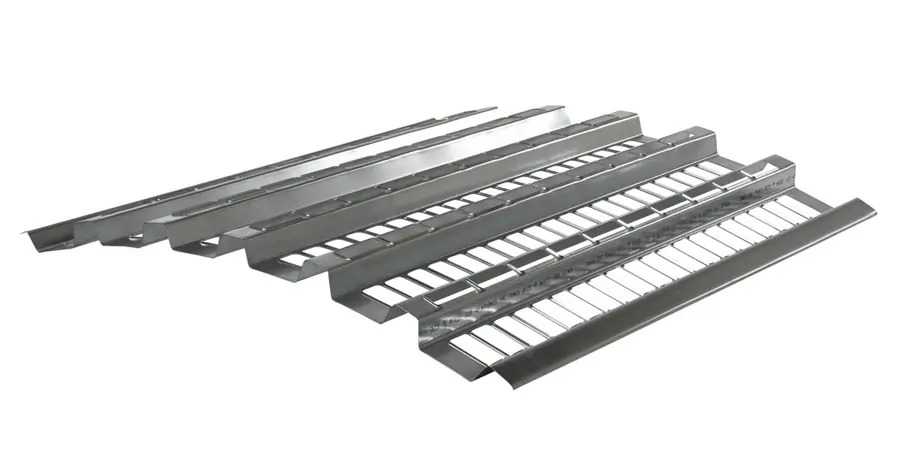







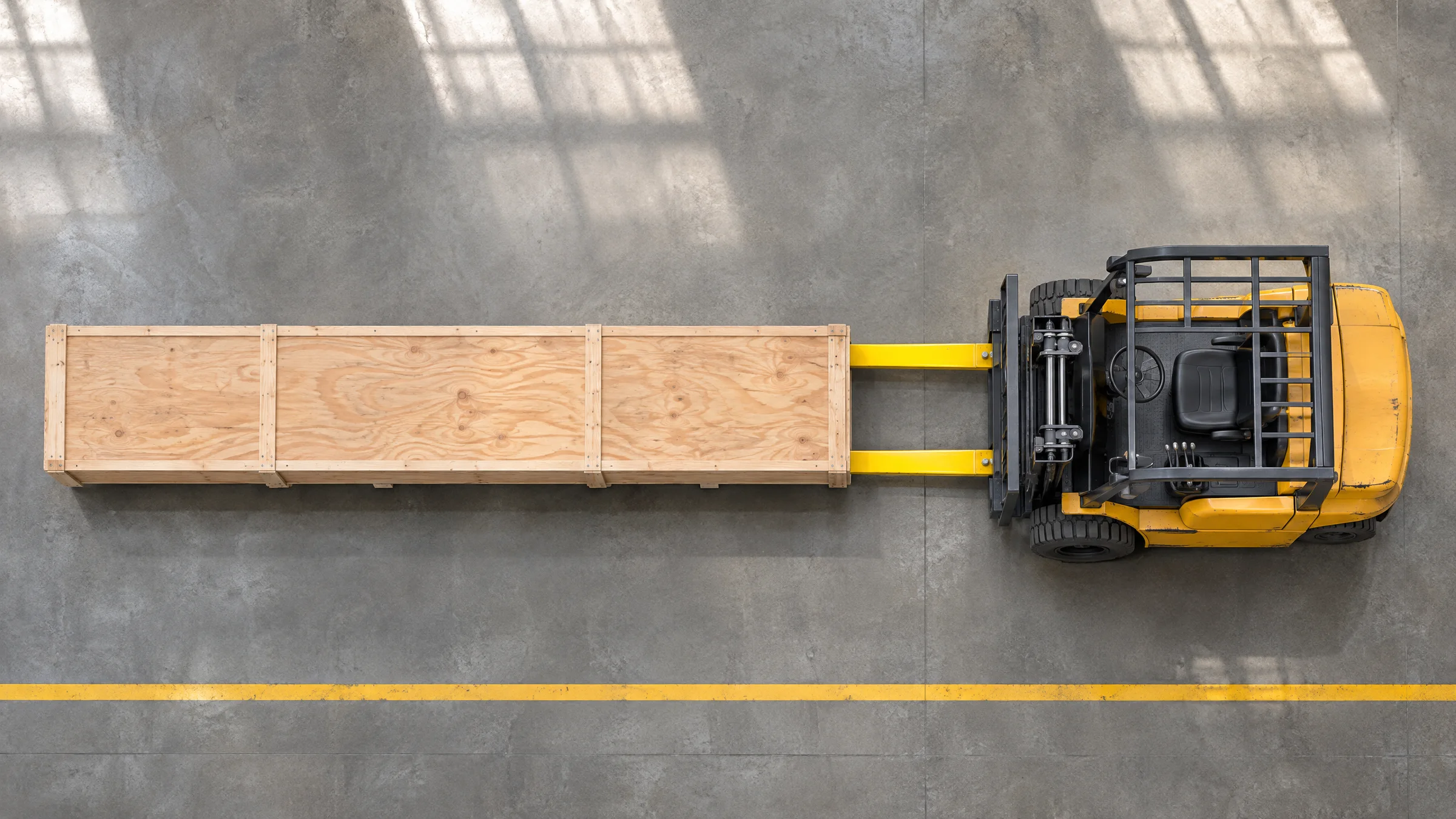
A fork extension slides over a forklift fork to carry longer loads. Vestil's manual limits an extension to 150% of the fork's length, so 48 in forks take up to 72 in. OSHA's rule sets no length; it requires the forklift maker's written approval and updated capacity plates for additions that affect capacity.[1][2][6]
Load center
Half its lengthB56.1 rates an extension at 50% of its supporting length: 36 in on a 72 in pair.[10]
OSHA
Maker's approval1910.178(a)(4): written approval from the forklift maker, plates changed to match.[6]
Strength
3 x ratingB56.1-2009 7.39.2: each extension holds three times its rated load, uniform.[10]
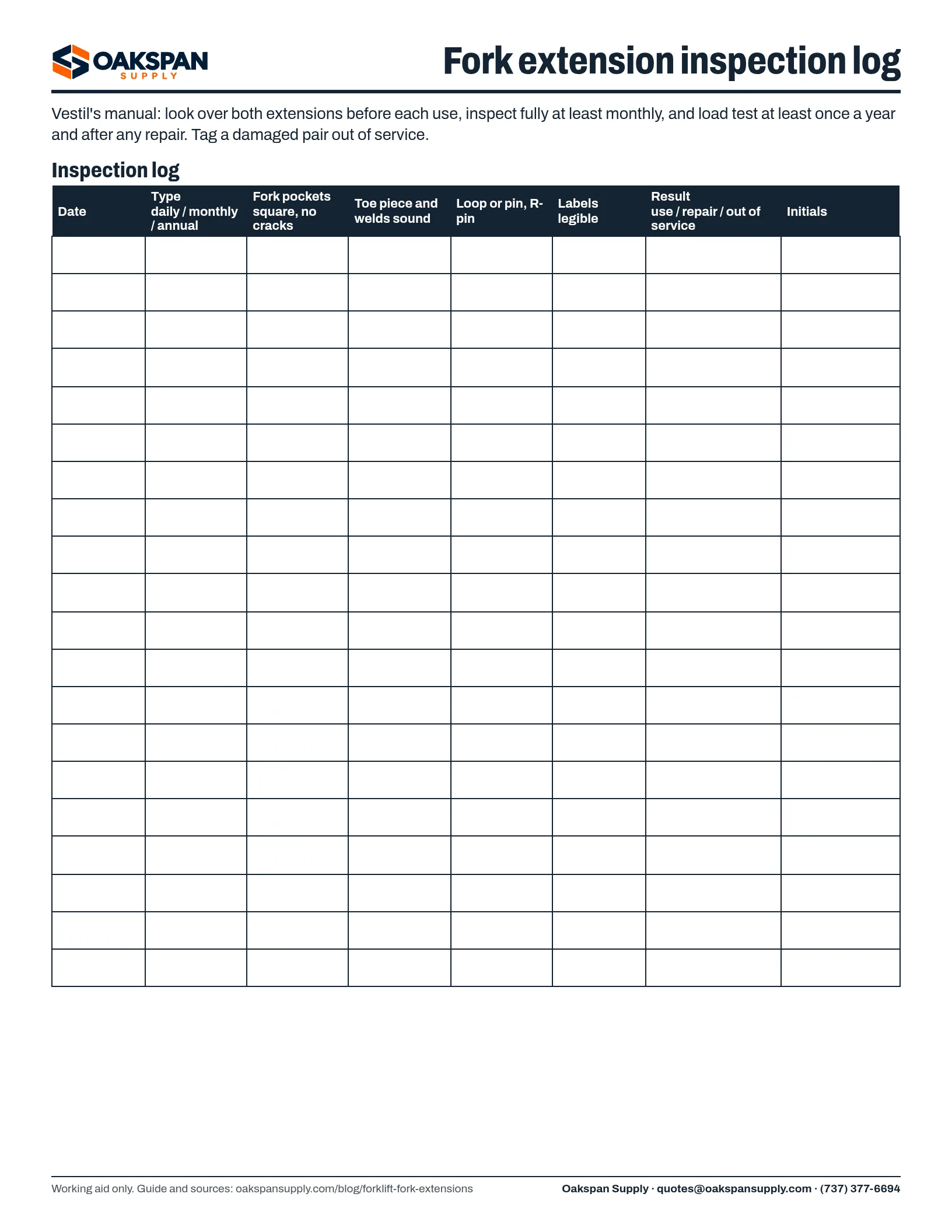
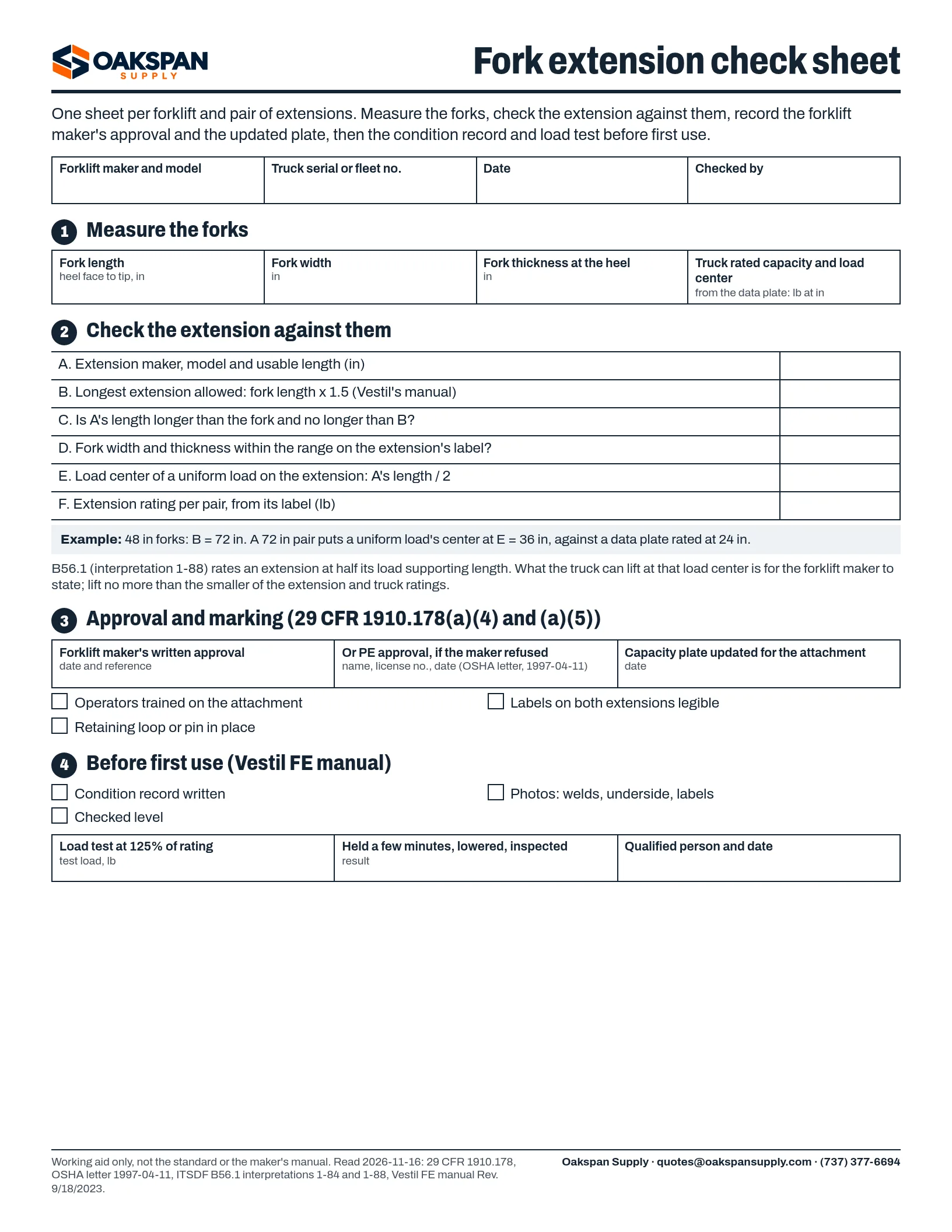
Free. Just your work email.
Print the fork extension check sheet
A two-page sheet: measure the forks, check the extension against the 150% limit, record the forklift maker's approval and plate, the 125% load test, and an inspection log.
- Measure fork length, width and thickness
- Longest extension: fork length x 1.5
- Record the maker's approval and new plate
- Log daily, monthly and annual checks
Two pages, letter size. The sheet downloads right away. We'll send you the occasional supply guide and may use your email to show you our ads. Unsubscribe any time. Privacy policy.
Try it
Which extensions fit your forks?
Pick the fork width, then type the fork's length and thickness at the heel. The calculator applies Vestil's 150% limit, lists the FE and FE-HS lengths longer than your forks and within it, and draws where a uniform load's center sits on the longest one, by B56.1's half-length rule, against the 24 in rating many forklifts carry.[1][5][9][10]
What a fork extension is
A fork extension is a steel sleeve that fits over a forklift fork to make it longer. The industrial truck standard ANSI/ITSDF B56.1 defines a fork extension as a lift truck attachment added to the truck fork to increase the fork's effective length for handling oversized uniformly distributed loads. ITSDF's interpretation 1-84 adds that fork extensions fit over the existing forks, keep the approximate shape of the forks and extend their length, so drum grippers and pipe lifters that slide onto forks are not fork extensions. Our drum lifter guide covers the drum carriers and lifters that ride on forks.[10]
Vestil's manual for its FE series says to use fork extensions only to support palletized loads or skids, only on high lift fork trucks with a vertical mast and carriage, and only on concrete or asphalt. The same manual says not to use them on rough terrain lift trucks or telehandlers, and not to lift a load on the toe of the extension alone.[1]
How long a fork extension can be
Vestil's FE manual says the extensions must not be more than 150% of the length of the forks. Vestil's own example: on 48 in forks, the extension should not exceed 72 in. The table applies that limit to common fork lengths.[1][2]
The 150% figure is the extension maker's instruction, not a number in OSHA's rule. The text of 29 CFR 1910.178 sets no length for fork extensions. The rule reaches them through the paragraphs on additions that affect capacity, attachment markings and operator training, covered below.[2][6]
Scroll across to see every column →
| Fork length | Longest extension at 150% | Vestil lengths longer than the fork, within 150% |
|---|---|---|
| 36 in | 54 in | 48, 54 in |
| 42 in | 63 in | 48, 54, 63 in |
| 48 in | 72 in | 54, 63, 72 in |
| 54 in | 81 in | 63, 72 in |
| 60 in | 90 in | 63, 72, 84 in |
| 64 in | 96 in | 72, 84, 96 in |
What an extension does to the load center
OSHA's forklift eTool explains that many forklifts are rated using a 24-inch load center: the load's center of gravity must be 24 inches or less from the face of the forks. OSHA's rule defines the load center as the horizontal distance from the fork's vertical face to the line through the load's center of gravity.[6][9]
B56.1 rates a fork extension at a load center of 50% of its load supporting length, according to ITSDF's interpretation 1-88 of section 7.39.3 of the 2009 edition. A 72 in extension carrying a uniform load therefore has its load center at 36 in, 12 in farther out than the 24 in rating many trucks carry. Vestil's family page says fork extensions do not increase forklift load center ratings.[2][9][10]
What the truck can lift at that longer load center is for the forklift maker to state. Vestil's manual says not to lift more than the capacity of the extensions or the load rating of the fork truck, whichever is smaller. OSHA's rule adds that trucks equipped with attachments shall be operated as partially loaded trucks when not handling a load.[1][6]
Appendix A to 1910.178, which the rule calls non-mandatory guidance, shows the arithmetic. It says trucks with a capacity of 30,000 pounds or less are normally rated at a 24-inch load center, and gives this example: "if an operator is operating a 3000 pound capacity truck (with a 24-inch load center), the maximum allowable load-moment is 72,000 inch-pounds (3,000 times 24). If a load is 60 inches long (30-inch load center), then the maximum that this load can weigh is 2,400 pounds (72,000 divided by 30)."[7]
What OSHA's rule requires
29 CFR 1910.178(a)(4) reads: "Modifications and additions which affect capacity and safe operation shall not be performed by the customer or user without manufacturers prior written approval. Capacity, operation, and maintenance instruction plates, tags, or decals shall be changed accordingly." Vestil's manual applies this paragraph to its fork extensions and tells the buyer to contact the forklift's maker before putting them into service.[1][6]
29 CFR 1910.178(a)(5) reads: "If the truck is equipped with front-end attachments other than factory installed attachments, the user shall request that the truck be marked to identify the attachments and show the approximate weight of the truck and attachment combination at maximum elevation with load laterally centered."[6]
OSHA's letter of April 11, 1997 covers the case where the forklift maker doesn't answer or says no: OSHA will accept a written approval from a Qualified Registered Professional Engineer, who must perform a safety analysis first, and the machine data plates must be changed accordingly. If the maker has been sold, the request goes to the company that bought it.[8]
Operator training under 1910.178(l)(3) lists fork and attachment adaptation, operation and use limitations among the truck-related topics, unless the employer shows a topic does not apply to safe operation in that workplace.[6]
Matching an extension to the fork
An extension has to match the fork's width and thickness as well as its length. Vestil's manual quotes B56.1-2005 paragraph 7.39.5: "Lateral clearance shall not exceed 12mm between fork and extension." The manual also says the warning label under each extension gives the minimum and maximum fork dimensions it fits. Measure the fork's width and thickness at the heel before choosing a size.[1]
ITSDF's interpretation 1-98 of the 2012 edition says the 12 mm, about 0.47 in, is a total for both sides: "There should be no more than a total of 12 mm clearance between the fork and fork extension." The same interpretation quotes section 7.39.4, "Each fork extension shall be clearly stamped", and answers that a durable adhesive label is not acceptable in place of stamping.[10]
Every Vestil FE and FE-HS pair in the table is rated 4,000 lb, evenly distributed, whatever its length. B56.1-2009 section 7.39.2, as quoted in ITSDF interpretation 1-88, requires each fork extension to support a uniformly distributed load of three times its rated capacity on a fork of the specified size.[5][10]
The FE-HS high strength series uses 3/16 in steel against the standard FE series' 5/16 in, and Vestil says those models are almost 40% lighter. A 72 in pair for 4 in forks ships at 114 lb in the FE series and 72 lb in the FE-HS series, by Vestil's listed shipping weights.[3][5]
Scroll across to see every column →
| Series | Fits fork width | Fork thickness | Lengths | Steel | Rated per pair |
|---|---|---|---|---|---|
FE-4 | 4 in | 2 in | 48, 54, 63, 72, 84, 96 in | 5/16 in | 4,000 lb |
FE-5 | 5 in | 2 in | 63, 72, 84, 96 in | 5/16 in | 4,000 lb |
FE-6 | 6 in | 2-1/2 in | 54, 72, 84, 96 in | 5/16 in | 4,000 lb |
FE-HS-4 | 4 in | 2 in max | 63, 72, 84, 96 in | 3/16 in | 4,000 lb |
FE-HS-5 | 5 in | 2 in max | 63, 72, 84, 96 in | 3/16 in | 4,000 lb |
FE-HS-6 | 6 in | 2-1/2 in max | 63, 72, 84, 96 in | 3/16 in | 4,000 lb |
Source: [5]
Before the first lift
Vestil's manual describes how a standard welded-loop extension goes on. Raise the forks about 4 to 6 in off the ground, lift the tip of the extension so it sits at 45 degrees to the floor, guide the tine loop under the tapered end of the fork, slide the extension on until it reaches the heel, then lower it onto the fork once the tine lock is behind the heel. Models ending in -P use a removable lock pin behind the heel instead of a welded loop, secured with an R-pin.[1]
Vestil's FE manual asks for a written record of each extension's condition before it goes into service, with photos of the welds, the underside and the labels. A qualified person then load tests the pair at 125% of its rated load: a 1,000 lb rating means a 1,250 lb test load, raised until the truck carries it, held a few minutes and lowered.[1]
The same manual calls for a visual check before each use, a fuller inspection at least monthly, and a load test at least once a year and after any repair. It lists cracked, bent or badly corroded fork pockets, a broken tine loop or lock, and damaged welds as structural damage that takes an extension out of service. Vestil says any modification it hasn't approved in writing voids the warranty.[1]
Pallet jack fork extensions
Vestil's Pallet Master extensions slide over the forks of Pallet Master pallet trucks and are held by a set screw and a steel retaining notch under the fork. PM-FE-6-48 fits forks 6 to 6-5/8 in wide and PM-FE-7-48 fits 7 to 7-1/8 in, both 48 in long. Vestil says their capacity is determined by the rated capacity of the pallet jack being used.[4][5]
Oakspan Supply sells industrial supplies for plant, warehouse and lab buyers, including Vestil fork extensions, forklift attachments, dock equipment and carts. Send us the fork width, thickness and length and our quotes desk will reply with the matching part numbers.
Questions
Are fork extensions OSHA approved?
OSHA does not approve products. Its rule, 29 CFR 1910.178(a)(4), requires the forklift maker's prior written approval for additions that affect capacity and safe operation, with the capacity plates changed to match. OSHA's 1997 letter accepts a Qualified Registered Professional Engineer's written approval if the maker doesn't answer or refuses.[6][8]
Do fork extensions reduce forklift capacity?
They move the load center out. B56.1 rates an extension at a load center of half its supporting length, so a 72 in extension puts a uniform load's center at 36 in, against the 24 in rating many forklifts carry. The capacity at that load center comes from the forklift maker.[9][10]
How long can fork extensions be?
Vestil's manual says no more than 150% of the fork's length: 72 in on 48 in forks, 96 in on 64 in forks. OSHA's rule text sets no length.[1][6]
Is the 150% fork extension limit an OSHA rule?
The text of 29 CFR 1910.178 never uses the words "fork extension" and states no percentage of fork length; the only extensions it names are load backrest extensions. The 150% limit on this page comes from Vestil's manual. OSHA's rule reaches fork extensions through paragraph (a)(4), on additions that affect capacity and safe operation.[1][6]
How do you attach fork extensions?
Vestil's manual for its welded-loop FE extensions: raise the forks about 4 to 6 in, hold the extension at 45 degrees to the floor, guide the tine loop under the tapered end of the fork, slide the extension on to the heel, then lower it once the tine lock is behind the heel.[1]
Have a list of what you need? Our quotes desk prices the exact items.

Written by Anastasiia Kuziak, Manager and President of Oakspan Supply. She has a business degree, owns a small business of her own, and has more than five years in medical and pharmaceutical sales. How we write and check our guides.
Sources
- FE-Series Fork Extensions instruction manual, Rev. 9/18/2023. Vestil Manufacturing. Accessed 2026-11-16.
- Loop-Style Fork Extensions (FE): product family page. Vestil Manufacturing. Accessed 2026-11-16.
- High Strength Fork Extensions (FE-HS): product family page. Vestil Manufacturing. Accessed 2026-11-16.
- Pallet Master Fork Extensions (PM-FE): product family page. Vestil Manufacturing. Accessed 2026-11-16.
- FE, FE-HS and PM-FE model pages: usable length, fork fit, steel thickness, capacity and shipping weight. Vestil Manufacturing. Accessed 2026-11-16.
- 29 CFR 1910.178, Powered industrial trucks. Electronic Code of Federal Regulations. Accessed 2026-11-16.
- Appendix A to 29 CFR 1910.178, Stability of Powered Industrial Trucks (non-mandatory), sections A-5.2 and A-5.3. Electronic Code of Federal Regulations. Accessed 2026-11-17.
- Powered industrial truck modifications and approval, standard interpretation, April 11, 1997. Occupational Safety and Health Administration. Accessed 2026-11-16.
- Powered Industrial Trucks eTool: Operating the Forklift, Load Handling. Occupational Safety and Health Administration. Accessed 2026-11-16.
- ANSI/ITSDF B56.1 interpretations, including 1-84 and 1-88 on section 7.39, Fork Extensions. Industrial Truck Standards Development Foundation. Accessed 2026-11-16.
Written from the sources above under our editorial policy. Published November 16, 2026, last updated November 17, 2026. Spot an error? Send us a correction and we fix it and note the date.
- Vestil FE loop-style fork extensions, 48 to 96 in
- Vestil FE-HS high strength fork extensions, 63 to 96 in
- Vestil PM-FE pallet jack fork extensions
- Vestil FE-4-72, 72 in for 4 in forks
- Vestil forklift lifting beams
- Self-dumping hopper sizes for forklifts
- Dock plate or dock board: what a forklift can cross
- Drum lifters, rotators and carriers: which one makes which move
- Wheel chocks: sizes, where they go and what OSHA requires
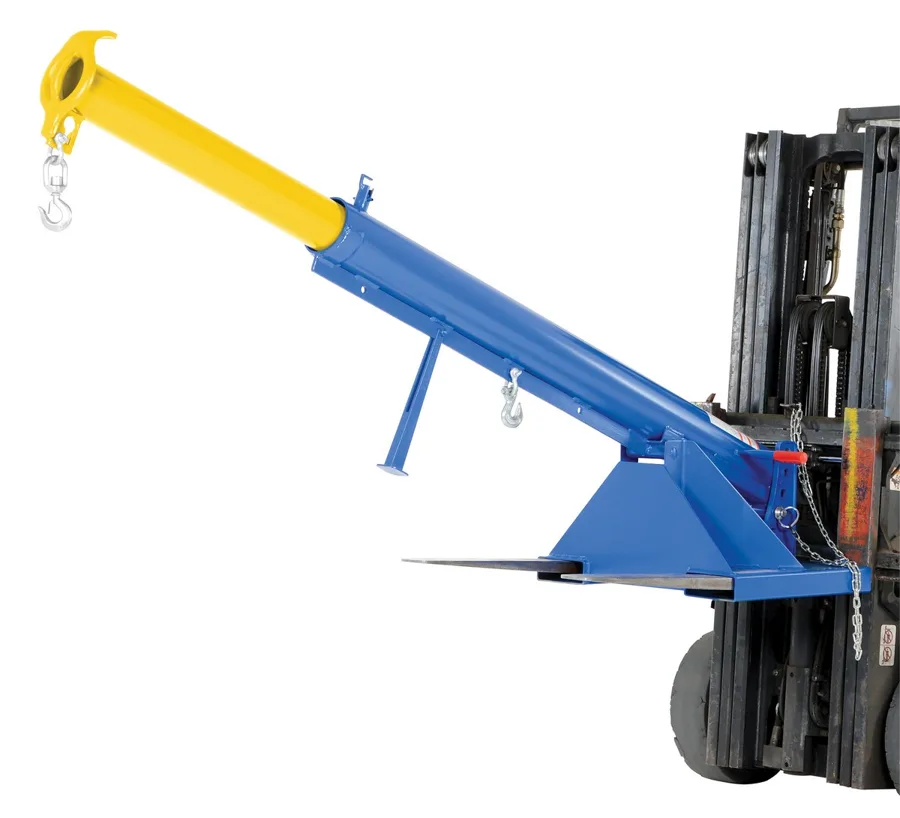
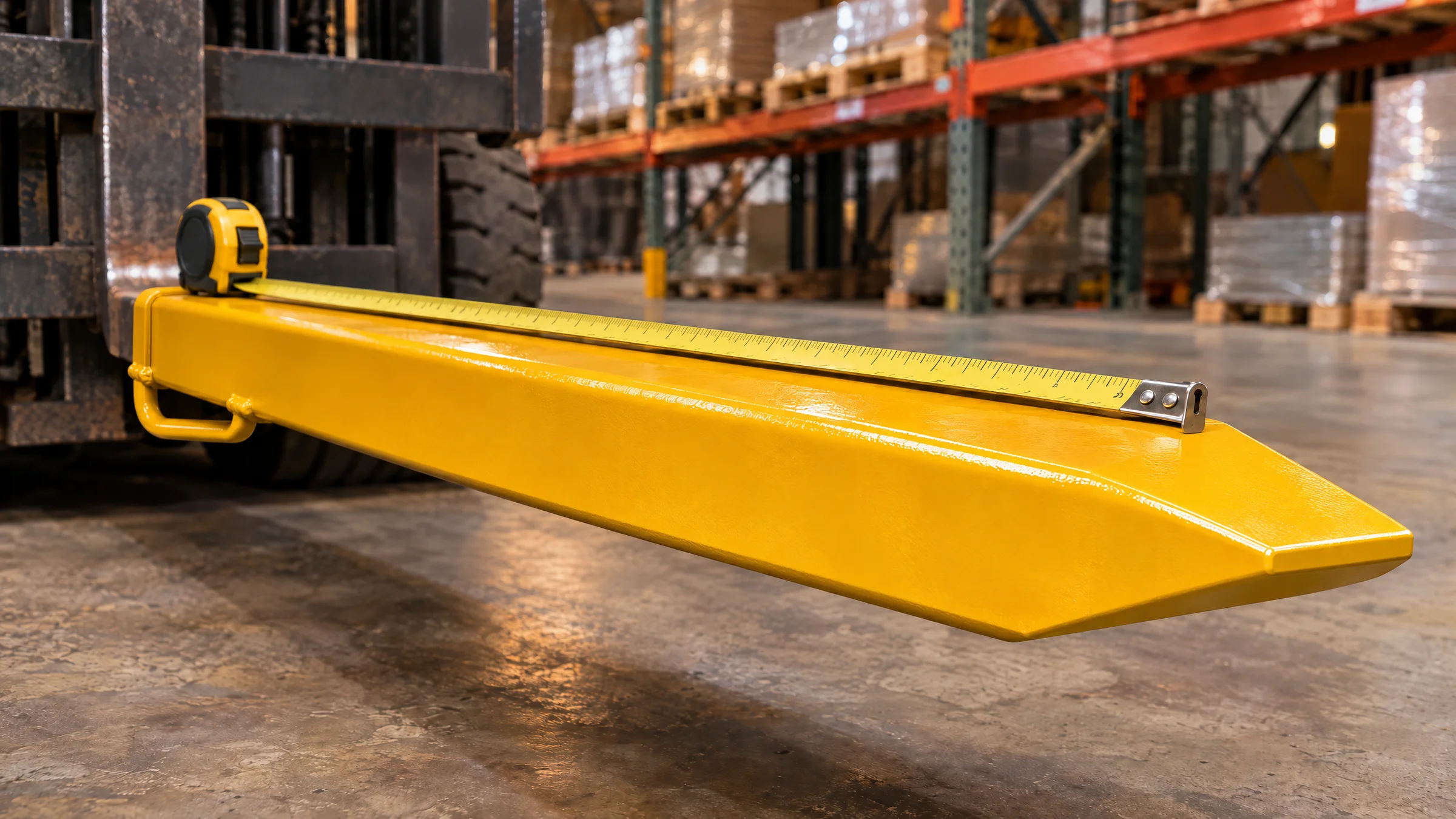
The photos on this page are AI images of generic forklift equipment, not a specific product. The drawing in the calculator is drawn to scale from the numbers typed.