
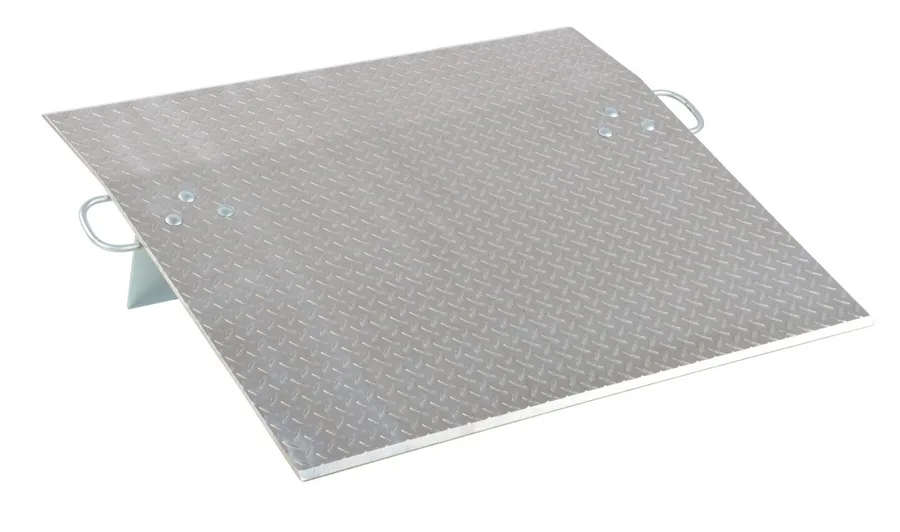
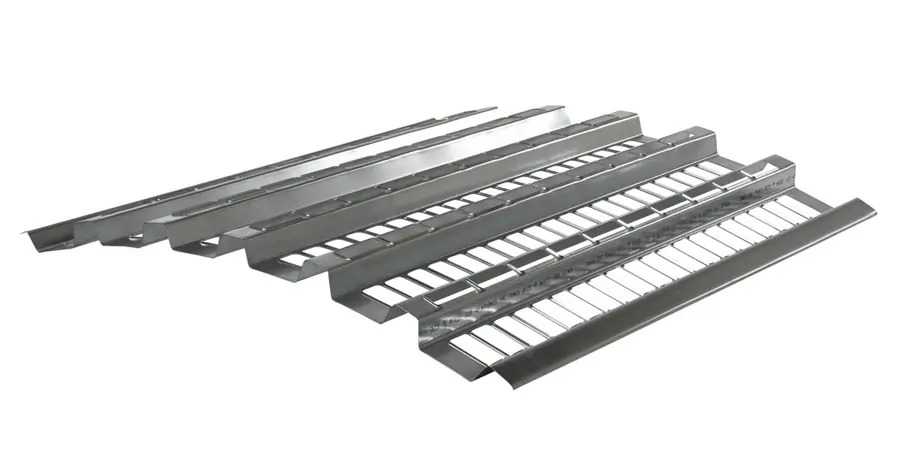






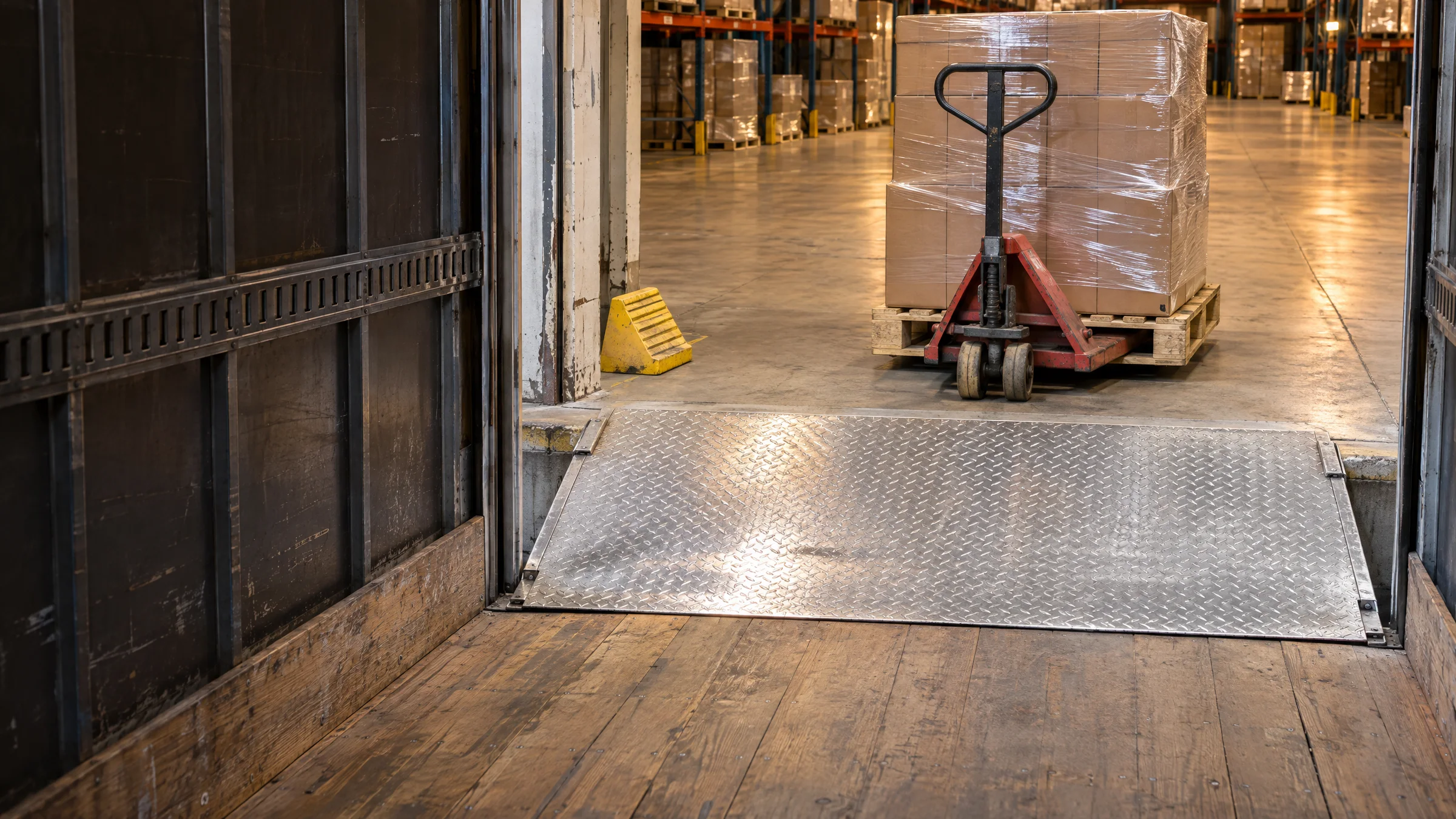
A dock plate bridges the gap between a loading dock and a trailer for hand trucks and manual pallet jacks. A dock board adds welded side curbs and carries forklifts. How long it has to be depends on the height difference: in Vestil's tables a 36 in plate is listed for up to 5 in.[1][2]
Dock plate
Hand trucksAnd foot traffic and manual pallet jacks. Vestil's manual: not for powered fork trucks.[1]
Dock board
ForkliftsTS and BTA boards have welded curbs and are the series Vestil lists for powered fork trucks.[2]
36 in long
Up to 5 inEach length is listed for a maximum dock-to-trailer height difference.[1]
Board capacity
3 x forklift4 x for a three-wheel forklift, by the maker's manual.[2]
Try it
How long a plate or board does your dock need?
Pick what will cross, then type the height difference between your dock and the trailer bed and the load. The calculator shows the series Vestil lists for that use, the shortest length listed for that height, and the models at that length rated at or above the load, or at or above 3 and 4 times the forklift's capacity for dock boards.[1][2][3][4]
The difference between a dock plate and a dock board
Both bridge the gap between a loading dock and a truck or trailer bed. The difference is what may cross. Vestil's manual for its aluminum dock plates says they are designed only for foot traffic, hand trucks or manual pallet jacks, and must not be used with powered fork trucks.[1]
Which hand truck or dolly suits the load crossing the plate is its own question, covered in our hand truck vs dolly guide.
A dock board is built for the forklift. Vestil's TS steel boards and BTA aluminum boards are the series its manual names as suitable for powered fork trucks, and they carry welded curbs along both sides. OSHA's dockboard rule requires dockboards put into service since January 17, 2017 to be designed, constructed and maintained to prevent transfer vehicles from running off the edge, unless the employer demonstrates there is no such hazard.[2][5]
The names are not used consistently. OSHA defines a dockboard as a portable or fixed device that spans a gap or compensates for a difference in elevation between a loading platform and a transport vehicle, and says dockboards include bridge plates, dock plates and dock levelers. Vestil's manual for its SE and SEH steel models calls them both dockplates and dockboards while stating they are for foot traffic, hand trucks and manual pallet jacks only. Read what the maker says may cross it, not the name. Before anything crosses the plate, the trailer has to stay put: our wheel chock guide covers where chocks go and what the rules say.[2][6]
Scroll across to see every column →
| Series | Material | Listed for | Curbs | Uniform capacity (lb) |
|---|---|---|---|---|
| A, AH | Aluminum | Foot traffic and hand trucks | None listed | 500 to 700 |
| E, EH | Aluminum | Foot traffic, hand trucks and manual pallet jacks | None listed | 1,400 to 11,900 |
| SE, SEH | Steel | Foot traffic, hand trucks and manual pallet jacks | None listed | 2,475 to 13,200 |
| TS | Steel | Powered fork trucks | Welded steel | 10,000 to 25,000 |
| BTA | Aluminum | Powered fork trucks | Welded aluminum | 5,000 to 20,000 |
Length comes from the height difference
Measure how far the trailer bed sits above or below the dock. That height difference sets the shortest dock plate or board you can use. Vestil's plate manual ties the limit to the last two digits of the model number: an A-3036 or E-3036 is listed for a height difference of up to 5 in. On the data sheets those two digits are the plate's usable length in inches, 36 in for both.[1][3]
The aluminum plates gain about an inch of height for every 6 in of length: 24 in covers 3 in, 30 in covers 4 in, 36 in covers 5 in, 48 in covers 7 in and 60 in covers 9 in. Steel TS boards are listed for more at the long end, 10 in at 60 in and 12 in at 72 in. The BTA figures in the manual's table are lower because they are its 8 degree values; a BTA-10006060 data sheet lists 7 in at 8 degrees and 10 in at 11 degrees.[1][2][4]
Both manuals say not to use a plate or board if the height differential exceeds its design limit. They also call for each end to overlap the trailer bed and the dock by at least 4 in, with both locking legs extending into the gap between dock and trailer.[1][2]
Scroll across to see every column →
| Length (in) | A, AH, E, EH aluminum plates | SE, SEH steel plates | TS steel boards | BTA aluminum boards, 8 degree |
|---|---|---|---|---|
| 24 | 3 in | Not listed | Not listed | Not listed |
| 30 | 4 in | 4 in | 4 in | 3 in |
| 36 | 5 in | 5 in | 5 in | 4 in |
| 42 | 6 in | Not listed | Not listed | 5 in |
| 48 | 7 in | 7 in | 7 in | 5.5 in |
| 54 | 8 in | Not listed | Not listed | 6 in |
| 60 | 9 in | 9 in | 10 in | 7 in |
| 66 | Not listed | Not listed | Not listed | 8 in |
| 72 | Not listed | Not listed | 12 in | 8.5 in |
| 78 | Not listed | Not listed | Not listed | 9 in |
| 84 | Not listed | Not listed | Not listed | 10 in |
Capacity: what the rating means
Every plate and board carries a uniform capacity, which Vestil's manuals define as the maximum evenly distributed weight it can support. Both manuals say not to exceed the maximum rated load.[1][2]
Capacity falls as a plate gets longer and rises as it gets wider. In the E series a 36 in long plate is rated 1,800 lb at 30 in wide, 2,500 lb at 36 in wide and 3,500 lb at 48 in wide, and the heavier EH plates of the same sizes are rated 3,500, 4,300 and 5,300 lb.[3]
For forklifts the manual gives a rule instead of a load: the dock board should have a capacity of 3 times the load rating of a four-wheel forklift, and with a three-wheel powered fork truck it must have a capacity of 4 times the fork truck's load rating. A 4,000 lb four-wheel forklift points to 12,000 lb, and the 15,000 lb TS models are the first at or above that.[2][4]
For the steel SE and SEH plates, Vestil's data sheets add that with three-wheeled pallet trucks the capacity selected should be 20% higher, because the load is concentrated at the center of the plate.[4]
What OSHA's dockboard rule requires
The rule is 29 CFR 1910.26. The employer must ensure dockboards are capable of supporting the maximum intended load, and that portable dockboards are secured by anchoring them in place or by equipment or devices that prevent them from moving out of a safe position.[5]
The "maximum intended load" in that rule is a defined term. 29 CFR 1910.21(b) reads: "Maximum intended load means the total load (weight and force) of all employees, equipment, vehicles, tools, materials, and other loads the employer reasonably anticipates to be applied to a walking-working surface at any one time."[6]
It also requires measures, such as wheel chocks or sand shoes, to keep the truck, semi-trailer, trailer or rail car from moving while employees are on the dockboard, and it requires portable dockboards to have handholds or other means to permit safe handling.[5]
Vestil's manuals state that the plates and boards covered here comply with OSHA 1910.26 and ANSI MH30.2 for portable dockboards, and tell the user to park the trailer at the dock with its wheels chocked.[1][2]
OSHA's forklift rule, 29 CFR 1910.178, has its own lines for the truck that crosses. Paragraph (n)(11) reads: "Dockboard or bridgeplates, shall be properly secured before they are driven over. Dockboard or bridgeplates shall be driven over carefully and slowly and their rated capacity never exceeded." Paragraph (j) of the same rule reads: "Dockboards (bridge plates). See subpart D of this part." Section 1910.26 is in subpart D.[5][7]
The forklift rule also covers the vehicle being loaded. Paragraph (k)(1) reads: "The brakes of highway trucks shall be set and wheel chocks placed under the rear wheels to prevent the trucks from rolling while they are boarded with powered industrial trucks." Paragraph (k)(4) reads: "Positive protection shall be provided to prevent railroad cars from being moved while dockboards or bridge plates are in position."[7]
Width and weight
Width has to clear what crosses it. Vestil's listing for the BTA boards says the width of the dock board should be at least 15 in wider than the load or equipment passing between the curbs.[4]
Weight decides who moves it. An aluminum A-3636 hand truck plate weighs 47 lb by its data sheet and is carried by its handles. A steel TS-10-6036 board weighs 263 lb and is moved with a forklift; the steel boards have uneven legs so they sit canted on the floor for pickup.[3][4]
Questions
What is a dock plate?
A dock plate is a portable flat plate, usually aluminum or steel, that bridges the gap and the height difference between a loading dock and a truck or trailer bed so foot traffic, hand trucks and manual pallet jacks can cross. OSHA's rules treat it as one kind of dockboard.[1][6]
What is the difference between a dock plate and a dock board?
A dock plate is a flat plate for foot traffic, hand trucks and manual pallet jacks. Vestil's TS and BTA dock boards are heavier, have welded side curbs and are the series its manual lists for powered forklifts. The manual says its dock plates must not be used with powered fork trucks.[1][2]
What size dock plate do I need?
Measure the height difference between the dock and the trailer bed, then pick a length listed for at least that much. In Vestil's tables for aluminum plates, 24 in covers 3 in, 30 in covers 4 in, 36 in covers 5 in, 48 in covers 7 in and 60 in covers 9 in. Then check the rated capacity against the heaviest load that will cross.[1]
Can you use a dock plate for a forklift?
Not the plates covered here. Vestil's manual says its A, AH, E and EH dock plates are designed only for foot traffic, hand trucks or manual pallet jacks, and its SE and SEH steel plates are not for powered equipment. Its TS and BTA dock boards are the series listed for powered fork trucks.[1][2]
What capacity dock board do I need for a forklift?
Vestil's manual says a dock board should have a capacity of 3 times the load rating of a four-wheel forklift, and must have 4 times the load rating of a three-wheel fork truck. For a 5,000 lb four-wheel forklift that is 15,000 lb.[2]
How much should a dock plate overlap the trailer?
Vestil's manuals call for both ends to overlap the trailer bed and the loading dock by at least 4 in, with the locking legs extending into the gap between them.[1][2]
Does OSHA require wheel chocks when using a dock plate?
29 CFR 1910.26(d) requires measures, such as wheel chocks or sand shoes, to prevent the transport vehicle a dockboard is placed on from moving while employees are on the dockboard.[5]
How much weight can an aluminum dock plate hold?
It depends on the series and size. Vestil's aluminum hand truck plates (A, AH) have uniform capacities of 500 to 700 lb, and its aluminum Economizer plates (E, EH) run from 1,400 to 11,900 lb. Capacity falls as the plate gets longer and rises as it gets wider.[3]
How much does a dock plate weigh?
A 36 x 36 in aluminum hand truck plate, Vestil's A-3636, weighs 47 lb by its data sheet. A 60 x 36 in steel dock board for forklifts, the TS-10-6036, weighs 263 lb.[3][4]
What does OSHA require for dockboards?
29 CFR 1910.26 requires that dockboards support the maximum intended load; that those put into service on or after January 17, 2017 prevent transfer vehicles from running off the edge, unless the employer shows there is no such hazard; that portable dockboards are secured or have sufficient contact to stay in a safe position; that the transport vehicle is kept from moving, for example with wheel chocks or sand shoes, while employees are on the dockboard; and that portable dockboards have handholds or other means for safe handling.[5]
What is OSHA's definition of a dockboard?
29 CFR 1910.21(b) reads: "Dockboard means a portable or fixed device that spans a gap or compensates for a difference in elevation between a loading platform and a transport vehicle. Dockboards include, but are not limited to, bridge plates, dock plates, and dock levelers."[6]
What does OSHA say about driving a forklift over a dockboard?
29 CFR 1910.178(n)(11) reads: "Dockboard or bridgeplates, shall be properly secured before they are driven over. Dockboard or bridgeplates shall be driven over carefully and slowly and their rated capacity never exceeded." Paragraph (k)(1) of the same rule requires the brakes of highway trucks to be set and wheel chocks placed under the rear wheels while the trucks are boarded with powered industrial trucks.[7]
Buying near Austin? Get a Central Texas freight quote.

Written by Anastasiia Kuziak, Manager and President of Oakspan Supply. She has a business degree, owns a small business of her own, and has more than five years in medical and pharmaceutical sales. How we write and check our guides.
Sources
- A, AH, E, EH Dockplates instruction manual, Rev. 11/11/2025. Vestil Manufacturing. Accessed 2026-11-13.
- BTA, SE, SEH, TS Dockboards instruction manual, Rev. 11/14/2025. Vestil Manufacturing. Accessed 2026-11-13.
- Aluminum Hand Truck Dockplates and Aluminum Economizer Dockplates: product family pages and model data sheets. Vestil Manufacturing. Accessed 2026-11-13.
- Steel Truck Dockboards, Steel Truck Dockplates and Aluminum Truck Dockboards: product family pages and model data sheets. Vestil Manufacturing. Accessed 2026-11-13.
- 29 CFR 1910.26, Dockboards. Electronic Code of Federal Regulations. Accessed 2026-11-13.
- 29 CFR 1910.21(b), Definitions: Dockboard. Electronic Code of Federal Regulations. Accessed 2026-11-13.
- 29 CFR 1910.178, Powered industrial trucks: paragraphs (j), (k) and (n)(11). Electronic Code of Federal Regulations. Accessed 2026-11-17.
Written from the sources above under our editorial policy. Published November 13, 2026, last updated November 17, 2026. Spot an error? Send us a correction and we fix it and note the date.
- Vestil aluminum hand truck dock plates (A, AH)
- Vestil steel truck dock plates (SE, SEH)
- Vestil steel truck dock boards (TS)
- Vestil aluminum truck dock boards (BTA)
- Rubber wheel chocks
- Vestil aluminum Economizer dock plates (E, EH)
- Self-dumping hopper sizes for forklifts
- Forklift fork extensions: how long they can be and what OSHA requires
- Hand truck vs dolly: what each one is, the types and how much they carry
- Wheel chocks: sizes, where they go and what OSHA requires
The photo is an AI-generated illustration of the kind of equipment this guide covers. It is not a photo of a Vestil product.