










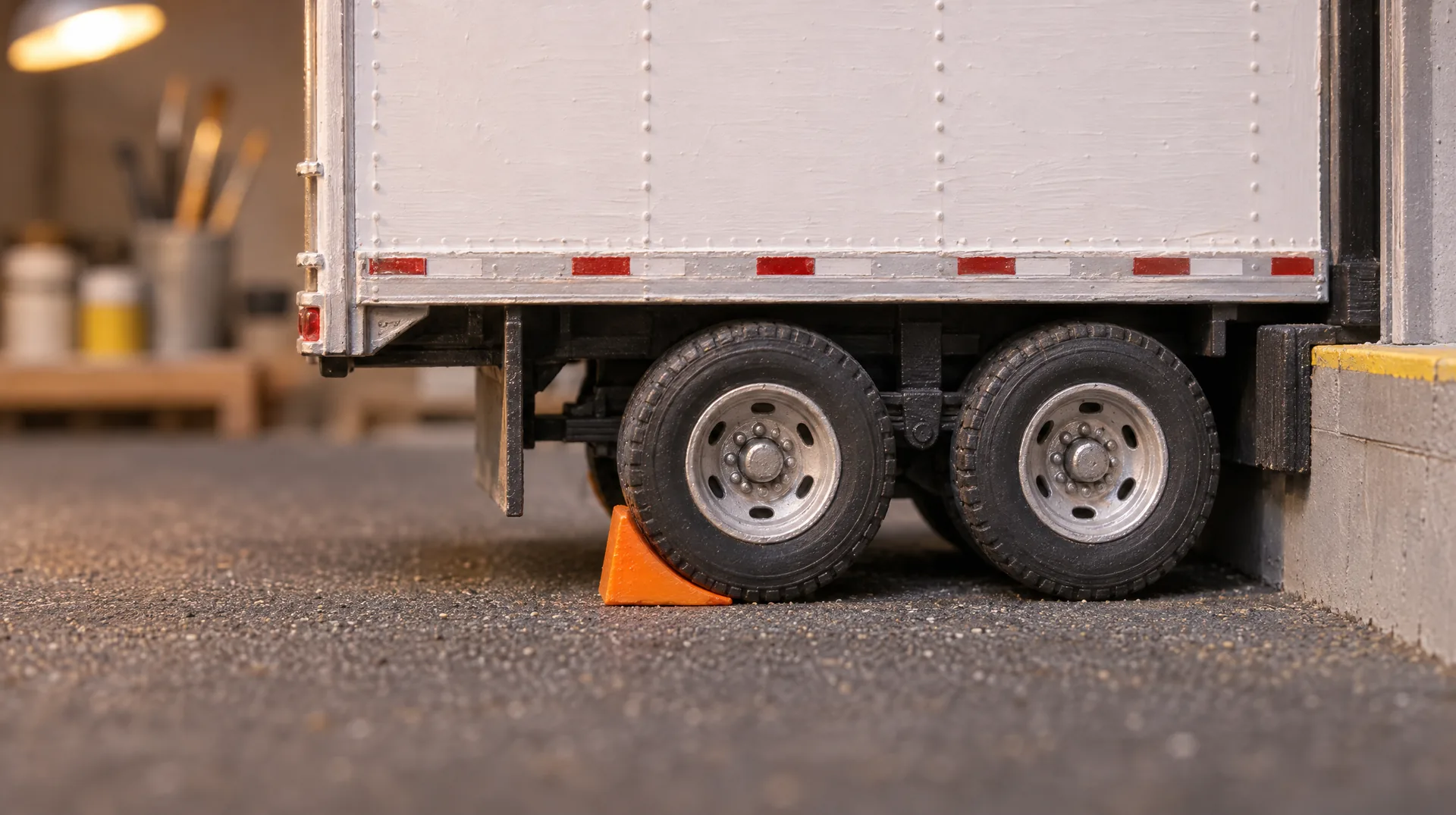
A wheel chock is a wedge set tight against a tire so a parked vehicle cannot roll. OSHA's forklift rule says to set the brakes and chock the rear wheels of a highway truck before a forklift drives in, but OSHA does not enforce it against commercial motor vehicles, which fall under federal parking brake rules. No federal rule sets a chock size: makers list each chock's height and limits.[1][3][12][19][20][21][22][23][24]
OSHA dock rule
Rear wheelsBrakes set and chocks under the rear wheels of a highway truck before a forklift boards it.[1]
Slope in two fatal rollaways
2%A woodchip truck in 2019 and a haul truck in 2021 both rolled from a 2% grade.[10][13]
Pull on a 2% grade
1,600 lbThe part of an 80,000 lb truck's weight that points downhill: 80,000 x sin(1.15 degrees).
Free. Just your work email.
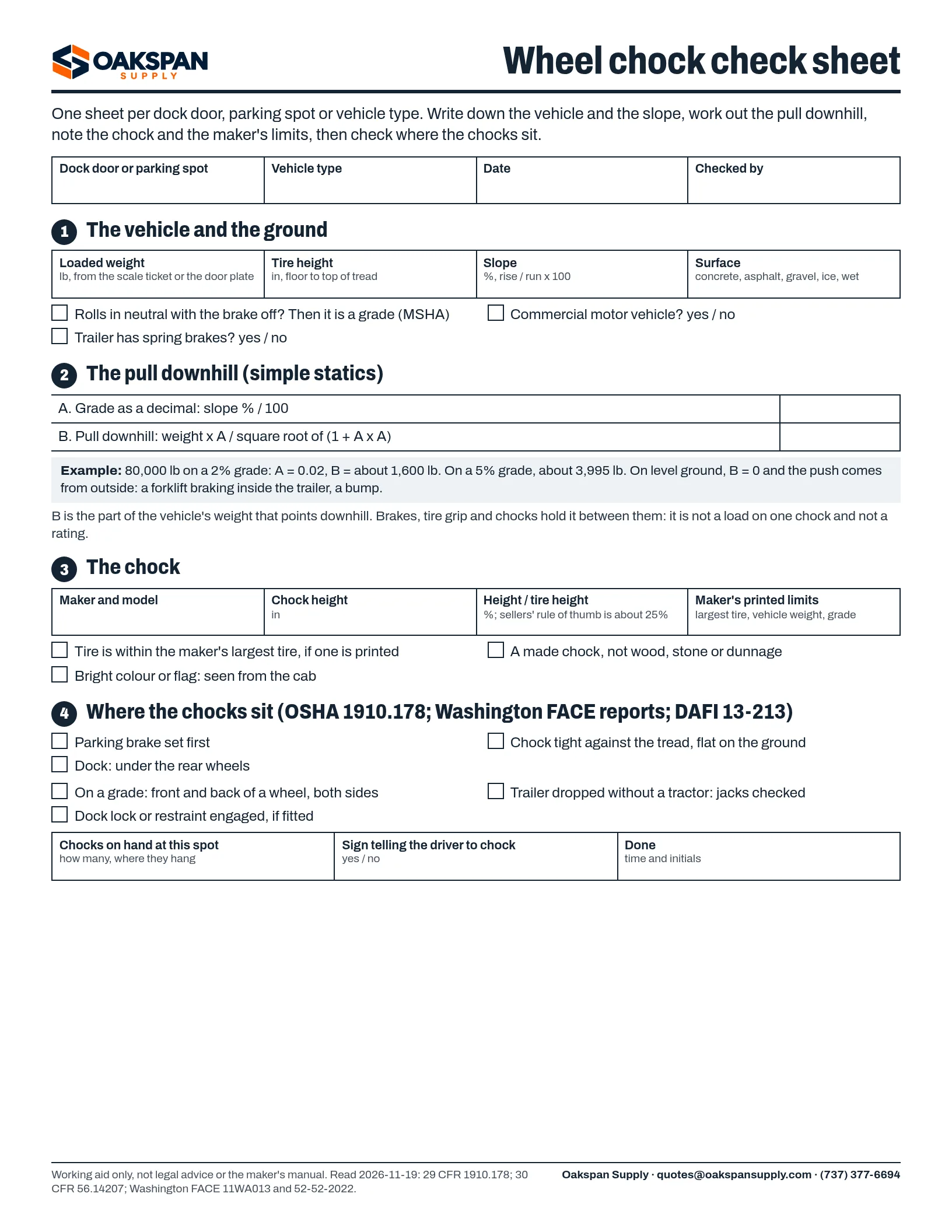
Print the wheel chock check sheet
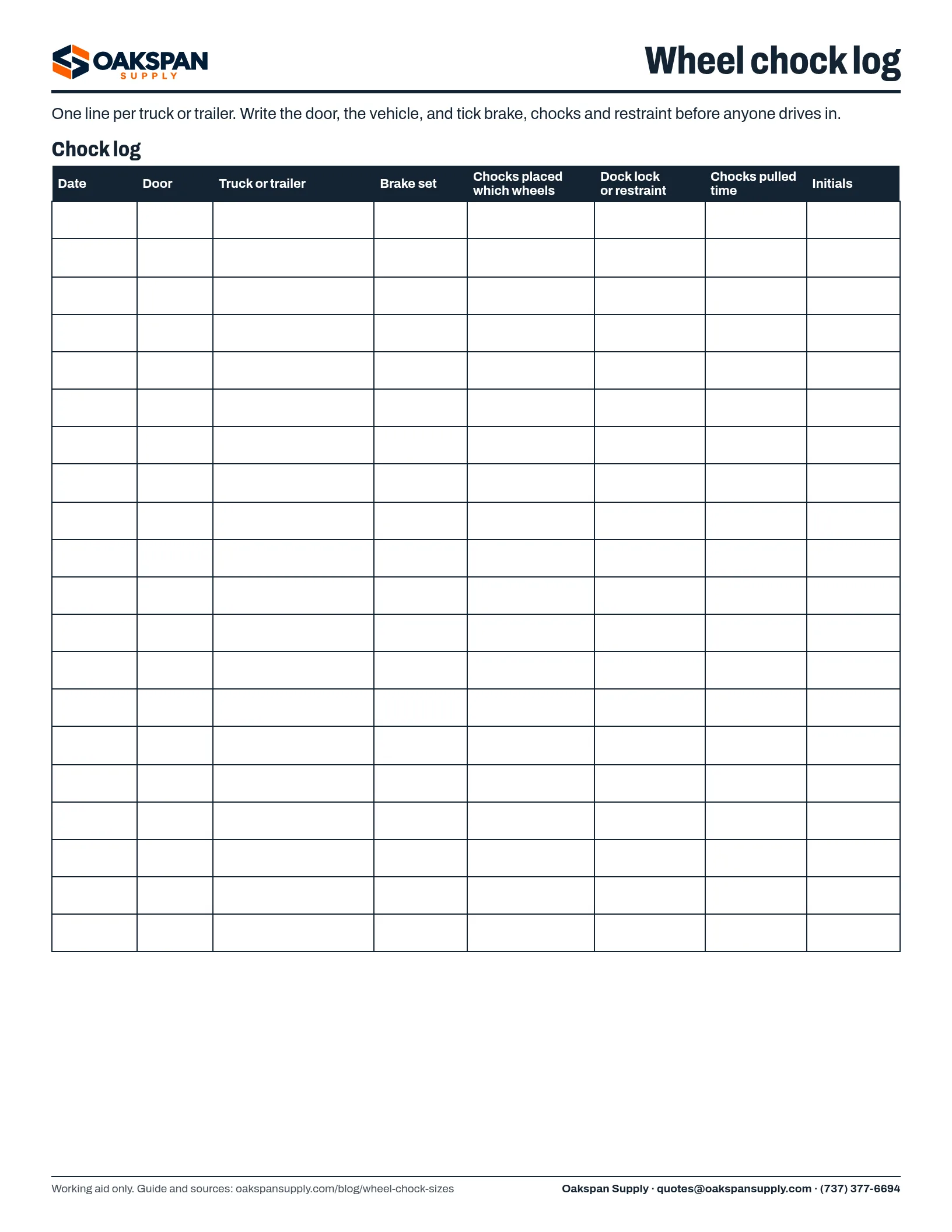
A two-page sheet: the vehicle and the slope, the pull downhill worked out by hand, the chock and the maker's limits, where the chocks sit, and a log for the dock door.
- Vehicle weight, tire height and slope
- The pull downhill, with a worked example
- The chock, its height and the maker's limits
- Where the chocks sit, from the rules and fatality reports
- A chock log for the dock door
Two pages, letter size. The sheet downloads right away. We'll send you the occasional supply guide and may use your email to show you our ads. Unsubscribe any time. Privacy policy.
Try it
How hard is your vehicle pushing downhill?
Type the vehicle's weight, the slope it is parked on and the height of its tire. The calculator works out how much of the weight points downhill, then shows each chock we list against that tire: its height, what share of the tire that is, and any limit the maker prints.[19][20][21][22][23][24]
What a wheel chock is, and why a 2% slope is enough
A wheel chock is a wedge that sits tight against a tire so the wheel cannot turn over it. That is the whole idea: put something in the way that the tire cannot climb.
The surprise is how little slope it takes. A grade is rise over run, so a 2% grade climbs 2 ft in 100 ft, an angle of about 1.15 degrees that most people would call flat. On that slope, the part of a vehicle's weight that points downhill is its weight times the sine of the angle: for a loaded 80,000 lb tractor-trailer, about 1,600 lb, pushing all the time. Two fatality investigations show that is enough. In July 2019 a Washington woodchip truck driver was crushed when his truck rolled away; the state's investigators wrote that "the road had a 2% downgrade" and that he "did not set the truck's parking brake before exiting the cab." In April 2021 a haul truck at a Texas sand and gravel mine rolled after being "left unattended on a two percent grade" with no chocks; MSHA found the operator "did not provide chocks for any of their mobile equipment."[10][13]
In a third case, a propane transport driver died in 2011 when his loaded truck rolled backward over him. A sheriff's deputy found the wheel chocks "in the equipment box behind the cab," where they "appeared clean and unused." A chock only works on the ground.[14]
What the rules actually say
Most pages about wheel chocks quote one OSHA sentence and stop. It is in the forklift standard, 29 CFR 1910.178(k)(1): "The brakes of highway trucks shall be set and wheel chocks placed under the rear wheels to prevent the trucks from rolling while they are boarded with powered industrial trucks." A second paragraph, (m)(7), says brakes shall be set and "wheel blocks shall be in place to prevent movement of trucks, trailers, or railroad cars while loading or unloading."[1]
Here is the part those pages leave out. OSHA does not enforce either paragraph against commercial motor vehicles. Its November 8, 2005 letter says the Federal Motor Carrier Safety Administration's braking regulations "preempt OSHA from enforcing" both, and that "if the trailer in question is a CMV ... OSHA would not enforce its chocking requirements." The March 7, 2011 letter confirms it and names the two letters as "current guidance on this subject." The federal rule that applies instead, 49 CFR 393.41, requires a parking brake "capable of holding the vehicle or combination of vehicles stationary under any condition of loading in which it is found on a public road (free of ice and snow)."[2][3][12]
That does not mean nobody at the dock needs chocks. The same 2011 letter says OSHA still enforces its chocking rules for vehicles that are not commercial motor vehicles, and can still require a company that does not own, operate or lease such vehicles "to take precautions to protect their workers, such as forklift operators, from the movement of trailers." Where the OSHA rule does apply, a dock lock counts: since 1981 OSHA has treated a missing chock as a de minimis violation, with no citation, when "a positive mechanical means to secure trucks or trailers to a loading dock" is installed and used, and a 2005 letter extends that to dock monitoring systems and other systems that prevent unintended movement.[3][4][5]
Other rules name chocks for other equipment, and the table lists them in their own words. Your own site rules, your insurer and your state may ask for more than any of these.[6][7][8][12][17]
Scroll across to see every column →
| Rule | Covers | What it says |
|---|---|---|
29 CFR 1910.178(k)(1) | Highway trucks boarded by forklifts | Brakes set and wheel chocks placed under the rear wheels. Not enforced by OSHA against commercial motor vehicles. |
29 CFR 1910.178(m)(7) | Trucks, trailers and railroad cars during loading | Brakes set and wheel blocks in place to prevent movement. Same enforcement limit. |
29 CFR 1910.178(m)(5)(i) | The forklift itself | Wheels shall be blocked if the truck is parked on an incline. |
29 CFR 1926.600(a)(3)(ii) | Construction equipment | Equipment parked on inclines shall have the wheels chocked and the parking brake set. |
30 CFR 56.14207 | Mobile equipment at surface mines | When parked on a grade, wheels or tracks shall be either chocked or turned into a bank. |
29 CFR 1910.111(f)(9) | Anhydrous ammonia tank trucks | At least two chock blocks, placed to prevent rolling whenever parked during loading and unloading. |
49 CFR 393.41(b) | Agricultural commodity, heavy hauler and pulpwood trailers | Shall carry sufficient chocking blocks to prevent movement when parked. |
Where the chocks go
OSHA's dock rule says only "under the rear wheels." The fullest instructions come from fatality investigators and the military. Washington's investigators, after the propane truck death, wrote that once the parking brake is set the driver should "place wheel chocks against the front and back of one of the rear semi-tractor wheels on both sides of the truck." After the woodchip truck death they added that on any grade a driver must turn the front wheels to the curb "and chock at least one tractor drive wheel on each side."[1][13][14]
The Air Force's airfield driving rule gives two ways to do it for a parked vehicle: "chocks placed in front of and behind a rear wheel, or one chock placed between the tandem wheels" of a dual-axle vehicle. The FAA's ground handling circular says the same of aircraft: the main gear wheels "should be chocked fore and aft," and chocks "should be painted a bright color so they can be easily seen." That last line is why so many chocks are orange or yellow, and why some come with a flag on a 3 ft handle.[15][16][24]
Two more points come straight from the reports. Use a real chock: the Washington report says to "select and use chocks manufactured for the type and size of vehicle tire to be chocked" and not "dunnage, blocks of wood, stones, or other objects." And put it against the tire: in a 2001 Nevada mine accident report MSHA recorded that "the rear chock was tight against the tire, but the front chock was about 1 foot ahead of the tire." The commercial driver manual adds one case where a chock is the only thing holding: "If the trailer does not have spring brakes, use wheel chocks to keep the trailer from moving."[11][14][17]
What size chock: no federal rule sets one
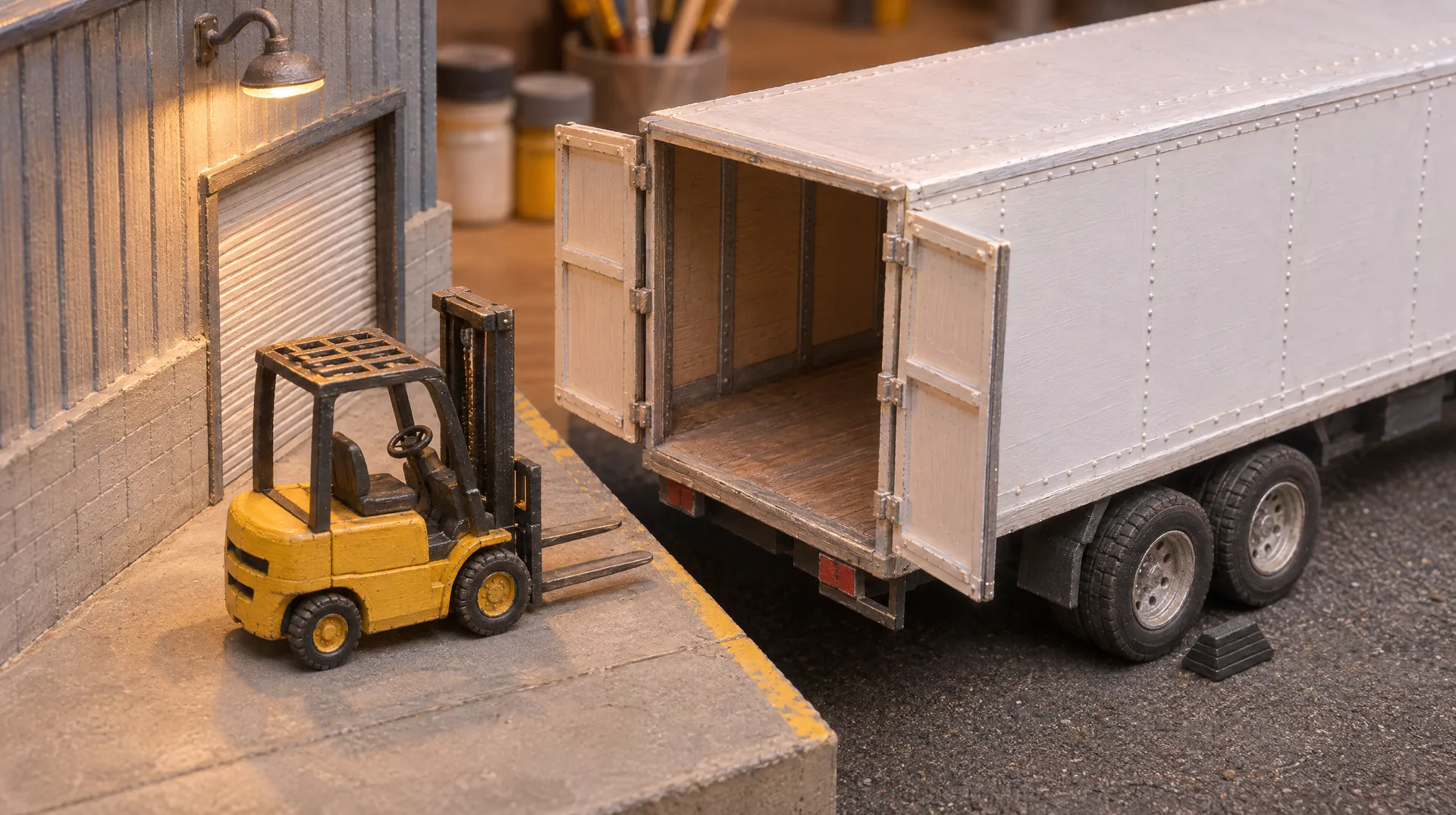
None of the rules above gives a chock height, a width or a fraction of the tire. SAE publishes a design standard for wheel chocks, but it is sold, not posted, so most buyers never read it. MSHA's own answer on what counts as a grade is practical instead of numeric: one way to tell is "testing the equipment to determine if it rolls when the transmission is placed in neutral."[8][9]
What you will see everywhere is a rule of thumb that sellers repeat: a chock should be about one quarter the height of the tire. One seller's guide puts it as "at least one quarter the height of the tire they restrain." We could not find that fraction in any federal rule or government guide, so treat it as a starting point and not a rating. A 31 in pickup tire would want a chock about 7-3/4 in tall by that rule, and a 41 in truck tire one about 10-1/4 in tall, which is taller than most chocks sold for trucks, including most in the table below.[18]
The numbers that do count are the maker's own. Some chocks carry a largest tire: of the ones we list, the URWC-15 urethane chock is listed for tires up to 40 in and the URWC-SH-15 for tires up to 46 in, while the PWC-BK plastic chock is listed for wheels up to 35 in and vehicles up to 40,000 lb. Some carry a slope: the EALUM-7 aluminum chocks are rated for a 30% grade and a 10,000 lb load bearing limit. Many carry no rating at all, only their dimensions. For scale at the far end, the chocks in that 2001 mine report, for a Caterpillar 789 haul truck, were 22 in long, 15 in wide and 11 in high and weighed 40 lb each.[11][20][21][23]
Wheel chock sizes: height, footprint, weight and maker's limits
This table is built from Vestil's model data for the chocks on our site: 36 distinct sizes out of 56 models, with colour variants folded together. Height is the chock's own height, which is what meets the tire. "None printed" means the maker lists dimensions only, not that the chock has been tested to nothing.[19][20][21][22][23][24]
Scroll across to see every column →
| Model | Material | Height | Footprint | Weight | Maker's printed limits |
|---|---|---|---|---|---|
EX-4 | Rubber | 3-3/4 in | 10 x 4-1/2 in | 5 lb | None printed |
RWC-3 | Rubber | 4 in | 7-3/4 x 7-7/8 in | 6 lb | None printed |
RWC-2-PR | Rubber | 4-1/8 in | 5 x 8-1/16 in | 7 lb | None printed |
AC-13 | Rubber | 4-1/2 in | 10 x 5 in | 8 lb | tires up to 18 in; listed for: airplane |
RMC-4 | Rubber | 4-3/4 in | 6-1/2 x 4-1/4 in | 5 lb | None printed |
RWC-10-HDL | Rubber | 4-7/8 in | 15-1/2 x 7-3/8 in | 12 lb | None printed |
LWC-14 | Rubber | 5-1/2 in | 12 x 11 in | 11 lb | None printed |
RWC-8-YL | Rubber | 5-1/2 in | 7 x 9 in | 7.4 lb | None printed |
EX-13 | Rubber | 5-3/4 in | 12 x 6-1/2 in | 16 lb | None printed |
RWC-8 | Rubber | 6 in | 9-1/2 x 8 in | 10 lb | None printed |
RWC-8-HDL | Rubber | 6 in | 8 x 11-1/4 in | 11 lb | None printed |
RWC-5 | Rubber | 6 in | 4 x 8 in | 5 lb | None printed |
RWC-11 | Rubber | 7-3/4 in | 7 x 10 in | 10 lb | None printed |
LWC-15 | Rubber | 8 in | 10-5/16 x 8 in | 13 lb | 15 tons |
RWC-25 | Rubber | 8 in | 11-3/4 x 17-3/4 in | 22 lb | None printed |
PEWC-3-YL | Plastic | 5-7/8 in | 4 x 8-1/2 in | 3 lb | 7,000 lb |
PWC-DS-OR | Plastic | 6 in | 9-1/4 x 10-11/16 in | 12 lb | None printed |
PEWC-7-YL | Plastic | 7-1/2 in | 5-1/2 x 12 in | 7 lb | 7,000 lb |
PWC-BK | Plastic | 7-1/2 in | 7-1/2 x 10-1/4 in | 6 lb | 40,000 lb; tires up to 35 in |
PLWC-Y | Plastic | 9 in | 7-1/4 x 18-1/2 in | 5 lb | None printed |
URWC-2 | Urethane | 6 in | 7 x 8 in | 3 lb | 15 tons |
URWC-8 | Urethane | 8 in | 9-1/2 x 6 in | 3 lb | 15 tons |
URWC-15 | Urethane | 8 in | 8 x 11 in | 9 lb | 30 tons; tires up to 40 in |
URWC-SH-15 | Urethane | 8.7 in | 8-3/4 x 11-1/2 in | 6 lb | 35 tons GVWR; tires up to 46 in |
URWC-25 | Urethane | 15 in | 14-7/8 x 17-1/2 in | 27 lb | 30 tons |
EALUM-7 | Aluminum | 8 in | 7 x 11-3/4 in | 8 lb | 10,000 lb; 30% grade |
CWS-13 | Aluminum | 8 in | 40-1/8 x 11-7/8 in | 13 lb | 10,000 lb; 30% grade |
SWC-9 | Steel | 3-3/4 in | 4 x 9 in | 5 lb | listed for: trailer |
GWC-10 | Steel | 5-3/16 in | 10-7/8 x 15-11/16 in | 10 lb | None printed |
MS-15 | Steel | 7-1/8 in | 8-9/16 x 8-1/4 in | 15 lb | None printed |
FAB-8 | Steel | 8-5/8 in | 7-1/2 x 9-1/2 in | 6 lb | None printed |
FAB-11 | Steel | 9 in | 8 x 10⁻³/4 in | 11 lb | None printed |
SWC-22 | Steel | 9-1/16 in | 6 x 17-5/16 in | 19 lb | None printed |
LWC-14M-ERGO | Long handle (rubber) | 5-1/2 in | With 3 ft handle | 15 lb | None printed |
RWC-8-ERGO | Long handle (rubber) | 6 in | With 3 ft handle | 13 lb | None printed |
FAB-11-ERGO-FL | Long handle (steel) | 9-1/8 in | With 3 ft handle | 14 lb | None printed |
Rubber, urethane, aluminum, steel or plastic
The materials differ most in weight for a given height, which matters to whoever carries the chock from its hook to the tire every time. Among 8 in tall chocks on our list, the aluminum EALUM-7 weighs 8 lb, the urethane URWC-15 weighs 9 lb and the molded rubber RWC-25 weighs 22 lb, though the RWC-25 is also much longer and wider. The tallest we list, the 15 in URWC-25 urethane chock, weighs 27 lb.[19][21][23]
Rubber is the largest family: 24 models from 3-3/4 to 8 in tall, molded, extruded or laminated from strips, with eye bolts, handles, ropes or chains. Steel chocks are folded or cast, 3-3/4 to about 9 in tall; the SWC-22 is the one Vestil lists for "mud, sand, or concrete." The PWC plastic chocks are 7-1/2 in tall and 6 lb. Long-handle chocks put a 6 in rubber or 9 in steel chock on a pole about 3 ft tall, some with a flag, so the chock can be set and seen without bending under the trailer.[19][20][22][24]
Which material suits a surface, a climate or a chemical is the maker's call, not ours: ask for the model's data sheet. For a rail car there are separate chocks that sit on the rail, and for the dock itself a chock is one part of a set with the holder, the chain and the sign that tells the driver to use it.[22]
When a chock is not enough
Every rule quoted here pairs the chock with the brake, and the brake comes first: "brakes shall be set and wheel blocks shall be in place." The reports explain why. In the 2019 case the parking brake was never set; in the 2011 case the brake "was not engaged" and the chocks never left the box. A chock is the backup for a brake that was forgotten, released by mistake or not there at all, as on a trailer without spring brakes.[1][13][14][17]
At a dock, OSHA's own policy points past the chock: a mechanical restraint that holds the trailer to the building, or a dock monitoring system, is accepted in place of chocks where the OSHA rule applies. And a semitrailer dropped without its tractor has a second problem a chock does not fix: the forklift rule notes that "fixed jacks may be necessary to support a semitrailer during loading or unloading when the trailer is not coupled to a tractor."[1][4][5]
Oakspan Supply sells industrial supplies to plants, labs, warehouses and shops: wheel chocks, dock equipment, drums and pails, gloves, labels and packaging. Send us your list, or a photo of your last invoice, and our quotes desk prices it.
On our shelves
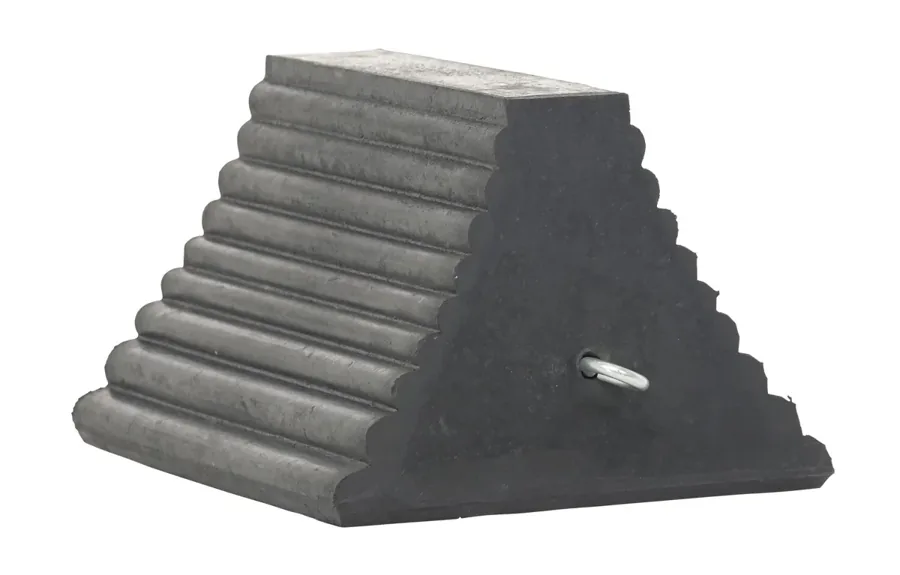
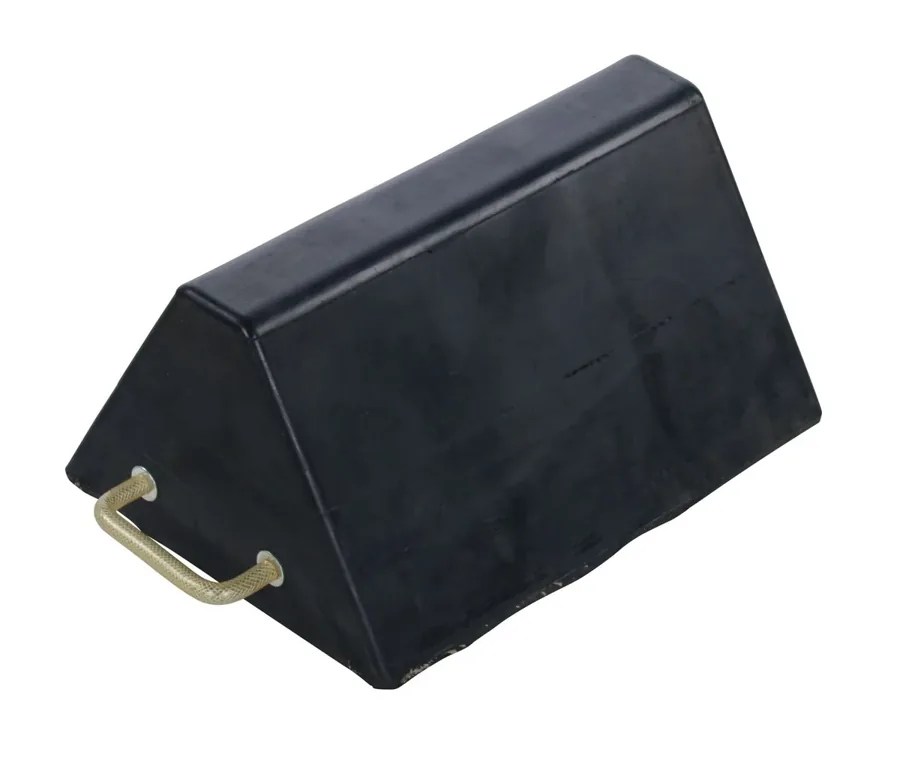
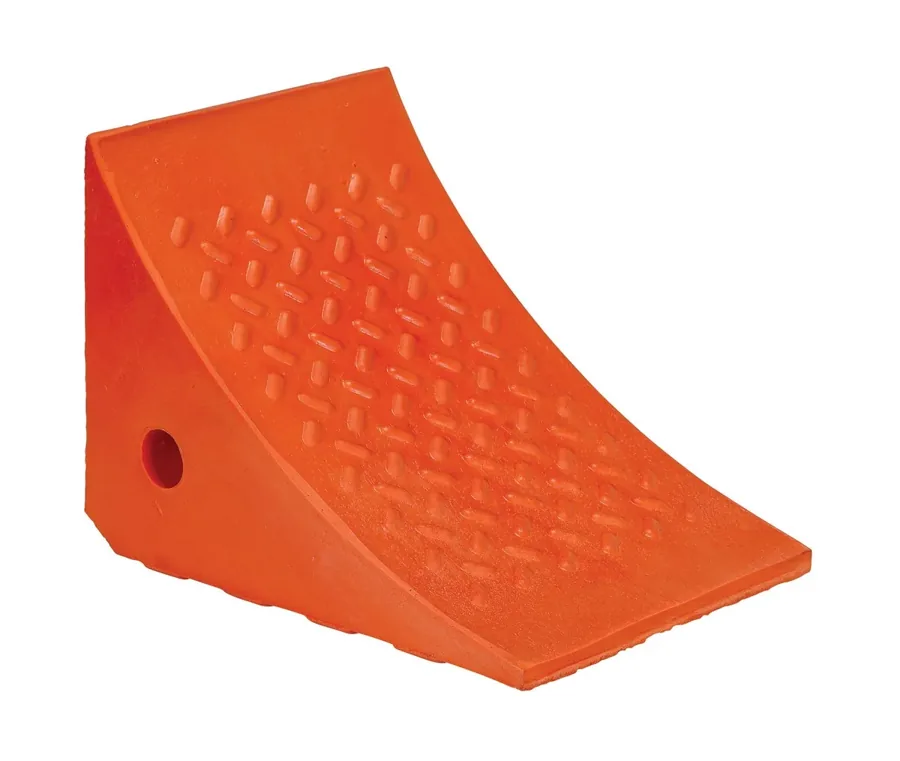
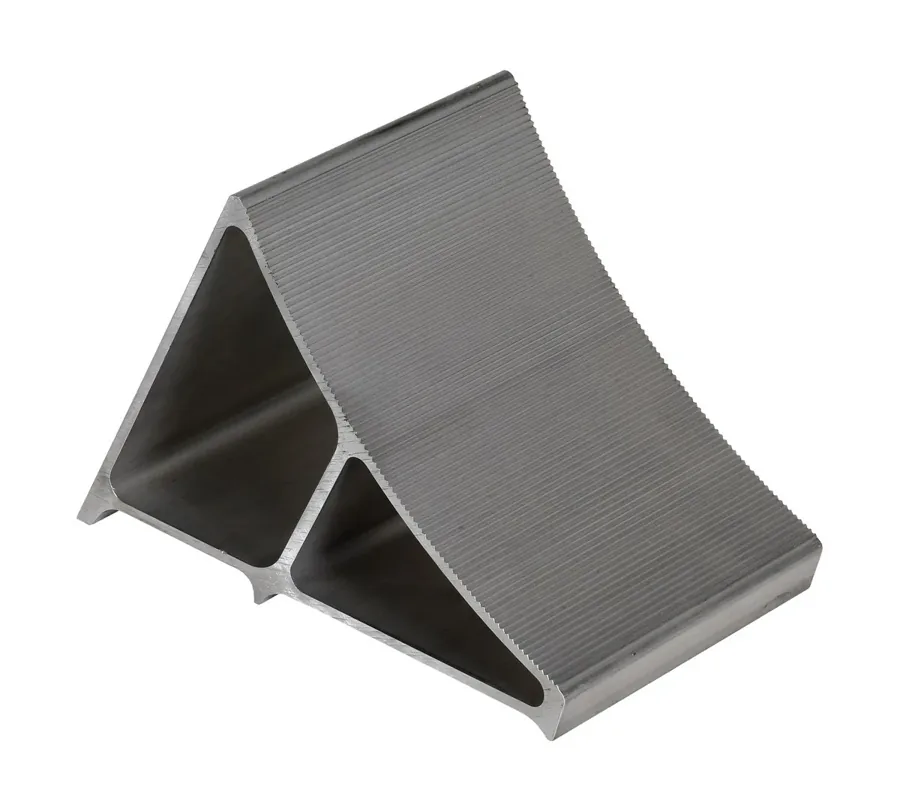
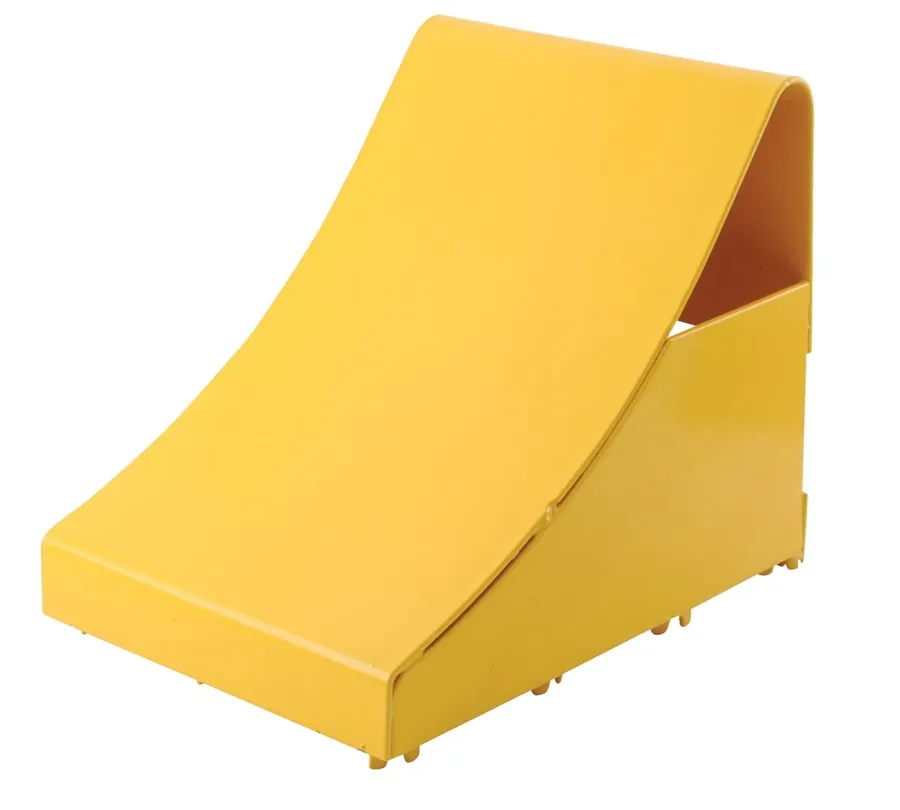
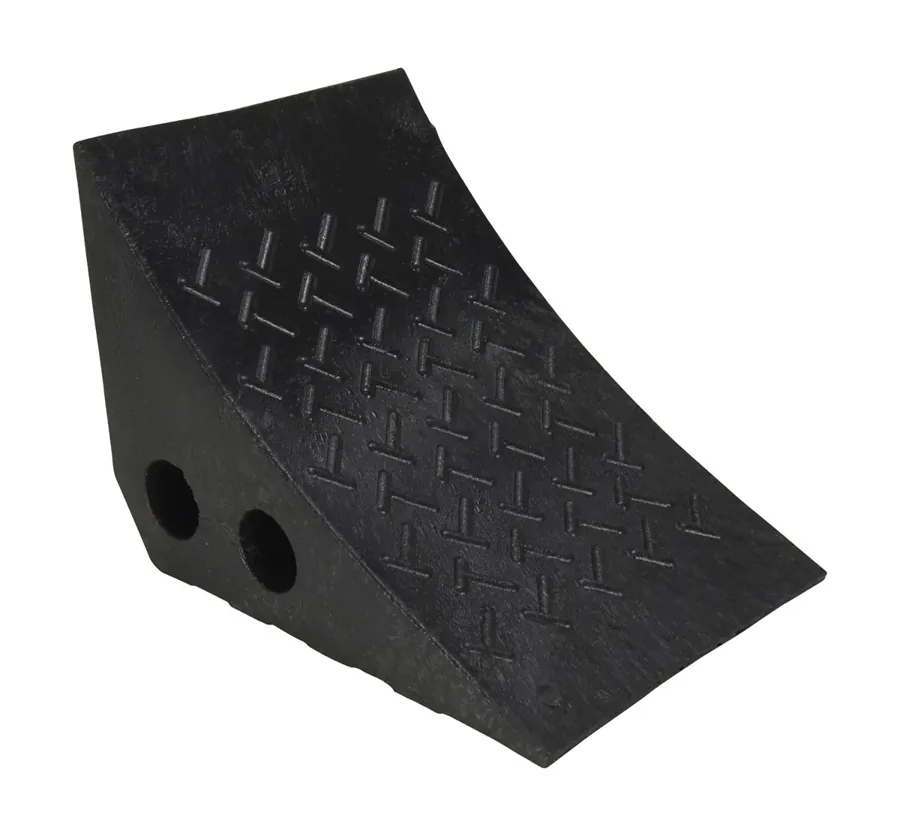

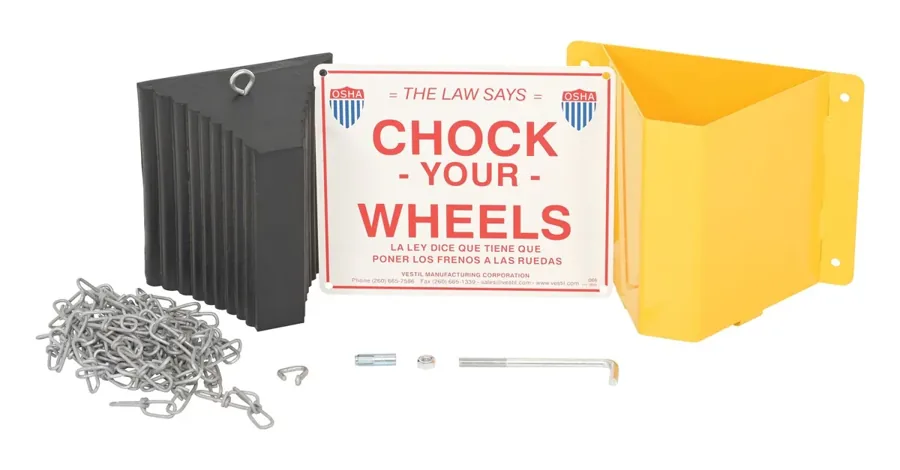
Vestil RWC-8-KIT-1 Molded Rubber Wheel Chock Kit, Includes Wheel Chock, CHAIN, Holder, and Sign Black/Yellow
OKS-DCK-VP-RWC-8-KIT-1
$120.45
Questions
Where should wheel chocks be placed?
Tight against the tire, on the ground, after the parking brake is set. OSHA's dock rule says under the rear wheels. Washington State's fatality investigators recommend chocks against the front and back of one rear tractor wheel on both sides of the truck, and the Air Force allows a chock in front of and behind a rear wheel or one chock between tandem wheels.[1][14][15]
Do you need wheel chocks on both sides?
OSHA's dock rule does not say. Washington State's fatality investigators say to chock at least one tractor drive wheel on each side when parked on any grade, and to chock the front and back of the wheel.[13][14]
Does OSHA require wheel chocks at a loading dock?
29 CFR 1910.178(k)(1) says to set the brakes and chock the rear wheels of a highway truck before a forklift boards it, but OSHA's 2005 and 2011 letters say it does not enforce that against commercial motor vehicles, which fall under federal parking brake rules. It still applies to other vehicles, and a dock lock used in place of a chock is treated as a de minimis violation with no citation.[1][3][5]
How big should a wheel chock be?
No federal rule gives a size. Sellers repeat a rule of thumb of about one quarter of the tire's height, and makers list each chock's height and, for some models, the largest tire, the vehicle weight or the slope it is rated for. Go by the maker's limits for your tire.[18][21][23]
How steep a slope needs wheel chocks?
Construction and mine rules say chocks on any incline or grade without giving a number, and two fatal rollaways in the reports cited here started on a 2% grade. MSHA's test for a grade is whether the equipment rolls with the transmission in neutral.[6][8][10][13]
Can you use a block of wood as a wheel chock?
Washington State's fatality investigators say not to: use chocks manufactured for the type and size of tire, and do not use dunnage, blocks of wood, stones or other objects not made to serve as chocks.[14]
Have a list of what you need? Our quotes desk prices the exact items.

Written by Anastasiia Kuziak, Manager and President of Oakspan Supply. She has a business degree, owns a small business of her own, and has more than five years in medical and pharmaceutical sales. How we write and check our guides.
Sources
- 29 CFR 1910.178, Powered industrial trucks. Occupational Safety and Health Administration (OSHA). Accessed 2026-11-19.
- Standard interpretation, November 8, 2005: chocking requirements for trailers docked to buildings with downward approaches. Occupational Safety and Health Administration (OSHA). Accessed 2026-11-19.
- Standard interpretation, March 7, 2011: OSHA chocking requirements and commercial motor vehicles. Occupational Safety and Health Administration (OSHA). Accessed 2026-11-19.
- Standard interpretation, September 14, 2005: wheel chocks and alternative means of preventing truck movement. Occupational Safety and Health Administration (OSHA). Accessed 2026-11-19.
- OSHA Instruction STD 1-11.7, August 5, 1981: mechanical means to secure trucks or trailers to a loading dock. Occupational Safety and Health Administration (OSHA). Accessed 2026-11-19.
- 29 CFR 1926.600, Equipment (construction). Occupational Safety and Health Administration (OSHA). Accessed 2026-11-19.
- 29 CFR 1910.111, Storage and handling of anhydrous ammonia. Occupational Safety and Health Administration (OSHA). Accessed 2026-11-19.
- 30 CFR 56.14207, Parking procedures for unattended equipment. Mine Safety and Health Administration (MSHA). Accessed 2026-11-19.
- 30 CFR 56.14207 questions and answers. Mine Safety and Health Administration (MSHA). Accessed 2026-11-19.
- Report of investigation, fatal powered haulage accident, April 19, 2021, La Joya, Texas. Mine Safety and Health Administration (MSHA). Accessed 2026-11-19.
- Report of investigation, fatal accident, February 16, 2001, Nevada. Mine Safety and Health Administration (MSHA). Accessed 2026-11-19.
- 49 CFR 393.41, Parking brake system. Federal Motor Carrier Safety Administration (FMCSA). Accessed 2026-11-19.
- Fatality investigation report 52-52-2022: semi-truck driver crushed by rollaway woodchip truck. Washington State FACE Program (NIOSH-funded). Accessed 2026-11-19.
- Fatality investigation 11WA013: propane transport driver run over by his truck. Washington State FACE Program (NIOSH-funded). Accessed 2026-11-19.
- DAFI 13-213, Airfield Driving. Department of the Air Force. Accessed 2026-11-19.
- Advisory Circular 00-34A, Aircraft Ground Handling and Servicing. Federal Aviation Administration (FAA). Accessed 2026-11-19.
- Commercial Driver License Manual, 2025 CDL Testing System. South Carolina Department of Motor Vehicles. Accessed 2026-11-19.
- Chocks and blocks that keep vehicles from rolling away (a chock seller's guide, cited only for the rule of thumb sellers repeat). Vulcan Brands. Accessed 2026-11-19.
- Rubber wheel chocks: family page and model data. Vestil Manufacturing. Accessed 2026-11-19.
- Plastic wheel chocks: family page and model data. Vestil Manufacturing. Accessed 2026-11-19.
- Urethane wheel chocks: family page and model data. Vestil Manufacturing. Accessed 2026-11-19.
- Steel wheel chocks: family page and model data. Vestil Manufacturing. Accessed 2026-11-19.
- Aluminum wheel chocks: family page and model data. Vestil Manufacturing. Accessed 2026-11-19.
- Ergo-handle wheel chocks: family page and model data. Vestil Manufacturing. Accessed 2026-11-19.
Written from the sources above under our editorial policy. Published November 19, 2026. Spot an error? Send us a correction and we fix it and note the date.
- Vestil rubber wheel chocks, 24 models
- Vestil urethane wheel chocks
- Vestil aluminum wheel chocks, rated for a 30% grade
- Vestil steel wheel chocks
- Vestil plastic wheel chocks
- Vestil long-handle wheel chocks with flags
- Wheel chock holders, chains and signs
- Dock plate vs dock board: what crosses each one
- Forklift fork extensions: length and capacity rules
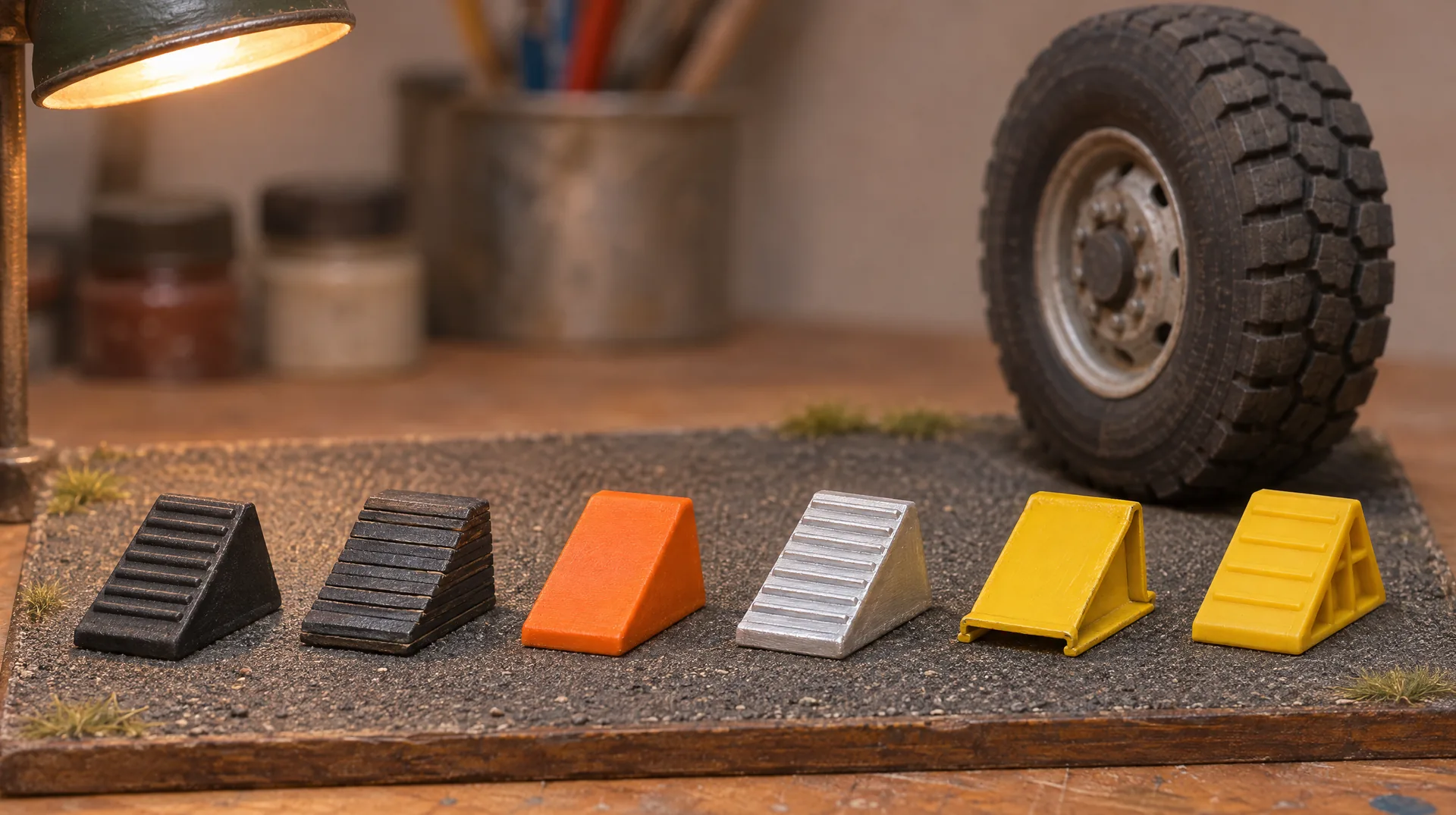
The pictures on this page are AI-made images of scale models of generic trailers and chocks, not a specific product. Each product page shows the maker's photo.