







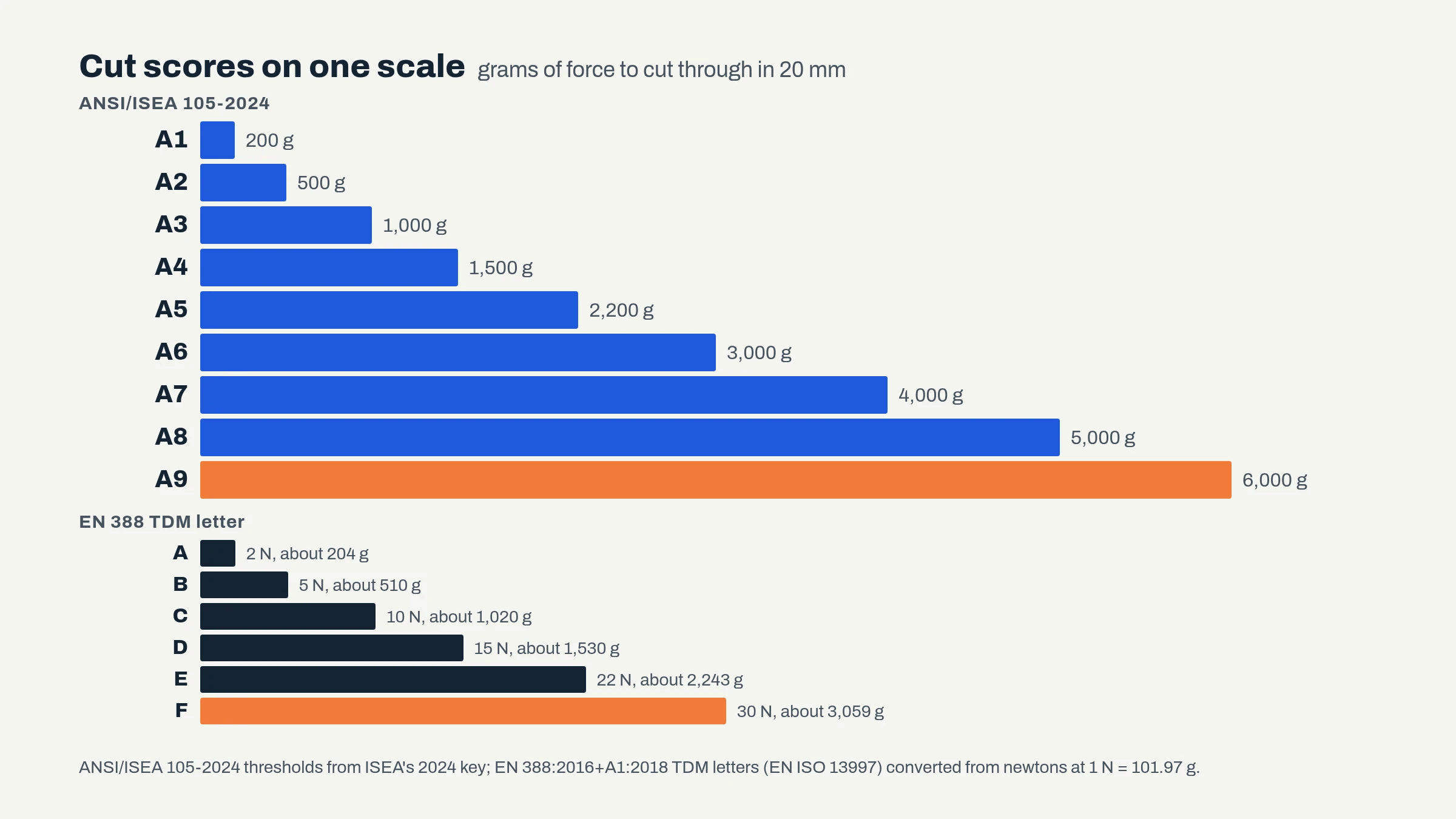
ANSI/ISEA 105-2024 rates a glove's cut resistance from A1 to A9 by the grams of force a razor blade needs to cut through the material in 20 mm of travel: A1 starts at 200 grams and A9 at 6,000 grams. Europe's EN 388 rates the same kind of test from A to F in newtons, and its top letter, F (30 N), is about half of an A9.[1][3][4][6]
A1
200 gThe lowest ANSI/ISEA 105 cut level: 200 grams of force to cut through.[3]
A9
6,000 gThe top ANSI/ISEA 105 cut level: 6,000 grams or more.[3]
EN 388 F
30 NEurope's top TDM cut letter, about 3,059 grams of force.[6]
Free. Just your work email.
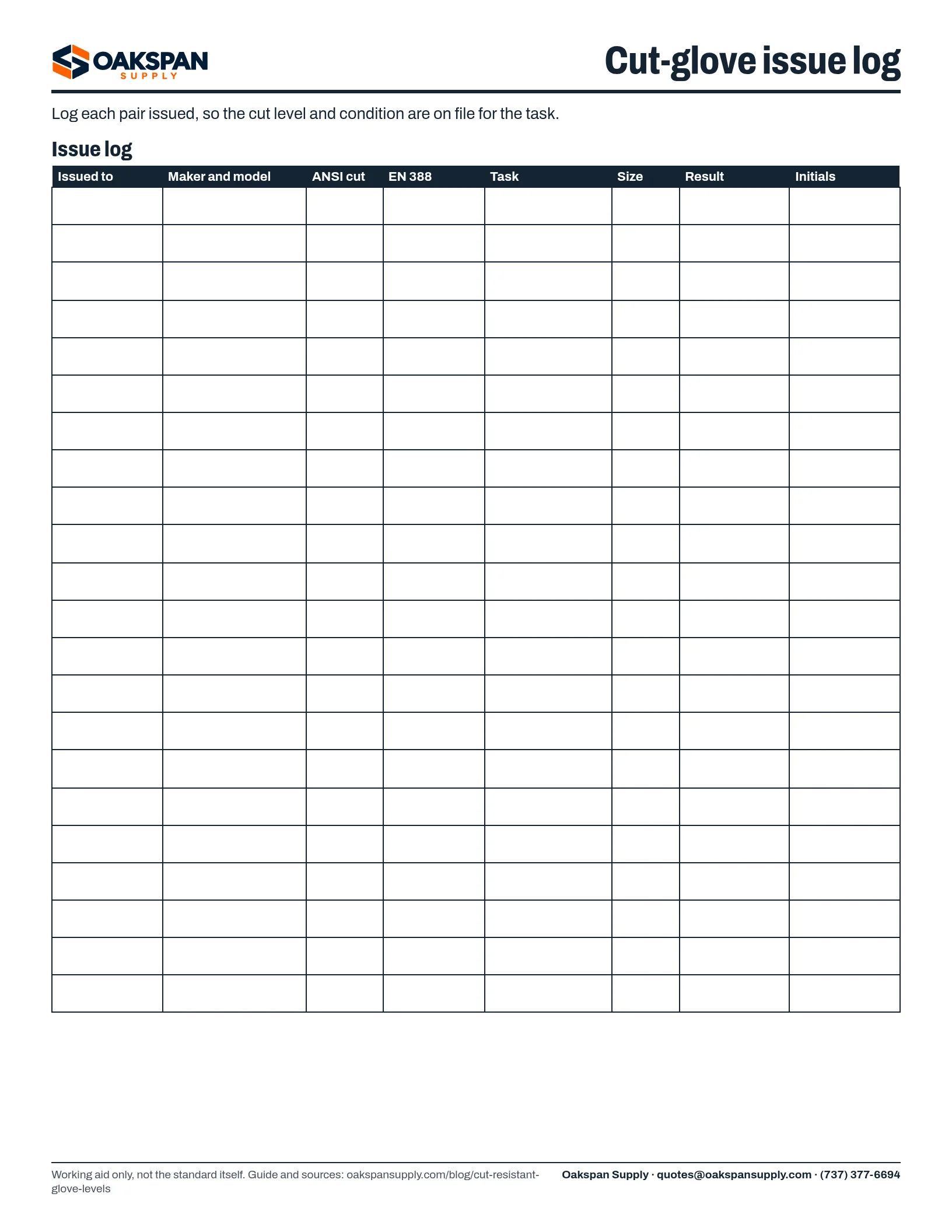
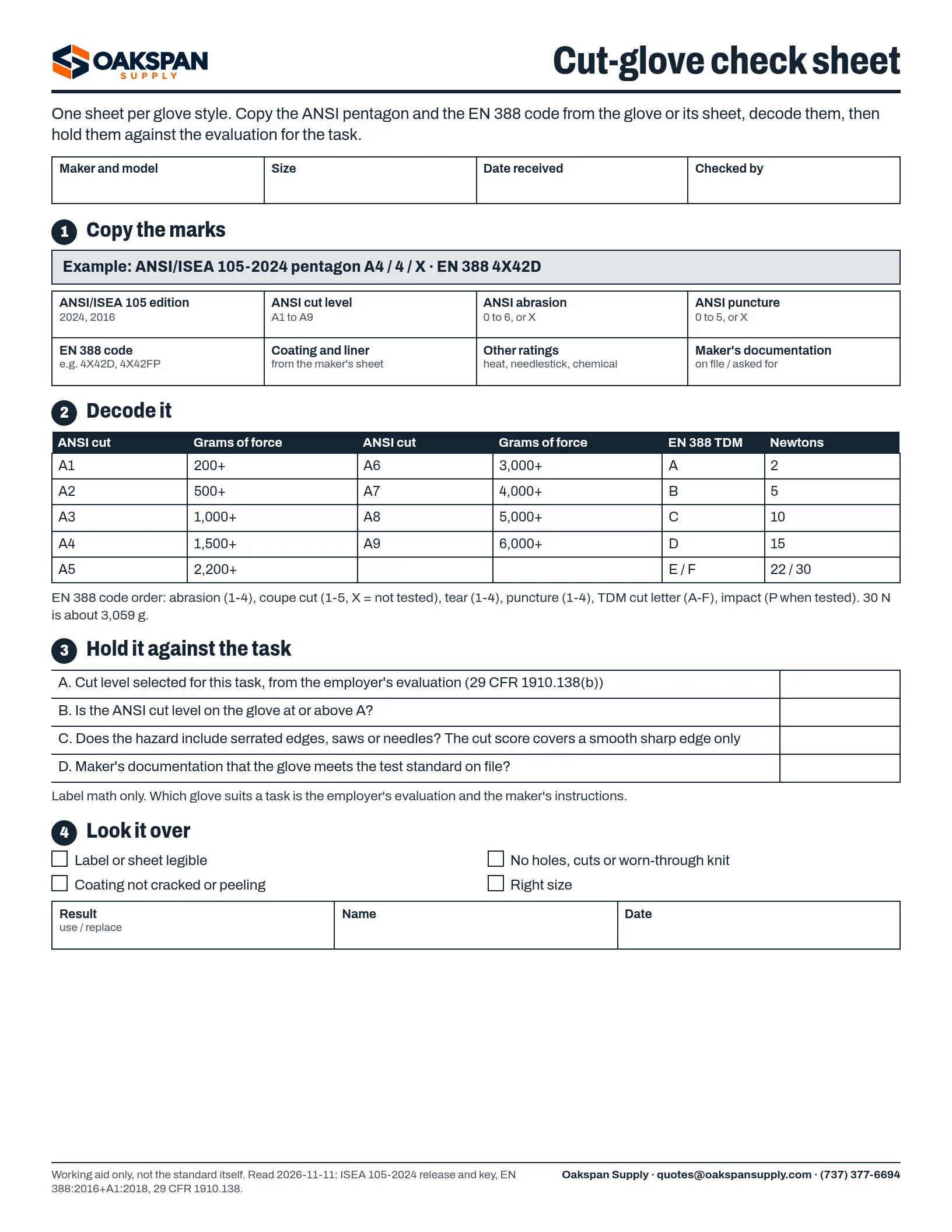
Print the cut-glove check sheet
A two-page sheet: copy a glove's ANSI pentagon and EN 388 code, decode the levels, hold them against the task's evaluation, and log every pair issued.
- Copy the ANSI/ISEA 105 pentagon and the EN 388 code
- Decode A1 to A9 in grams and A to F in newtons
- Check the hazard is a smooth sharp edge
- Log every pair issued
Two pages, letter size. The sheet downloads right away. We'll send you the occasional supply guide and may use your email to show you our ads. Unsubscribe any time. Privacy policy.
What A1 to A9 mean on a cut-resistant glove
The A level on a cut-resistant glove is its cut classification under ANSI/ISEA 105-2024, the American National Standard for Hand Protection Classification published by the International Safety Equipment Association (ISEA). ISEA classifies cut resistance "by the weight needed to cut through the material with 20 mm of blade travel." A higher A number means a heavier load on the blade before it cuts through.[1][4]
ISEA's key to the 2024 classifications gives the nine levels in grams-force, from "A1 Light cut hazards (200 gf)" to "A9 High cut hazards (6000 gf)". ISEA describes them in three bands: "Levels A1, A2, A3 protect against scrapes. Levels A4, A5, A6 protect against cuts for which stitches would be required. Levels A7, A8 and A9 are meant to offer protection against brutal or extreme injuries." Those are ISEA's descriptions; which level a job needs is the employer's evaluation under OSHA's rule, below.[2][3]
Scroll across to see every column →
| Cut level | Grams of force | ISEA's description band |
|---|---|---|
A1 | 200 to 499 | Scrapes |
A2 | 500 to 999 | Scrapes |
A3 | 1,000 to 1,499 | Scrapes |
A4 | 1,500 to 2,199 | Cuts that would need stitches |
A5 | 2,200 to 2,999 | Cuts that would need stitches |
A6 | 3,000 to 3,999 | Cuts that would need stitches |
A7 | 4,000 to 4,999 | Brutal or extreme injuries |
A8 | 5,000 to 5,999 | Brutal or extreme injuries |
A9 | 6,000 and up | Brutal or extreme injuries |
How the ANSI cut test works
The 2024 standard uses ASTM F2992-23, which ISEA's own cut calculator labels with the TDM-100 machine and a 20 mm reference distance. Ironclad, a glove maker, describes the test: "A specified vertical force is applied to a razor blade bringing it into contact with the fabric. The blade is then moved across the fabric until cut through is achieved, and the distance traveled is recorded. This process is repeated five times at three different vertical forces, each with a fresh razor blade." The results make a trend line that gives the grams needed to cut through at 20 mm.[5][10]
How to read the ANSI/ISEA 105-2024 label
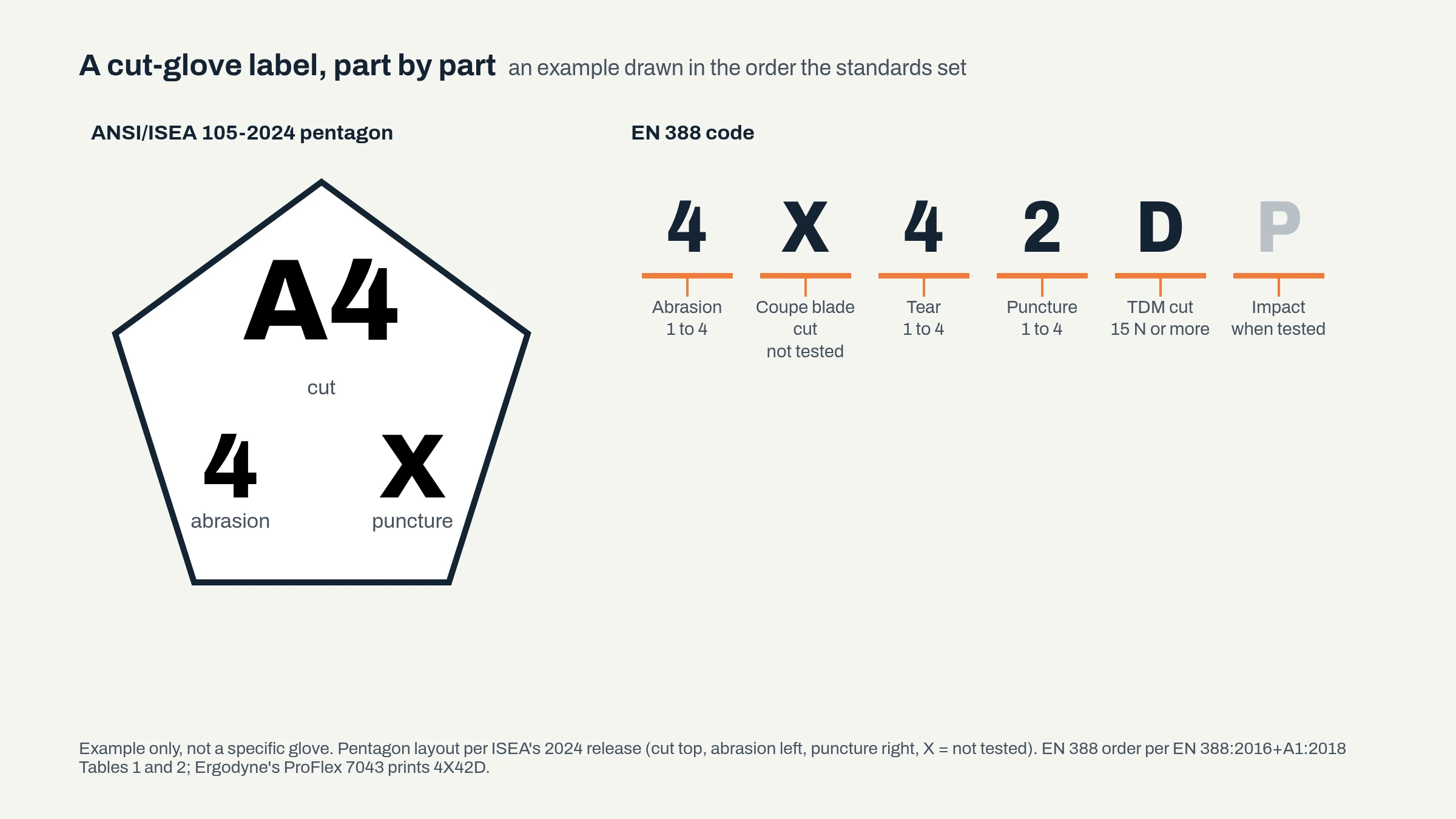
ISEA's 2024 change is the label, not the test. The chair of ISEA's hand protection group said the edition "does not make any major changes to test methods or levels of protection ... The big change is in product labeling." The new label is a pentagon badge: "The Cut rating symbol is in the top center," "The Abrasion rating symbol is on the left," and "The Puncture rating symbol is on the right." An X "can be applied in place of a rating to indicate the classification was not tested or is not applicable."[1]
ISEA also asks that makers and sellers not write "ANSI Cut" or "ANSI 105" but "ANSI/ISEA, the number 105, and the standard year (ANSI/ISEA 105-2024)." Many spec sheets still use the older wording, and some still cite the 2016 edition: Ergodyne's ProFlex 7043 page reads "ANSI/ISEA 105-2016 A4, EN 388: 4X42D". ISEA says the cut levels themselves did not change in 2024.[1][12]
ANSI's own summary of the 2024 edition calls it "the sixth edition of the voluntary industry consensus standard on hand and arm protection classification that was first published in 1999." Among the changes it lists: "The scope now covers both gloves and sleeves (i.e., “arm protection”), extending beyond hand protection alone."[18]
The abrasion and puncture numbers in the pentagon
The two lower numbers in the pentagon have their own scales. ISEA's key to the 2024 classifications rates abrasion from 0 to 6 by revolutions on the abrasion tester: levels 0 to 3 are run under a 500 gram load and levels 4 to 6 under a 1,000 gram load. ISEA describes abrasion resistance as "measured by the number of abrasion cycles the material can withstand before failure."[3][4]
Puncture runs from 0 to 5 in newtons. ISEA's key heads that column "non-hypodermic needle", and ISEA's hand protection page notes that "not all puncture-resistant gloves protect against needle sticks." ISEA's key prints the same figure, 100 newtons, beside puncture levels 4 and 5; the table below shows the key as printed.[2][3]
Scroll across to see every column →
| Level | Abrasion, revolutions | Abrasion test load | Puncture, newtons |
|---|---|---|---|
0 | Under 100 | 500 g | Under 10 |
1 | 100 or more | 500 g | 10 or more |
2 | 500 or more | 500 g | 20 or more |
3 | 1,000 or more | 500 g | 60 or more |
4 | 3,000 or more | 1,000 g | 100 or more |
5 | 10,000 or more | 1,000 g | 100 or more (as printed) |
6 | 20,000 or more | 1,000 g | No level 6 |
Source: [3]
EN 388 codes like 4X42D, decoded
Gloves sold in Europe carry the EN 388 shield: EN 388:2016+A1:2018, "Protective gloves against mechanical risks". Its scope covers "abrasion, blade cut, tear, puncture and, if applicable, impact." Makers print the results as a code of up to six characters in the standard's table order: abrasion (1 to 4), coupe blade cut (1 to 5), tear (1 to 4), puncture (1 to 4), the TDM cut letter (A to F) and, when tested, impact (P).[6][15]
The X in a code like 4X42D usually sits in the coupe-cut place. Ironclad explains: "With the advent of hardened fibers such as stainless steel, the coup test proved to have a major flaw: hardened fibers will dull the blade," and "if the blade becomes dulled during the coup test, then a value of 'X' is recorded, and the TDM test must be used to evaluate the cut rating." EN 388 itself notes: "There is no correlation between the levels of performance obtained with the 6.2 and 6.3 test methods."[6][10]
Scroll across to see every column →
| EN 388 letter | Newtons | About grams of force |
|---|---|---|
A | 2 | 204 |
B | 5 | 510 |
C | 10 | 1,020 |
D | 15 | 1,530 |
E | 22 | 2,243 |
F | 30 | 3,059 |
Source: [6]
The other EN 388 numbers: abrasion, coupe cut, tear and puncture
Table 1 of EN 388:2016+A1:2018 sets the minimum result for each numbered level. Abrasion is counted in rubs and has four levels, the coupe blade-cut test gives an index with five levels, and tear and puncture are measured in newtons with four levels each. So the 4X42D on Ergodyne's ProFlex 7043 reads: abrasion level 4, 8,000 rubs or more; X, no coupe result; tear level 4, 75 newtons or more; puncture level 2, 60 newtons or more; and TDM cut level D, 15 newtons or more.[6][12]
EN 388 rates the palm: "All specimens shall be taken from the palm of different gloves for classification purposes." It also carries a note on puncture: "Gloves meeting the requirements for resistance to puncture may not be suitable for protection against sharply pointed objects such as hypodermic needles."[6]
Scroll across to see every column →
| Test | Level 1 | Level 2 | Level 3 | Level 4 | Level 5 |
|---|---|---|---|---|---|
| Abrasion resistance (number of rubs) | 100 | 500 | 2,000 | 8,000 | No level 5 |
| Coupe blade cut (index) | 1.2 | 2.5 | 5.0 | 10.0 | 20.0 |
| Tear resistance (newtons) | 10 | 25 | 50 | 75 | No level 5 |
| Puncture resistance (newtons) | 20 | 60 | 100 | 150 | No level 5 |
Source: [6]
One glove, two labels: a real pentagon and EN 388 code side by side
Ansell's product data sheet for the HyFlex 11-541 prints both labels. The pentagon, headed ANSI/ISEA 105-2024, shows A4 at the top, 4 on the left and 2 on the right. Beside it the EN 388 shield carries 4X21D. (The same sheet's feature list gives the ANSI puncture level as 3; the badge prints 2.)[16]
Read against each standard's own table, the same glove's numbers do not match digit for digit. The 4 for abrasion means 3,000 revolutions or more under a 1,000 gram load in the ANSI pentagon and 8,000 rubs or more in the EN 388 code. The puncture place reads 2 in the pentagon and 1 in the EN 388 code, and both of those levels start at 20 newtons. The two cut marks sit close together: A4 starts at 1,500 grams and D at 15 newtons, about 1,530 grams.[3][6][16]
Scroll across to see every column →
| Mark | Label and place | What it rates | The level starts at |
|---|---|---|---|
A4 | ANSI pentagon, top | Cut | 1,500 grams of force |
4 | ANSI pentagon, left | Abrasion | 3,000 revolutions, 1,000 g load |
2 | ANSI pentagon, right | Puncture | 20 newtons |
4 | EN 388 code, first | Abrasion | 8,000 rubs |
X | EN 388 code, second | Coupe blade cut | No coupe result |
2 | EN 388 code, third | Tear | 25 newtons |
1 | EN 388 code, fourth | Puncture | 20 newtons |
D | EN 388 code, fifth | TDM cut | 15 newtons, about 1,530 grams of force |
Why an A9 glove can also be an EN 388 F
The two scales top out in different places. EN 388's TDM letters stop at F, 30 newtons, which is about 3,059 grams of force. ANSI/ISEA 105 keeps going to A9 at 6,000 grams; HexArmor, a glove maker, writes that ANSI/ISEA "extends their scale by three levels to 60 Newtons or 6000 grams." So one glove can carry the top mark in both: Ironclad's COMMAND A9 PU lists "EN 388 Rating: 4X43F" and "ANSI Cut Rating: A9".[3][6][11][14]
Converting each EN 388 letter's threshold to grams shows where it would sit on the ANSI scale: A falls in the A1 band, B in A2, C in A3, D in A4, E in A5 and F in A6. That is arithmetic on the thresholds, not a conversion of a glove's rating. Each rating comes from its own test, ASTM F2992-23 for ANSI/ISEA 105-2024 and EN ISO 13997 for EN 388, and makers' sheets show pairs that follow the arithmetic and a pair that does not. Ergodyne's ProFlex 7043 and Ansell's HyFlex 11-541 are both A4 with D, while Ironclad's COMMAND A2 PU lists "EN 388 Rating: 3X42C" with "ANSI Cut Rating: A2".[3][5][6][12][16][19]
Scroll across to see every column →
| EN 388 letter | Starts at, newtons | About grams of force | ANSI band that figure falls in |
|---|---|---|---|
A | 2 | 204 | A1 (200 to 499) |
B | 5 | 510 | A2 (500 to 999) |
C | 10 | 1,020 | A3 (1,000 to 1,499) |
D | 15 | 1,530 | A4 (1,500 to 2,199) |
E | 22 | 2,243 | A5 (2,200 to 2,999) |
F | 30 | 3,059 | A6 (3,000 to 3,999) |
No letter | None | None | A7, A8 and A9 (4,000 and up) |
What is inside a cut-resistant glove
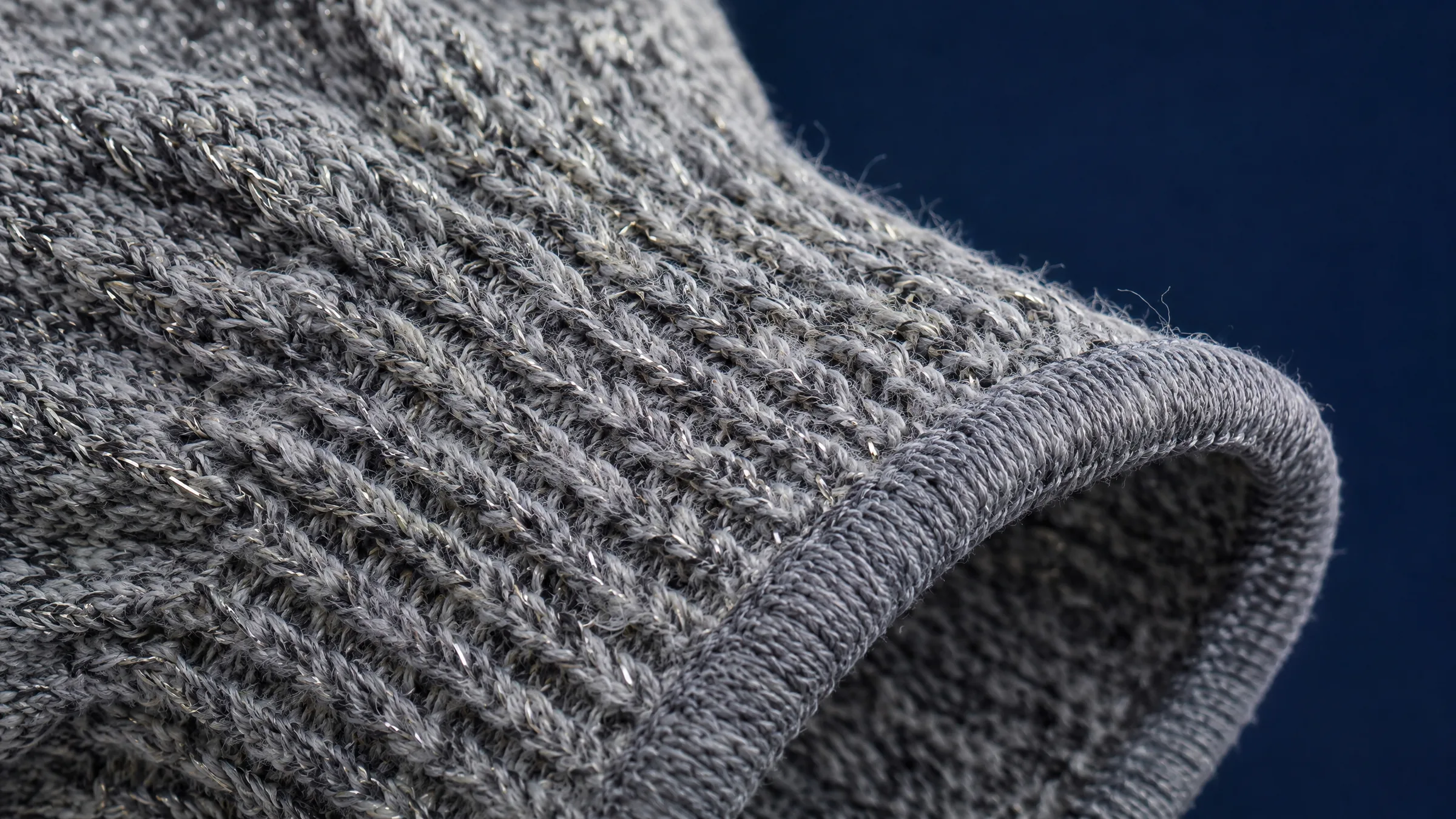
Cut resistance comes from the yarn. Ironclad's COMMAND A9 reads "Blended HPPE/Tungsten knit provides ANSI A9 cut resistance," and Ansell's HyFlex 11-541 lists its liner as "Nylon, Stainless steel, Spandex, Kevlar®." Arclin, which now makes Kevlar, calls it "a heat-resistant para-aramid synthetic fiber" created by Stephanie Kwolek.[11][16][17]
What OSHA 29 CFR 1910.138 says about gloves
OSHA's hand protection rule names hazards, not glove ratings. 29 CFR 1910.138(a) reads: "Employers shall select and require employees to use appropriate hand protection when employees' hands are exposed to hazards such as those from skin absorption of harmful substances; severe cuts or lacerations; severe abrasions; punctures; chemical burns; thermal burns; and harmful temperature extremes." Paragraph (b) adds that employers "shall base the selection of the appropriate hand protection on an evaluation of the performance characteristics of the hand protection relative to the task(s) to be performed, conditions present, duration of use, and the hazards and potential hazards identified."[7]
OSHA's nonmandatory Appendix B to Subpart I says: "Before purchasing gloves, the employer should request documentation from the manufacturer that the gloves meet the appropriate test standard(s) for the hazard(s) anticipated." ISEA notes that following ANSI/ISEA 105-2024 "is voluntary" while OSHA requires employers to address hand protection.[4][8]
A 2004 study of occupational hand injuries (Sorock and others, Journal of Occupational and Environmental Hygiene) interviewed 1,166 hand-injured workers and found that 19 percent were wearing gloves at the time of the injury, and that glove use was associated with a 60 to 70 percent lower estimated risk of lacerations and punctures, though not of crush injuries, fractures or amputations.[9]
What Oakspan Supply sells
Oakspan Supply sells the supplies on a plant's list (gloves, labels, drums, pails, totes, boxes, tape) and quotes any item a buyer sends, cut-resistant gloves included. Send the part number, a photo of the glove's label or your last invoice to quotes@oakspansupply.com and our quotes desk prices the exact item.
For hearing protection, our guide to the NRR explains the number on every earplug and earmuff package and OSHA's 7 dB adjustment.
Questions
What does A4 mean on cut-resistant gloves?
A4 is the fourth of nine cut levels in ANSI/ISEA 105-2024: the material needs at least 1,500 grams of force on the test blade to cut through in 20 mm of travel. ISEA groups A4 to A6 as protecting "against cuts for which stitches would be required."[2][3]
What is the highest cut level for gloves?
A9, at 6,000 grams of force or more, is the top level in ANSI/ISEA 105-2024. In EN 388 the top TDM letter is F, 30 newtons, about 3,059 grams.[3][6]
What does 4X42D mean on a glove?
It is an EN 388 code: abrasion level 4, X for the coupe blade-cut test (not tested, usually because hard fibers dull that blade), tear level 4, puncture level 2, and D on the TDM cut test, 15 newtons or more.[6][10][15]
Does OSHA require a specific cut level?
No. 29 CFR 1910.138 requires employers to select appropriate hand protection based on an evaluation of the task, conditions, duration and hazards. It names no cut level and no standard; ANSI/ISEA 105-2024 is a voluntary consensus standard.[4][7]
What changed in ANSI/ISEA 105-2024?
The label. ISEA says the 2024 edition makes no major changes to test methods or protection levels; it introduces a pentagon badge with cut at the top, abrasion on the left and puncture on the right.[1]
What do the three marks in the ANSI/ISEA 105 pentagon mean?
Cut is at the top (A1 to A9), abrasion is on the left (0 to 6) and puncture is on the right (0 to 5). ISEA says an X in a place means the classification "was not tested or is not applicable."[1][3]
What is the difference between A1 and A2 cut-resistant gloves?
The grams of force on the test blade. A1 covers 200 to 499 grams and A2 covers 500 to 999 grams, each to cut through in 20 mm of blade travel. ISEA's key calls A1 "Light cut hazards (200 gf)" and A2 "Light/Medium cut hazards (500 gf)".[3][4][13]
Is cut level 5 the same as A5, and is level C the same as level 5?
No to both. A5 is an ANSI/ISEA 105 level, 2,200 to 2,999 grams of force. A plain 5 in the second place of an EN 388 code is the top level of the coupe blade-cut test, an index of 20 or more. C is an EN 388 TDM letter, 10 newtons or more. EN 388 states: "There is no correlation between the levels of performance obtained with the 6.2 and 6.3 test methods."[3][6][13]
Can an EN 388 cut letter be converted to an ANSI cut level?
Only the thresholds can be compared. EN 388 F starts at 30 newtons, about 3,059 grams, which is inside the ANSI A6 band, and EN 388 has no letter above F. A glove's two ratings come from two separate tests: Ironclad's COMMAND A2 PU lists EN 388 3X42C with ANSI cut A2, though the C threshold, about 1,020 grams, is above the A2 band.[3][6][19]
Have a list of what you need? Our quotes desk prices the exact items.

Written by Anastasiia Kuziak, Manager and President of Oakspan Supply. She has a business degree, owns a small business of her own, and has more than five years in medical and pharmaceutical sales. How we write and check our guides.
Sources
- ISEA announces updated ANSI/ISEA 105 hand protection standard (105-2024), November 21, 2024. International Safety Equipment Association. Accessed 2026-11-17.
- Hand protection. International Safety Equipment Association. Accessed 2026-11-17.
- Key to hand classifications, ANSI/ISEA 105-2024 (November 2024). International Safety Equipment Association. Accessed 2026-11-17.
- Hand and arm protection: 5 facts (November 2024). International Safety Equipment Association. Accessed 2026-11-17.
- Hand protection classifications. International Safety Equipment Association. Accessed 2026-11-17.
- SS-EN 388:2016+A1:2018, Protective gloves against mechanical risks (preview). Swedish Institute for Standards (SIS). Accessed 2026-11-17.
- 29 CFR 1910.138, Hand protection. Electronic Code of Federal Regulations. Accessed 2026-11-11.
- 29 CFR Part 1910 Subpart I, Appendix B: Nonmandatory compliance guidelines for hazard assessment and PPE selection. Electronic Code of Federal Regulations. Accessed 2026-11-11.
- Sorock et al., Glove use and the relative risk of acute hand injury: a case-crossover study, J Occup Environ Hyg 2004;1(3):182-90. PubMed, US National Library of Medicine. Accessed 2026-11-11.
- Cut resistance standards explained. Ironclad Performance Wear. Accessed 2026-11-11.
- COMMAND A9 PU glove (KKC9PU), product specifications. Ironclad Performance Wear. Accessed 2026-11-17.
- ProFlex 7043 nitrile coated cut-resistant gloves, specifications. Ergodyne. Accessed 2026-11-17.
- All about cut-resistant glove levels. MCR Safety. Accessed 2026-11-11.
- ISEA versus CE: know the difference. HexArmor. Accessed 2026-11-11.
- Understanding cut standards. Mechanix Wear. Accessed 2026-11-11.
- HyFlex 11-541 product data sheet. Ansell. Accessed 2026-11-17.
- What is Kevlar?. Arclin. Accessed 2026-11-11.
- ANSI/ISEA 105-2024: Hand Protection and Cut Level Ratings (The ANSI Blog), Internet Archive copy of April 18, 2026. American National Standards Institute (ANSI). Accessed 2026-11-17.
- COMMAND A2 PU glove (SKC2PU), ratings and specifications. Ironclad Performance Wear. Accessed 2026-11-17.
Written from the sources above under our editorial policy. Published November 11, 2026, last updated November 17, 2026. Spot an error? Send us a correction and we fix it and note the date.
- Safety and cleanup supplies: gloves, arm sleeves, paper towels
- Ansell TouchNTuff 69-318 latex disposable gloves, 5 mil
- Hi-vis vest classes: Class 1, 2 and 3 explained
- What Z87 and Z87+ mean on safety glasses
- Earplug NRR explained: what the number means
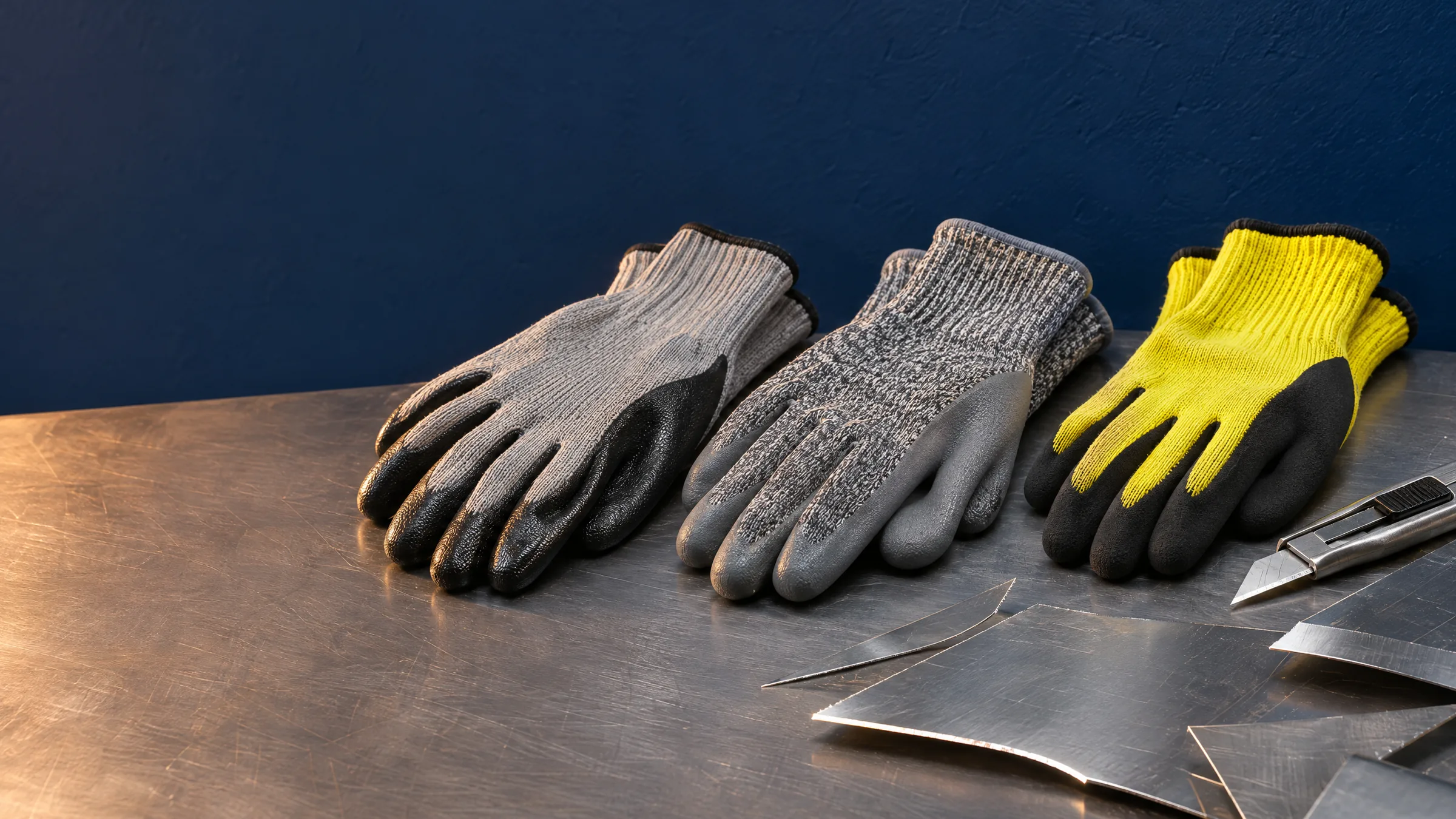
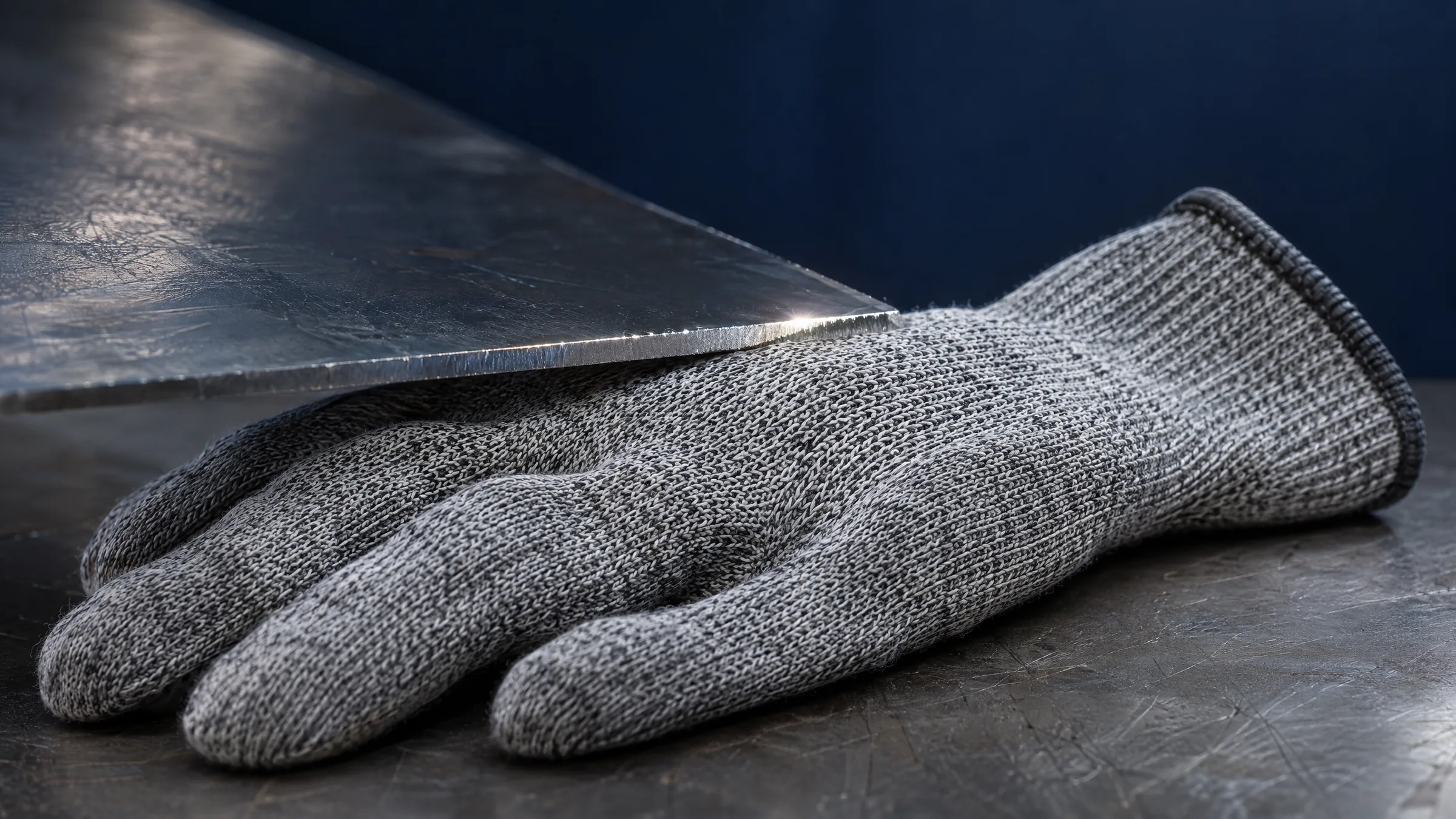
The photos on this page are AI images of generic gloves, not a specific product. The diagrams are drawn from the figures in the sources.