





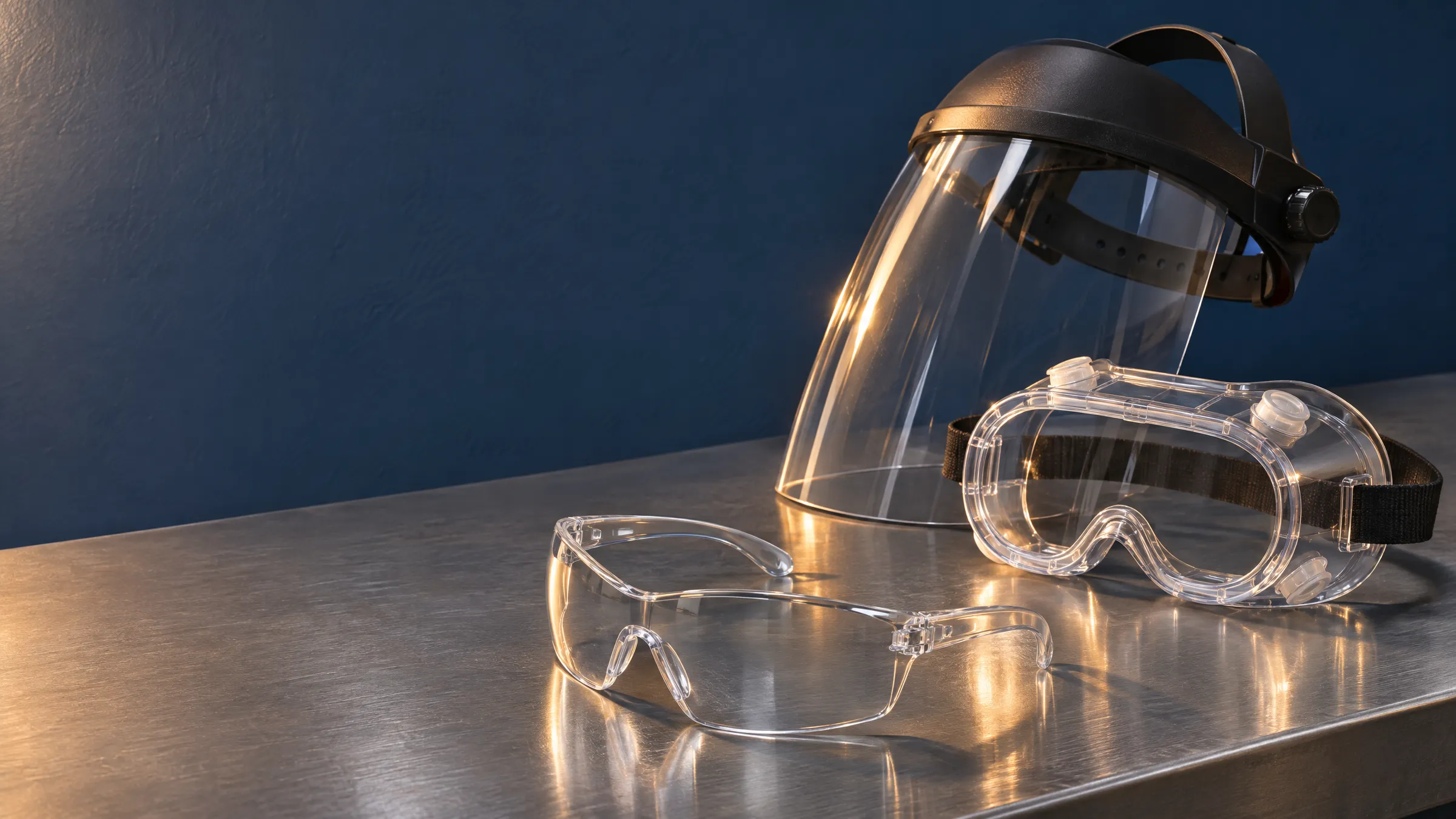
Z87 on a safety-glasses frame or lens means the maker marks the product to ANSI/ISEA Z87.1, the American National Standard for occupational and educational eye and face protection. Z87+ means it is also marked as impact rated; plain Z87 meets the basic requirements without an impact rating.[1][5][6]
Z87-2
PrescriptionA prescription device marked to Z87.1; Z87-2+ is impact rated.[5]
What Z87 and Z87+ mean on safety glasses
Z87 on a safety-glasses frame or lens means the maker marks the product to ANSI/ISEA Z87.1, the American National Standard for occupational and educational personal eye and face protection devices. Z87+ means the product is also marked as impact rated; NIOSH describes Z87 as the mark for normal safety wear and Z87+ as the mark for high impact.[5][11]
Plain Z87 is not the same as no impact testing. Radians lists minimum impact resistance by a drop ball test among the requirements for every device, and cautions not to mistake that minimum for an impact-rated device.[11]
ISEA, which publishes the standard, announced ANSI/ISEA Z87.1-2025 on January 8, 2026. Among the changes, ISEA lists "Clearer, more standardized product markings to better communicate intended hazard protection", and says the 2025 edition "retains options introduced in recent editions, including relaxed optics and anti-fog performance."[6]
The marks decoded below are the 2020 edition's, as ISEA's excerpt of that edition and the makers' product sheets show them. ISEA's announcement does not list the 2025 marks one by one, so for a product marked to 2025 the maker's instructions say what each mark means.[6][7]
ANSI's own summary of the 2025 edition does list its marks: Z87-2 for prescription, H for coverage, +, Z87+ and Z87-2+ as the impact marks, O2 for the relaxed optical level, W, U, R and L with their numbers for welding, UV, IR and visible light filter lenses, V, S, X for anti-fog, and D3, D4 and D5. Every mark in the table below is on that list. ANSI points to Table 3 of the standard for the marking requirements.[13]
The Vision Council calls ANSI/ISEA Z87.1-2025 "the sixth revision of this voluntary industry consensus standard." Its list of updates includes "Expanded clarification and requirements for product markings, including specific guidance on prescription lens carriers and detailed examples in Annex L." It says the relaxed optics and anti-fog criteria and marks "were first introduced in the 2020 revision."[14]
Every Z87 mark, decoded
OSHA's 2015 proposed rule explains that the 2010 edition of Z87.1 focuses on a hazard, such as droplet and splash, impact, optical radiation, dust and fine dust, where earlier versions focused on protector type. Radians describes the maker's mark and the Z87 mark as required on every device, and the impact, splash, dust and anti-fog ratings as optional ones a maker claims.[4][11]
29 CFR 1910.133(a)(4) adds a marking rule of its own: "Eye and face PPE shall be distinctly marked to facilitate identification of the manufacturer." NIOSH notes that older Z87 editions may have had marking differences from the newest one, and that the edition year is not always marked on products.[1][5]
Scroll across to see every column →
| Mark | What it means | Where it appears |
|---|---|---|
3M, P | Maker's mark or logo (3M; P for Pyramex): identifies the manufacturer, as 29 CFR 1910.133(a)(4) requires | Lens and frame; first in the 3M and Pyramex marking lines |
Z87 | Marked to ANSI/ISEA Z87.1: the basic requirements, without an impact rating | Frame and lens; NIOSH says the rating is required on both |
Z87+ | Impact rated: passed the high-velocity and high-mass impact tests | Frame of plano glasses; non-spectacle lenses |
+ (on its own) | Impact-rated spectacle lens | Spectacle lens |
Z87-2 | Prescription device marked to Z87.1 | Prescription eyewear |
Z87-2+ | Impact-rated prescription device | Prescription frame |
H | Small head size | Lens marking of Pyramex's frameless Mini Intruder |
W and a shade number | Welding filter lens and its shade number | With the lens type marks |
U and a scale number (U6) | Ultraviolet filter and its scale number; 3M notes U6 is the highest rating in the 2020 edition | Lens |
R and a scale number | Infrared filter and its scale number | With the lens type marks |
L and a scale number (L3) | Visible light filter; Pyramex gives L3 as 18% maximum visible light | Lens |
V | Variable tint lens | With the lens type marks |
S | Special purpose lens | With the lens type marks |
O2 | Relaxed optical level, on ANSI's list of the 2025 edition's marks; The Vision Council says the relaxed optics option was first introduced in the 2020 edition | ANSI's list does not give the place |
X | Passed the optional anti-fog lens test; Pyramex says the lens must stay fog-free for at least eight seconds | Lens |
D3 | Splash and droplet: tested for the capability to keep liquid splash and droplets from getting through | Device marking |
D4 | Dust: tested for the capability to keep dust and debris from getting through | Frame (Radians) |
D5 | Fine dust | Device marking |
How to read a real marking: 3M Z87+ U6 X D3 D4
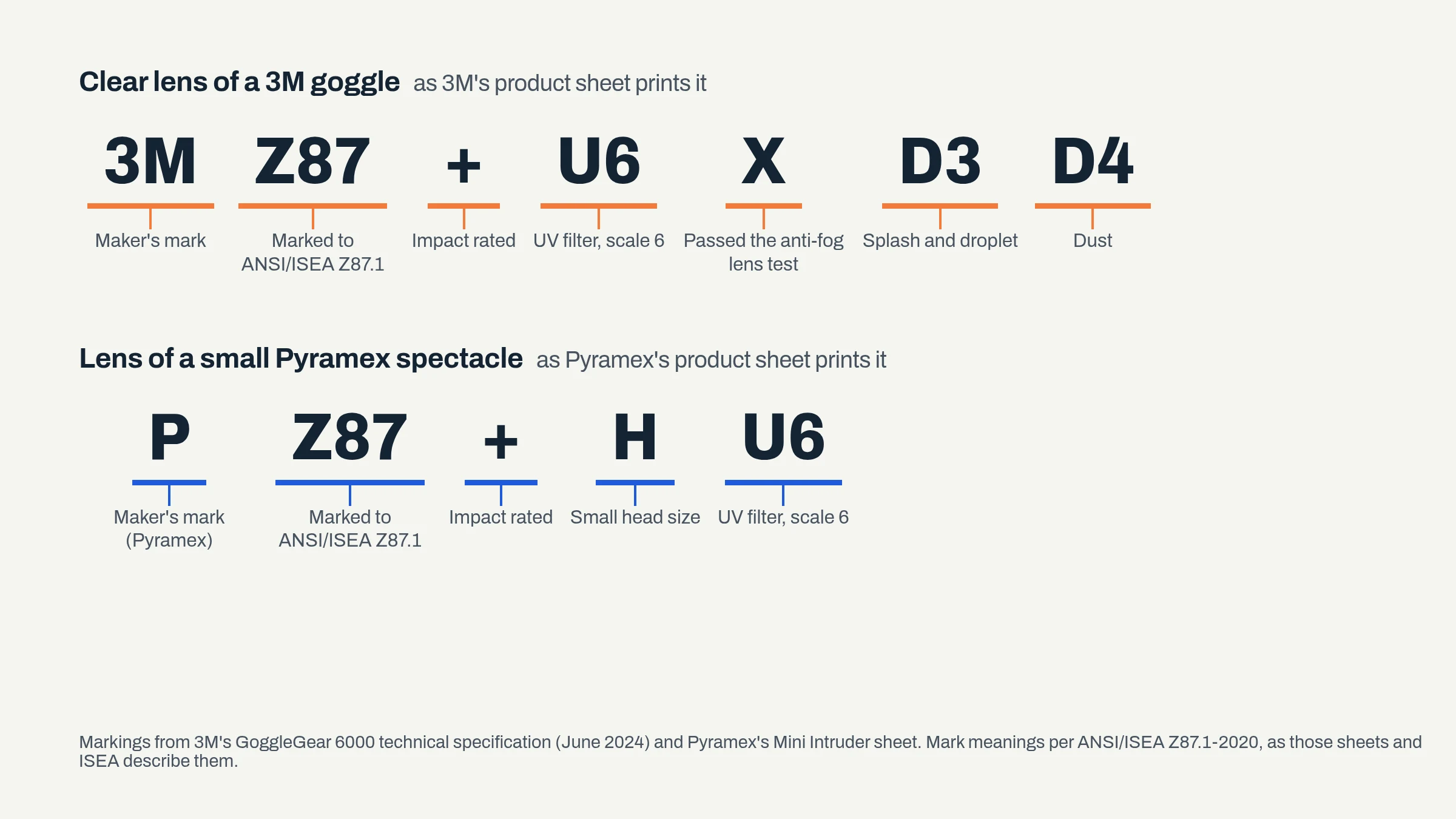
3M's June 2024 technical specification for its GoggleGear 6000 goggle gives the clear lens the marking 3M Z87+ U6 X D3 D4 and explains each part. 3M is the manufacturer's identification, Z87 the standard, + the impact rating, U6 the UV scale number, X a pass on the optional anti-fog lens test, D3 splash and droplet protection and D4 dust protection. The gray lens reads 3M Z87+ U6 L3 X D3 D4, where L3 is the visible light filter scale number.[8]
Pyramex's sheet for its Mini Intruder, a frameless spectacle 8% smaller than its Intruder, gives the clear lens marking P Z87 + H U6 and the temple marking P Z87 +. P is the Pyramex manufacturer's mark, + is high impact and H is small head size. The same sheet gives U6 as 0.01% maximum effective far UV and 0.1% maximum near UV transmittance.[9]
The impact tests behind Z87+
To carry Z87+, Radians says, a device must pass high-velocity impact, high-mass impact and penetration tests and give a minimum of side coverage. The high-velocity test fires a 0.25 in steel ball at 150 ft/s for glasses, 250 ft/s for goggles and 300 ft/s for faceshields. The high-mass test drops a 17.6 oz (500 g) projectile from 50 in (127 cm).[11]
MCR Safety's 2026 catalog gives the same glasses tests: a 0.25 inch steel ball at 150 fps (102 mph), and a 1.1 lb conical-tip projectile dropped from 50 inches. NIOSH also cites a 1.1-pound object dropped from 50 inches and notes that tests vary for specific types of eyewear and use.[5][12]
Radians gives the side coverage for impact-rated protectors as at least 10 mm behind the corneal plane and 10 mm above and below the horizontal plane, with no openings over 1.5 mm. The drop ball test that every device passes became universal in the 2010 edition: OSHA's 2015 proposal says the test "is universally-applied rather than protector-dependent."[4][11]
The three high-velocity speeds are easier to compare in one unit. Radians' 150, 250 and 300 feet per second work out to about 102, 170 and 205 miles per hour, or 45.7, 76.2 and 91.4 metres per second. The high-mass drop, 500 grams from 127 cm, carries about 6.2 joules to the lens (mass times gravity times height). Radians lists a third test, penetration, with a weighted needle of more than 1.56 oz and the pass rule "The lens shall not be penetrated as a result of this test."[11]
Scroll across to see every column →
| Test | Projectile | Speed or drop | Converted |
|---|---|---|---|
| High velocity, glasses | 0.25 in steel ball | 150 ft/s | 102 mph, 45.7 m/s |
| High velocity, goggles | 0.25 in steel ball | 250 ft/s | 170 mph, 76.2 m/s |
| High velocity, faceshields | 0.25 in steel ball | 300 ft/s | 205 mph, 91.4 m/s |
| High mass | 17.6 oz (500 g) projectile | Dropped from 50 in (127 cm) | About 6.2 joules |
| Penetration | Weighted needle, more than 1.56 oz | Not given on Radians' sheet | Not worked out |
Source: [11]
Hazards the Z87.1 marks do not cover
Some hazards have no Z87 mark at all. ISEA's selection tool, excerpted from Annex J of the 2020 edition, puts a note in the marking column instead of a mark for four of them: heat or high-temperature exposure, irritating mists, lasers and electric arcs. Each note says there are "currently no marking designations" for that protection in ANSI/ISEA Z87.1-2020.[7]
ANSI's summary of the 2025 edition says the standard "does not cover other hazardous exposures like bloodborne pathogens, X-rays, high-energy particulate radiation, microwaves, radio-frequency radiation, lasers, masers, and sports and recreation." Blood and body-fluid spray has its own standard, ANSI/ISEA Z87.62-2021, which ISEA says addresses exposure "caused by spray or spurt of blood, body fluids and/or other potentially infectious materials (OPIM)." The Vision Council lists a cross-reference to Z87.62-2021 among the 2025 updates.[13][14][16]
Scroll across to see every column →
| Hazard | What the marking column says | Where ISEA's tool points |
|---|---|---|
| Heat or high-temperature exposure | "currently no marking designations for eye protection to heat or high-temperature exposure" | No other standard named |
| Irritating mists | "currently no marking designations for eye protection to Irritating mists exposure" | No other standard named |
| Lasers | "currently no marking designations for eye protection to Lasers" | ANSI Z136.1-2014, "Safe Use of Lasers" |
| Electric arcs | "currently no marking designations for eye protection to electrical arcs" | NFPA 70E-2018, "Standard for Electrical Safety in the Workplace" |
Source: [7]
What OSHA 29 CFR 1910.133 says about Z87.1
29 CFR 1910.133(b)(1) reads: "Protective eye and face protection devices must comply with any of the following consensus standards:" It then lists ANSI/ISEA Z87.1-2010, ANSI Z87.1-2003 and ANSI Z87.1-1989 (R-1998), each "incorporated by reference in § 1910.6."[1]
29 CFR 1910.133(b)(2) adds: "Protective eye and face protection devices that the employer demonstrates are at least as effective as protective eye and face protection devices that are constructed in accordance with one of the above consensus standards will be deemed to be in compliance with the requirements of this section." The rule text names no later edition. NIOSH writes that "newer Z87 versions, such as 2015 and 2020, are acceptable and may be required by an employer."[1][5]
OSHA's 2016 final rule, which added the 2010 edition, states: "Employers are not required to update or replace protection devices solely as a result of this rule."[3]
What a job calls for comes from the hazard assessment, not from the mark. 29 CFR 1910.132(d)(1) says: "The employer shall assess the workplace to determine if hazards are present, or are likely to be present, which necessitate the use of personal protective equipment (PPE)." If they are, the employer shall "Select, and have each affected employee use, the types of PPE that will protect the affected employee from the hazards identified in the hazard assessment." The maker's instructions state what each product is marked for.[2]
On March 12, 2026, ISEA and other organizations petitioned OSHA to update the editions it references. The petition lists OSHA's Z87.1 references as 2010, 2003 and "1989 (reaffirmed in 1998)" and asks for 2025, 2020 and 2015. It says the 2025 edition "Strengthens impact, lens haze, and minimum coverage area testing requirements" and "Improves marking requirements for prescription lens carriers." In the eCFR dated November 1, 2026, 29 CFR 1910.133(b)(1) still lists the 2010, 2003 and 1989 (R-1998) editions.[1][15]
Side protection and prescription safety glasses
29 CFR 1910.133(a)(2) reads: "The employer shall ensure that each affected employee uses eye protection that provides side protection when there is a hazard from flying objects." NIOSH adds that ANSI/ISEA Z87.1 "requires wrap around coverage or side-shields on safety glasses for impact protection (Z87+)."[1][5]
The same paragraph of the rule goes on: "Detachable side protectors (e.g. clip-on or slide-on side shields) meeting the pertinent requirements of this section are acceptable."[1]
29 CFR 1910.133(a)(3) reads: "The employer shall ensure that each affected employee who wears prescription lenses while engaged in operations that involve eye hazards wears eye protection that incorporates the prescription in its design, or wears eye protection that can be worn over the prescription lenses without disturbing the proper position of the prescription lenses or the protective lenses."[1]
Prescription safety eyewear is marked Z87-2, or Z87-2+ when impact rated, NIOSH says. NIOSH also notes that regular eyewear is usually stamped ANSI Z80, and that Z80 "does NOT indicate an industrial protection level."[5]
What Oakspan Supply sells
Oakspan Supply sells the supplies on a plant's list (gloves, labels, drums, pails, totes, boxes, tape) and quotes any item a buyer sends. Send the part number, a photo or your last invoice to quotes@oakspansupply.com and our quotes desk prices the exact item.
For hi-vis vests, our guide to ANSI/ISEA 107 decodes Class 1, 2 and 3 and Type O, R and P, the same way this page decodes Z87.
For gloves, our guide to ANSI/ISEA 105-2024 decodes the A1 to A9 cut levels and EN 388 codes like 4X42D.
For hearing protection, our guide to the NRR explains the number on every earplug and earmuff package and OSHA's 7 dB adjustment.
Questions
What does Z87+ mean on safety glasses?
Z87+ means the device is marked as impact rated to ANSI/ISEA Z87.1: it passed the high-velocity and high-mass impact tests. On spectacles, ISEA's excerpt of the 2020 edition puts a + on its own on the lens and Z87+ on the frame.[7][11]
What is the current edition of ANSI Z87.1?
ANSI/ISEA Z87.1-2025, which ISEA announced on January 8, 2026. The edition before it was Z87.1-2020.[5][6]
How do I know if my safety glasses are Z87?
The marks are on the product. NIOSH says industrial safety eyewear and face shields are marked or stamped with Z87, or Z87-2 for prescription. 29 CFR 1910.133(a)(4) requires a mark that identifies the manufacturer. Regular eyewear is usually stamped ANSI Z80, which NIOSH says "does NOT indicate an industrial protection level."[1][5]
What does Z87-2+ mean?
Z87-2 marks a prescription device made to ANSI/ISEA Z87.1, and the + adds the impact rating. ISEA's excerpt of the 2020 edition gives Z87-2+ as the impact mark for a prescription frame.[5][7]
Does OSHA require Z87+ safety glasses?
The rule text does not use the + mark. 29 CFR 1910.133(b)(1) requires eye and face protection to comply with one of three listed editions of Z87.1, and (b)(2) accepts devices the employer demonstrates are at least as effective. Under 29 CFR 1910.132(d)(1) the employer selects the protection from its hazard assessment.[1][2]
Is the anti-fog X mark new in Z87.1-2025?
No. The Vision Council says the anti-fog criteria and marks "were first introduced in the 2020 revision" and are kept in 2025. 3M's June 2024 goggle specification already prints X in the lens marking.[8][14]
Is there a Z87 mark for lasers or electric arcs?
Not in the 2020 edition. ISEA's selection tool says there are "currently no marking designations" for eye protection to lasers or to electrical arcs in ANSI/ISEA Z87.1-2020. It refers readers to ANSI Z136.1-2014 for lasers and NFPA 70E-2018 for electrical work.[7]
Have a list of what you need? Our quotes desk prices the exact items.

Written by Anastasiia Kuziak, Manager and President of Oakspan Supply. She has a business degree, owns a small business of her own, and has more than five years in medical and pharmaceutical sales. How we write and check our guides.
Sources
- 29 CFR 1910.133, Eye and face protection. Electronic Code of Federal Regulations. Accessed 2026-11-17.
- 29 CFR 1910.132, General requirements (personal protective equipment). Electronic Code of Federal Regulations. Accessed 2026-11-10.
- Updating OSHA Standards Based on National Consensus Standards; Eye and Face Protection, final rule, 81 FR 16085, March 25, 2016. Federal Register. Accessed 2026-11-10.
- Updating OSHA Standards Based on National Consensus Standards; Eye and Face Protection, proposed rule, 80 FR 13295, March 13, 2015. Federal Register. Accessed 2026-11-10.
- The Manufacture and Selection of Eye Protection at Work (NIOSH Science Blog, June 8, 2022). NIOSH (CDC). Accessed 2026-11-17.
- ISEA Releases Updated ANSI/ISEA Z87.1 Standard for Eye and Face Protection (January 8, 2026). International Safety Equipment Association (ISEA). Accessed 2026-11-17.
- Eye and Face Protection Selection Tool: Annex J, as excerpted from ANSI/ISEA Z87.1-2020. International Safety Equipment Association (ISEA). Accessed 2026-11-17.
- 3M GoggleGear Protective Goggle 6000 Series, Technical Specification (June 2024). 3M Personal Safety Division. Accessed 2026-11-10.
- Mini Intruder ANSI Product Sheet (updated October 2024). Pyramex Safety. Accessed 2026-11-10.
- Pyramex Anti-fog Technology Becomes a Must-have (H2X and H2MAX, ANSI Z87.1-2020 anti-fog marking). Pyramex Safety. Accessed 2026-11-10.
- Fast Facts: Eye/Face Protection, Eyewear Standards and Markings (5064, REV03, May 2023). Radians. Accessed 2026-11-17.
- 2026 Eye Protection Catalog (ANSI Z87.1-2020 impact testing requirements). MCR Safety. Accessed 2026-11-17.
- ANSI/ISEA Z87.1-2025: Current Standard for Safety Glasses (The ANSI Blog), Internet Archive copy of October 20, 2026. American National Standards Institute (ANSI). Accessed 2026-11-17.
- The Vision Council Announces the Publication of ANSI/ISEA Z87.1-2025 (press release, January 9, 2026). The Vision Council. Accessed 2026-11-17.
- Petition to OSHA: Update PPE Standard References (March 12, 2026). International Safety Equipment Association (ISEA). Accessed 2026-11-17.
- Eye and face protection. International Safety Equipment Association (ISEA). Accessed 2026-11-17.
Written from the sources above under our editorial policy. Published November 10, 2026, last updated November 17, 2026. Spot an error? Send us a correction and we fix it and note the date.
- Safety and cleanup supplies: gloves, arm sleeves, paper towels
- Labels and printing
- Drums, totes and pails
- How to read UN markings on drums, pails and boxes
- Hi-vis vest classes: Class 1, 2 and 3 explained
- Cut-resistant glove levels: A1 to A9 explained
- Earplug NRR explained: what the number means
The photos on this page are AI images of generic eyewear, not a specific product. The marking diagram copies two makers' printed markings.