





NRR, the Noise Reduction Rating, is the single number in decibels that the EPA requires on every hearing protector's package under 40 CFR Part 211, measured in a lab under ANSI S3.19-1974. OSHA subtracts 7 dB from it when the noise is measured in dBA, and both OSHA and NIOSH say real-world protection is usually lower than the label.[1][2][3][5]
NRR
DecibelsOne EPA-required number on every hearing protector package.[1]
OSHA dBA
NRR - 7Appendix B: subtract 7 dB from the NRR when the noise is measured in dBA.[2]
Two protectors
+5 dBOSHA: a muff over a plug adds only 5 dB to the better one.[3]
Free. Just your work email.
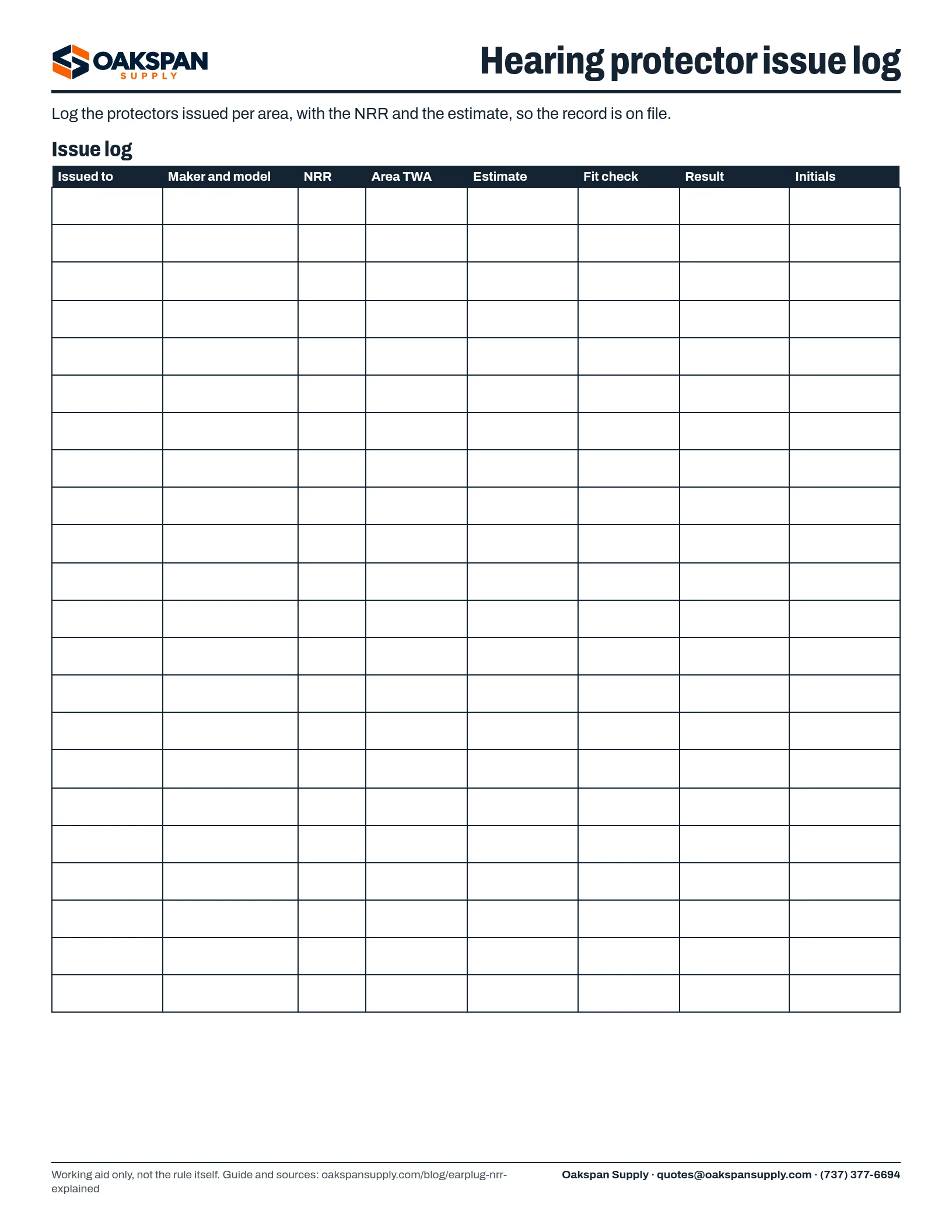
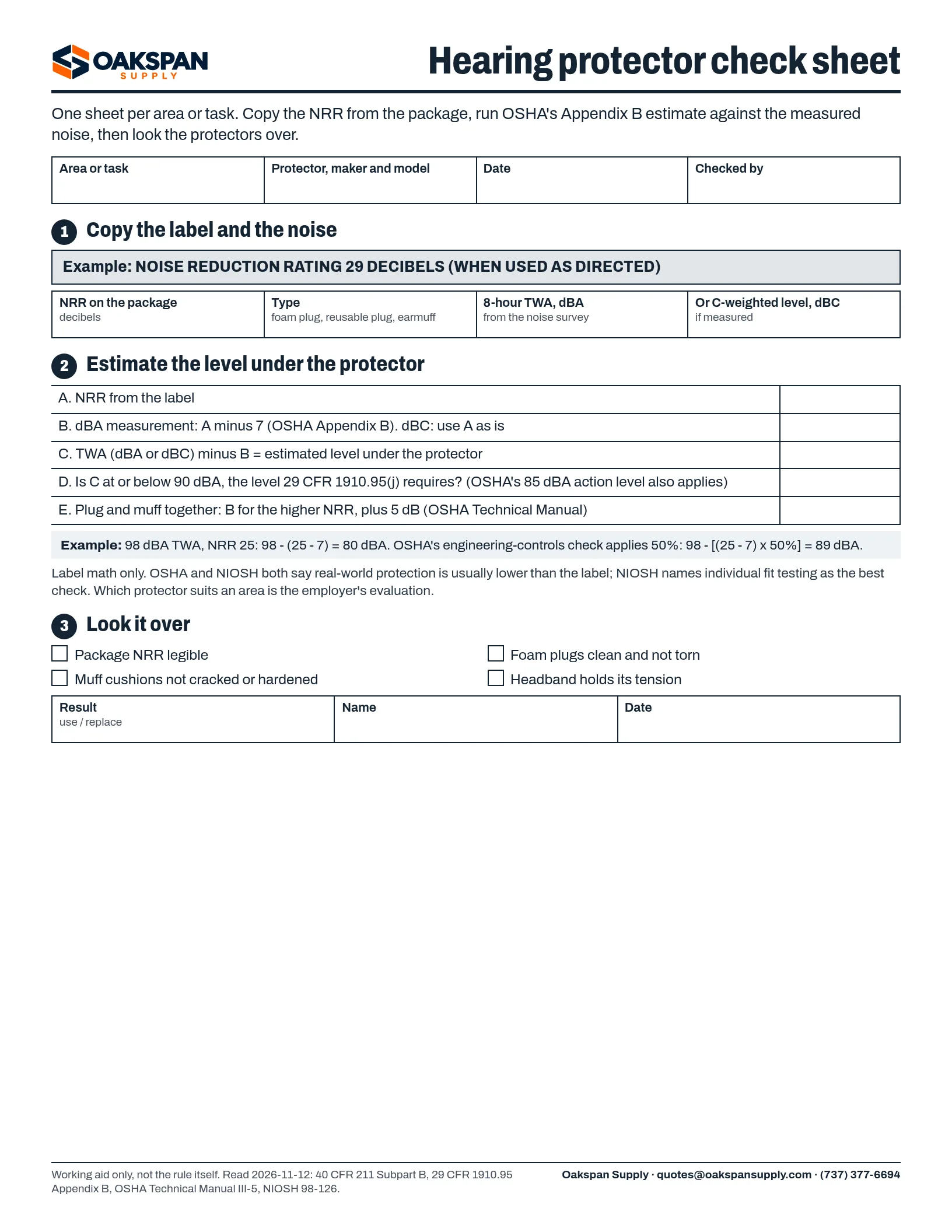
Print the hearing protector check sheet
A two-page sheet: copy the NRR and the measured noise, run OSHA's Appendix B estimate, check plugs plus muffs, and log what's issued.
- Copy the NRR and the 8-hour TWA
- Subtract 7 dB for dBA, per OSHA Appendix B
- Add only 5 dB for a plug plus a muff
- Log protectors issued per area
Two pages, letter size. The sheet downloads right away. We'll send you the occasional supply guide and may use your email to show you our ads. Unsubscribe any time. Privacy policy.
Try it
Run the label math on your own numbers
Type the 8-hour noise level from your survey and the NRR on the package. The calculator runs the same methods as the table below: the EPA's package text, OSHA's Appendix B and Technical Manual, and NIOSH's 1998 derating. For a plug worn under a muff, add the second protector's NRR.[1][2][3][4]
What NRR means on earplugs and earmuffs
NRR stands for Noise Reduction Rating. The EPA's hearing protector rule, 40 CFR Part 211 Subpart B, defines it as "a single number noise reduction factor in decibels" that "takes into account performance variation of protectors in noise reducing effectiveness due to differing noise spectra, fit variability and the mean attenuation of test stimuli." Every hearing protector made on or after September 27, 1980 must carry it on its package.[1]
The number comes from a lab test, ANSI S3.19-1974, "Method for the Measurement of Real-Ear Protection of Hearing Protectors and Physical Attenuation of Earmuffs." The rule's formula takes the mean attenuation at each test frequency minus two standard deviations, then subtracts "an extra three decibel reduction" for differences between workplace noise and the lab's pink noise. A maker may label a protector lower than its test result, never higher.[1]
How to read the NRR label
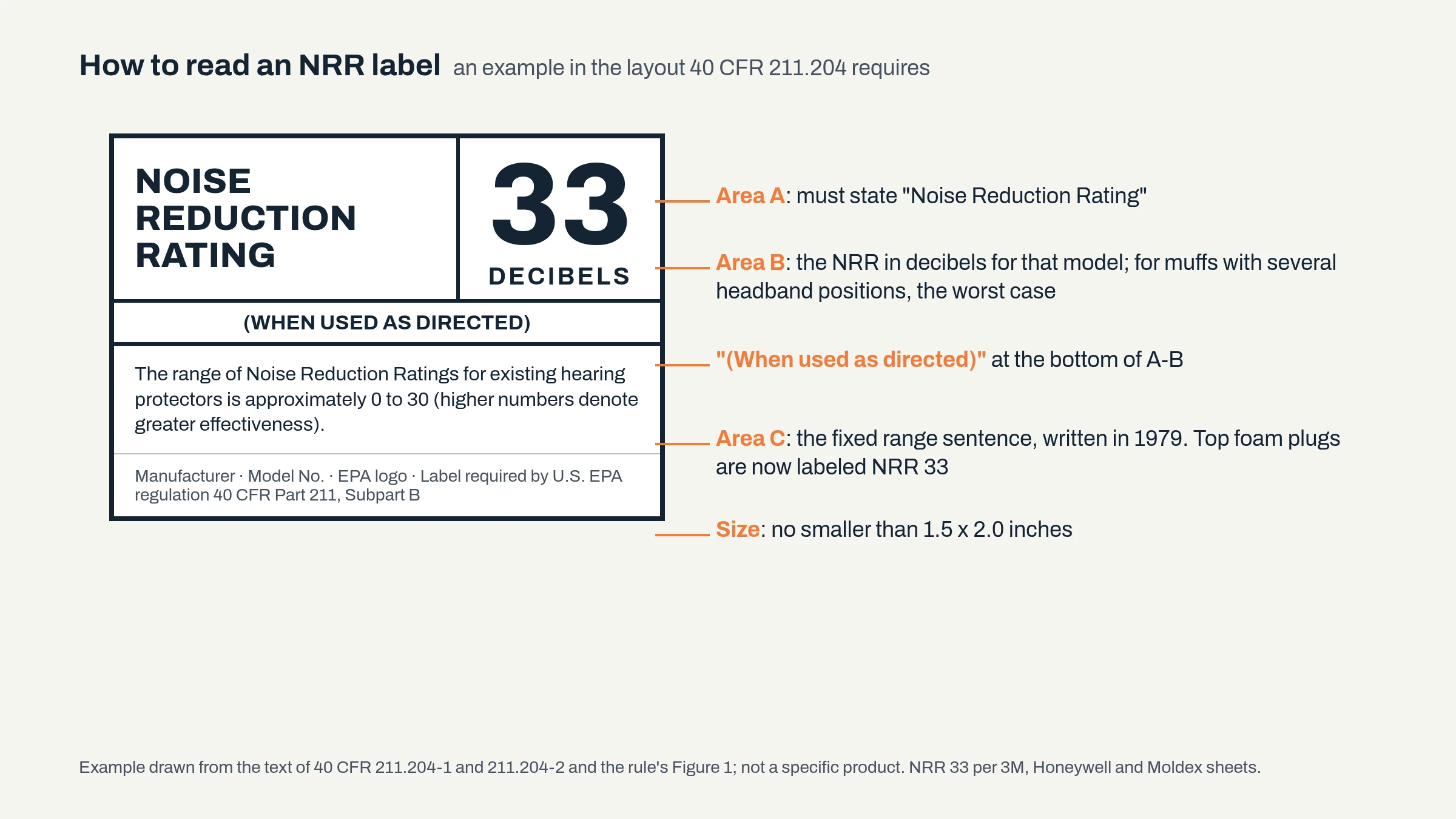
The label layout is fixed by the rule. One area must state "Noise Reduction Rating"; the next must state the NRR "in decibels for that model hearing protector," followed by "(When used as directed)." A third must read: "The range of Noise Reduction Ratings for existing hearing protectors is approximately 0 to 30 (higher numbers denote greater effectiveness)." For earmuffs with several headband positions, "the worst case NRR must be specified." The label must be at least 1.5 by 2.0 inches.[1]
The required text dates from 1979, and today's top ratings sit above its range. 3M's product line card lists its E-A-Rsoft Yellow Neons and E-A-R Classic Large plugs at 33 dB, Honeywell lists its Howard Leight MAX at NRR 33, and Moldex lists its Pura-Fit 6800 at NRR 33. For passive earmuffs the same sheets list NRR 30 to 31: Howard Leight L3 and T3 at 30, 3M PELTOR X5A at 31.[1][10][11][12]
Where the NRR comes from: the rule's calculation on a real data sheet
The test results behind the number must come with the protector. 40 CFR 211.204-4(a) requires "the mean attenuation and standard deviation values obtained for each test frequency" and "the NRR calculated from those values." Moldex prints that table on its Pura-Fit foam earplug data sheet: nine test frequencies from 125 to 8000 Hz, mean attenuation from 36.8 to 48.1 dB, standard deviations from 2.0 to 4.9 dB, and NRR 33.[1][13]
Figure 2 of 40 CFR 211.207 turns that table into the label number in nine steps. The figure assumes 100 dB of pink noise in each of seven octave bands, which adds up to 107.9 dB on the C scale. In each band the figure takes the mean attenuation minus two standard deviations and subtracts the result from the A-weighted noise. The seven bands under the protector are added together, and the NRR is 107.9 dB minus that sum minus 3 dB.[1]
We ran those steps on Moldex's Pura-Fit table. The seven bands under the plug add up to 72.1 dBA, so the result is 107.9 - 72.1 - 3 = 32.8 dB, which matches the NRR 33 on the sheet. The 1000 and 2000 Hz bands carry about 73 percent of the sound energy that gets past the plug in this calculation. With the mean attenuation alone and no standard deviations subtracted, the same steps give 38.4 dB.[1][13]
The rule's figure names 3000 and 6000 Hz, and the Moldex sheet lists 3150 and 6300 Hz. The working pairs 3150 with 4000 Hz and 6300 with 8000 Hz, the way the figure pairs its bands. The table below is our arithmetic on the maker's published numbers, not a test result.[1][13]
Scroll across to see every column →
| Octave band (Hz) | Mean attenuation (dB) | Two standard deviations (dB) | A-weighted pink noise (dB) | Under the plug (dBA) |
|---|---|---|---|---|
| 125 | 42.4 | 9.8 | 83.9 | 51.3 |
| 250 | 43.5 | 8.4 | 91.4 | 56.3 |
| 500 | 45.9 | 9.8 | 96.8 | 60.7 |
| 1000 | 39.8 | 6.8 | 100.0 | 67.0 |
| 2000 | 36.8 | 4.0 | 101.2 | 68.4 |
| 3150 and 4000 | 45.55 | 6.6 | 101.0 | 62.05 |
| 6300 and 8000 | 47.75 | 9.3 | 98.9 | 60.45 |
| All seven bands added | 72.1 |
How OSHA and NIOSH turn the NRR into protection
The EPA's required package text says the noise entering the ear "is closely approximated by the difference between the A-weighted environmental noise level and the NRR." OSHA's mandatory Appendix B to 29 CFR 1910.95 adds a correction: with a sound level meter on A-weighting, "Subtract 7 dB from the NRR, and subtract the remainder from the A-weighted TWA." With C-weighted levels, OSHA subtracts the NRR directly.[1][2]
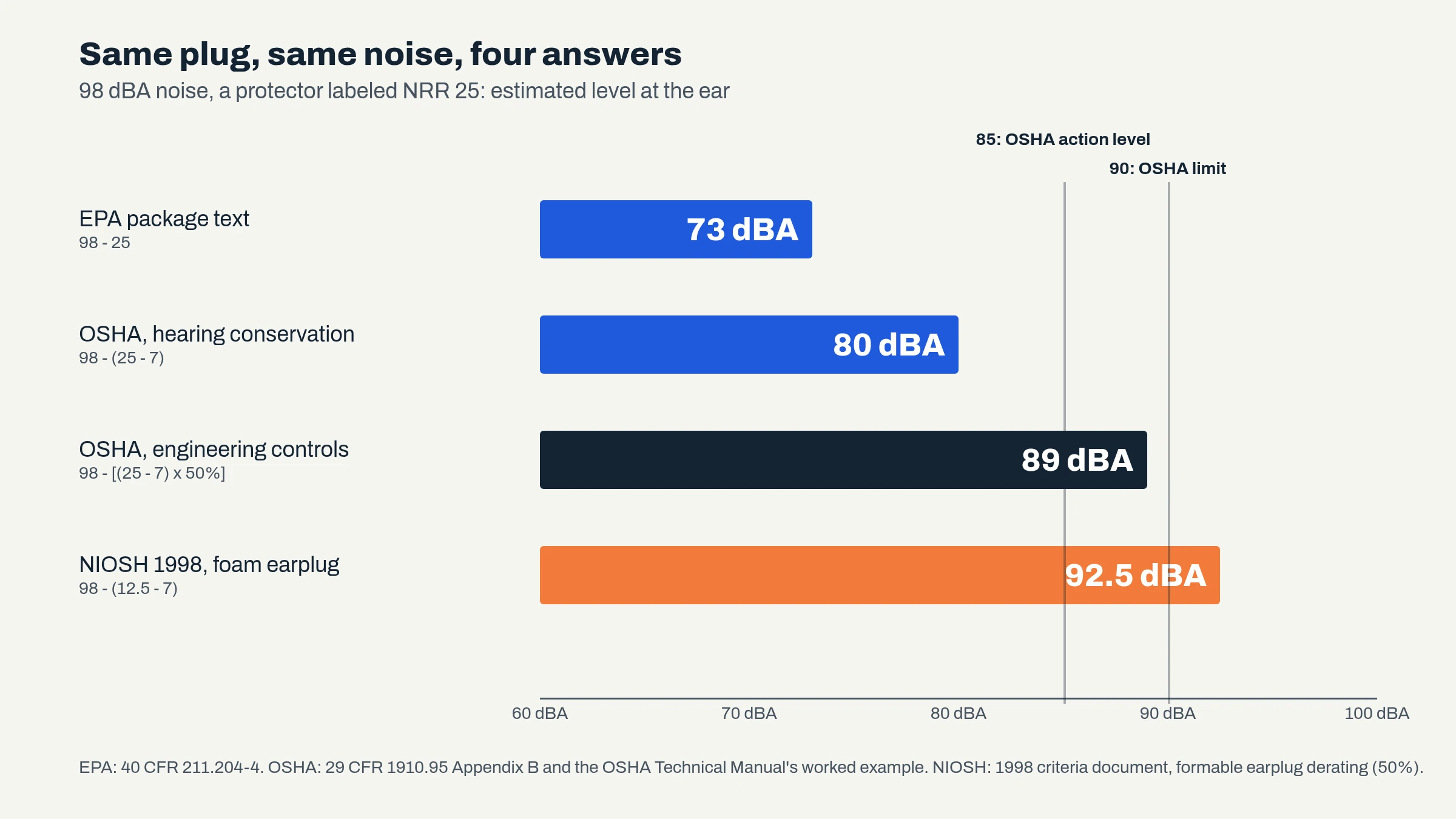
OSHA's Technical Manual applies a further 50 percent safety factor, but only for one question. It is "used when considering whether engineering controls are to be implemented"; when judging hearing protection for hearing conservation, inspectors "should only subtract 7dB from the NRR." Its worked example: at 98 dBA with an NRR of 25, the estimate is 89 dBA for the engineering-controls question and 80 dBA for hearing conservation.[3]
NIOSH's 1998 criteria document recommended its own derating: subtract 25 percent from the labeled NRR for earmuffs, 50 percent for slow-recovery formable earplugs and 70 percent for all other earplugs. NIOSH's current page says it "has previously recommended derating the NRR" but that "individual hearing protector fit testing is the best way to check if each worker is getting the amount of protection needed."[4][5]
Scroll across to see every column →
| Method | Formula | Estimated level at the ear |
|---|---|---|
| EPA package text | 98 - 25 | 73 dBA |
| OSHA Appendix B, hearing conservation | 98 - (25 - 7) | 80 dBA |
| OSHA Technical Manual, engineering controls | 98 - [(25 - 7) x 50%] | 89 dBA |
| NIOSH 1998, formable earplug (50% derating) | 98 - (12.5 - 7) | 92.5 dBA |
| NIOSH 1998, earmuff (25% derating) | 98 - (18.75 - 7) | 86.25 dBA |
What OSHA's two adjustments take off common NRR labels
OSHA's two adjustments answer two different questions. Appendix B to 29 CFR 1910.95 subtracts 7 dB from the NRR when the noise is measured in dBA. OSHA's Technical Manual halves what is left only "when considering whether engineering controls are to be implemented." For a label of NRR 33 the two figures are 26 dB and 13 dB.[2][3]
Paragraph (j) of 29 CFR 1910.95 sets what the estimate is held against. Protectors "must attenuate employee exposure at least to an 8-hour time-weighted average of 90 decibels," and for employees who have had a standard threshold shift, "to an 8-hour time-weighted average of 85 decibels or below."[2]
Scroll across to see every column →
| NRR on the label | OSHA Appendix B: NRR - 7 | OSHA Technical Manual, engineering controls: (NRR - 7) x 50% |
|---|---|---|
| 20 | 13 dB | 6.5 dB |
| 22 | 15 dB | 7.5 dB |
| 25 | 18 dB | 9 dB |
| 27 | 20 dB | 10 dB |
| 29 | 22 dB | 11 dB |
| 30 | 23 dB | 11.5 dB |
| 33 | 26 dB | 13 dB |
Why the label number is higher than real-world protection
OSHA's Technical Manual says the NRR "often did not reflect the actual level of protection," because most workers are not fit-tested and lab fitting does not match how workers put protectors in. It cites fit-test studies in which "roughly half of the workers achieve less than 5 to 15 dB of attenuation without training." NIOSH's 1998 document reports that "laboratory NRRs consistently overestimated the real-world NRRs by 140% to 2,000%."[3][4]
Wear time matters as much as the rating. NIOSH gives the arithmetic: a protector that "could optimally provide 30 dB of attenuation for an 8-hr exposure would effectively provide only 15 dB if the worker removed the device for a cumulative 30 min during an 8-hr day." NIOSH's own conclusion: "The best hearing protector is the one that the worker will wear."[4]
The EPA rule puts a fit warning with every protector: "Improper fit of this device will reduce its effectiveness in attenuating noise. Consult the enclosed instructions for proper fit." NIOSH's page describes the individual check: "Hearing protector fit testing generates a Personal Attenuation Rating (PAR). A PAR estimates an individual worker's reduction in noise exposure when using that hearing protector." OSHA's Technical Manual says fit testing "cannot be substituted for the NRR when assessing the adequacy of a given protector to reduce noise exposure; however, HPD fit-testing can be used in addition to NRR."[1][3][5]
Earplugs and earmuffs together: why it is only 5 dB more
Two protectors do not add their NRRs. OSHA's Technical Manual takes the higher NRR, subtracts 7 dB for A-weighted data, and adds 5 dB: "It is important to note that using such double protection will add only 5 dB of attenuation." Its example is 110 dBA with a plug rated 29 and a muff rated 25: 110 - [(29 - 7) + 5] = 83 dBA. NIOSH recommends double protection for workers whose 8-hour exposures exceed 100 dBA.[3][4]
Impulse and impact noise: what the NRR does not rate
The NRR is a rating for continuous noise. 40 CFR 211.204-4(f) requires this statement with every protector: "Although hearing protectors can be recommended for protection against the harmful effects of impulsive noise, the Noise Reduction Rating (NRR) is based on the attenuation of continuous noise and may not be an accurate indicator of the protection attainable against impulsive noise such as gunfire."[1]
OSHA's figure for that kind of noise is a peak, not an 8-hour average. The note under Table G-16 in 29 CFR 1910.95 reads: "Exposure to impulsive or impact noise should not exceed 140 dB peak sound pressure level." OSHA's Technical Manual gives "the impact of two metal objects" as an example of impact noise.[2][3]
The OSHA and NIOSH noise limits
Under 29 CFR 1910.95, an employer must run a hearing conservation program "whenever employee noise exposures equal or exceed an 8-hour time-weighted average sound level (TWA) of 85 decibels measured on the A scale," the action level. The permissible exposure limit is 90 dBA for 8 hours, with the allowed time halving for every 5 dB: 95 dBA for 4 hours, 100 dBA for 2. Protectors must bring exposure "at least to an 8-hour time-weighted average of 90 decibels."[2]
NIOSH's recommended limit is stricter: 85 dBA for 8 hours, halving the time for every 3 dB, so 100 dBA is allowed for 15 minutes. CDC lists printing presses, lawn mowers and power tools around 85 to 90 dBA, and bulldozers and chain saws at 95 dBA or more. NIOSH estimates that about 27 million workers are exposed to hazardous noise at work each year, and calls occupational hearing loss "one of the most common work-related illnesses."[6][7]
Scroll across to see every column →
| Noise level | OSHA 29 CFR 1910.95 | NIOSH REL |
|---|---|---|
| 85 dBA | Action level (hearing conservation program) | 8 hours |
| 88 dBA | 4 hours | |
| 90 dBA | 8 hours | |
| 91 dBA | 2 hours | |
| 94 dBA | 1 hour | |
| 95 dBA | 4 hours | |
| 97 dBA | 3 hours | 30 minutes |
| 100 dBA | 2 hours | 15 minutes |
| 105 dBA | 1 hour | |
| 115 dBA | 15 minutes or less | 28 seconds |
The NRR rule the EPA never changed
In 2009 the EPA proposed replacing the single NRR with a range: a lower number "achieved by at least 80 percent of the test subjects" and a higher one achieved by at least 20 percent, drawn as a bar on a 0 to 50 decibel scale, tested under ANSI/ASA S12.6. The notice said ANSI had withdrawn S3.19-1974, the test the rule still requires. The Unified Agenda shows the proposal "Withdrawn 06/30/2025": "No additional action has been taken since the initial proposal, therefore the agency is withdrawing this action."[8][9]
What Oakspan Supply sells
Oakspan Supply sells the supplies on a plant's list (gloves, labels, drums, pails, totes, boxes, tape) and quotes any item a buyer sends, earplugs and earmuffs included. Send the part number, a photo of the package or your last invoice to quotes@oakspansupply.com and our quotes desk prices the exact item.
Questions
What does NRR 33 mean on earplugs?
It is the Noise Reduction Rating in decibels from the lab test the EPA requires. Under OSHA's Appendix B, with noise measured in dBA, subtract 7 first: an NRR 33 plug in 100 dBA gives an estimate of 100 - (33 - 7) = 74 dBA, when fitted and worn as directed.[1][2]
How does OSHA use the NRR in dBA?
OSHA's Appendix B to 29 CFR 1910.95 says that when noise is measured with a sound level meter on A-weighting, subtract 7 dB from the NRR, then subtract the remainder from the A-weighted TWA. With C-weighted measurements, subtract the NRR directly.[2]
Do earplugs and earmuffs add up?
No. OSHA's Technical Manual adds only 5 dB to the better protector's field-adjusted NRR when both are worn.[3]
What is the highest NRR for earplugs?
On the maker sheets we read, the top foam earplugs are labeled NRR 33 (3M, Howard Leight and Moldex) and passive earmuffs NRR 30 to 31. Those are the makers' own figures; no government source names a market maximum.[10][11][12]
Is the NRR going to change?
Not under the 2009 proposal. The EPA withdrew it on June 30, 2025, so labels still use the 1979 rule and the ANSI S3.19-1974 test.[1][9]
Does OSHA cut the NRR in half?
Only for one question. OSHA's Technical Manual applies a 50 percent factor after the 7 dB subtraction "when considering whether engineering controls are to be implemented." For judging a protector in a hearing conservation program, Appendix B to 29 CFR 1910.95 subtracts 7 dB and nothing more. For NRR 33 that is 26 dB under Appendix B and 13 dB with the 50 percent factor.[2][3]
Does the NRR cover gunfire or impact noise?
The label rule says it may not. The statement 40 CFR 211.204-4(f) requires with every protector says the NRR "is based on the attenuation of continuous noise and may not be an accurate indicator of the protection attainable against impulsive noise such as gunfire." The note under Table G-16 in 29 CFR 1910.95 gives the figure for impulsive or impact noise as 140 dB peak sound pressure level.[1][2]
Can an earplug be labeled NRR 40 or NRR 50?
The EPA rule says the label value "must be no greater than the NRR value determined by using the computation method of § 211.207." Under that method an NRR of 50 would take about 52 dB of mean attenuation minus two standard deviations in every band. Moldex's NRR 33 table works out to between 32.6 and 39.0 dB per band, and 33 is the highest label on the maker sheets we read.[1][10][11][13]
Have a list of what you need? Our quotes desk prices the exact items.

Written by Anastasiia Kuziak, Manager and President of Oakspan Supply. She has a business degree, owns a small business of her own, and has more than five years in medical and pharmaceutical sales. How we write and check our guides.
Sources
- 40 CFR Part 211 Subpart B, Hearing Protective Devices. Electronic Code of Federal Regulations. Accessed 2026-11-17.
- 29 CFR 1910.95, Occupational noise exposure, with Appendix B. Electronic Code of Federal Regulations. Accessed 2026-11-17.
- OSHA Technical Manual, Section III Chapter 5: Noise (Appendix F, Noise Reduction Rating). Occupational Safety and Health Administration. Accessed 2026-11-17.
- Criteria for a Recommended Standard: Occupational Noise Exposure, Revised Criteria 1998 (DHHS (NIOSH) Publication 98-126). National Institute for Occupational Safety and Health. Accessed 2026-11-12.
- Hearing protection devices. National Institute for Occupational Safety and Health. Accessed 2026-11-17.
- About noise and occupational hearing loss. National Institute for Occupational Safety and Health. Accessed 2026-11-12.
- Noise and occupational hearing loss: noise levels. National Institute for Occupational Safety and Health. Accessed 2026-11-12.
- EPA proposed rule revising the noise labeling standards for hearing protection devices, 74 FR 39150, August 5, 2009 (FR Doc E9-18003). Federal Register. Accessed 2026-11-12.
- Unified Agenda entry, RIN 2060-AO25 (Spring 2025). Office of Information and Regulatory Affairs. Accessed 2026-11-12.
- 3M hearing protection product line card (US). 3M. Accessed 2026-11-12.
- Howard Leight hearing protection mini guide (US). Honeywell. Accessed 2026-11-12.
- Pura-Fit uncorded disposable foam earplug 6800. Moldex. Accessed 2026-11-12.
- Pura-Fit disposable foam earplugs data sheet with attenuation data (9700-769 REV K, 10/19). Moldex. Accessed 2026-11-17.
Written from the sources above under our editorial policy. Published November 12, 2026, last updated November 17, 2026. Spot an error? Send us a correction and we fix it and note the date.
- Safety and cleanup supplies: gloves, arm sleeves, paper towels
- Cut-resistant glove levels: A1 to A9 explained
- Hi-vis vest classes: Class 1, 2 and 3 explained
- What Z87 and Z87+ mean on safety glasses
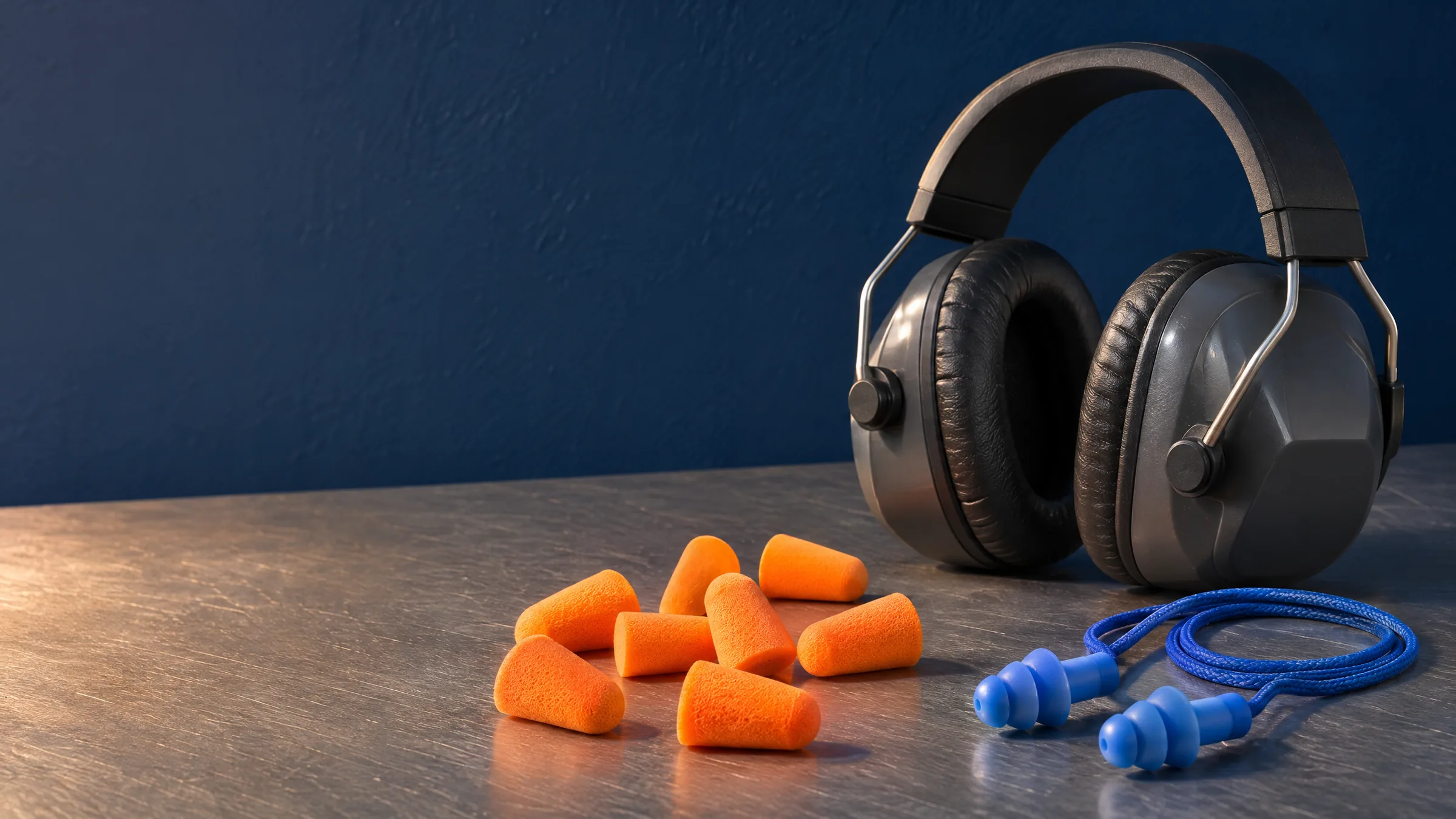
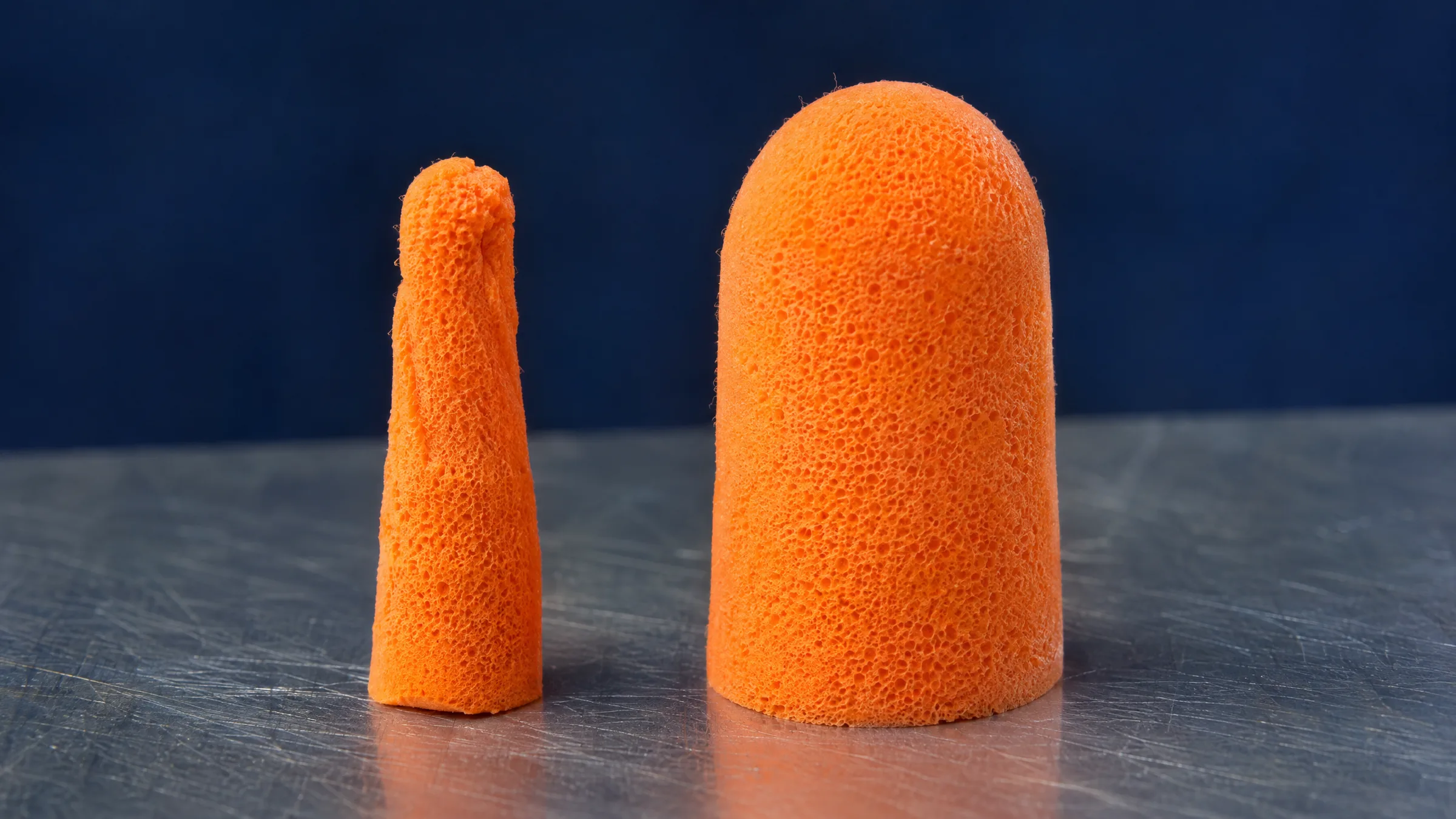
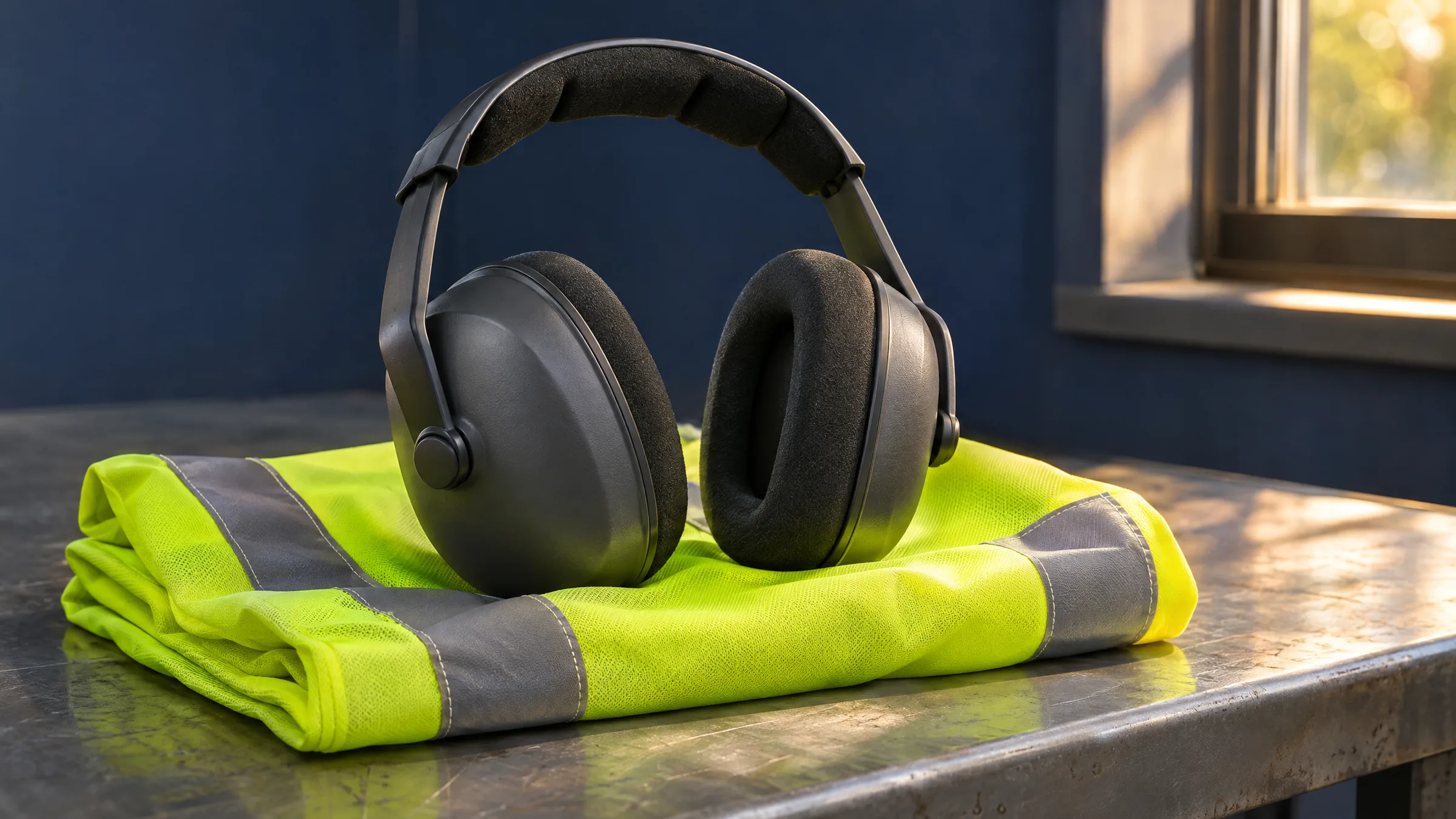
The photos on this page are AI images of generic hearing protection, not a specific product. The diagrams are drawn from the figures in the sources.