








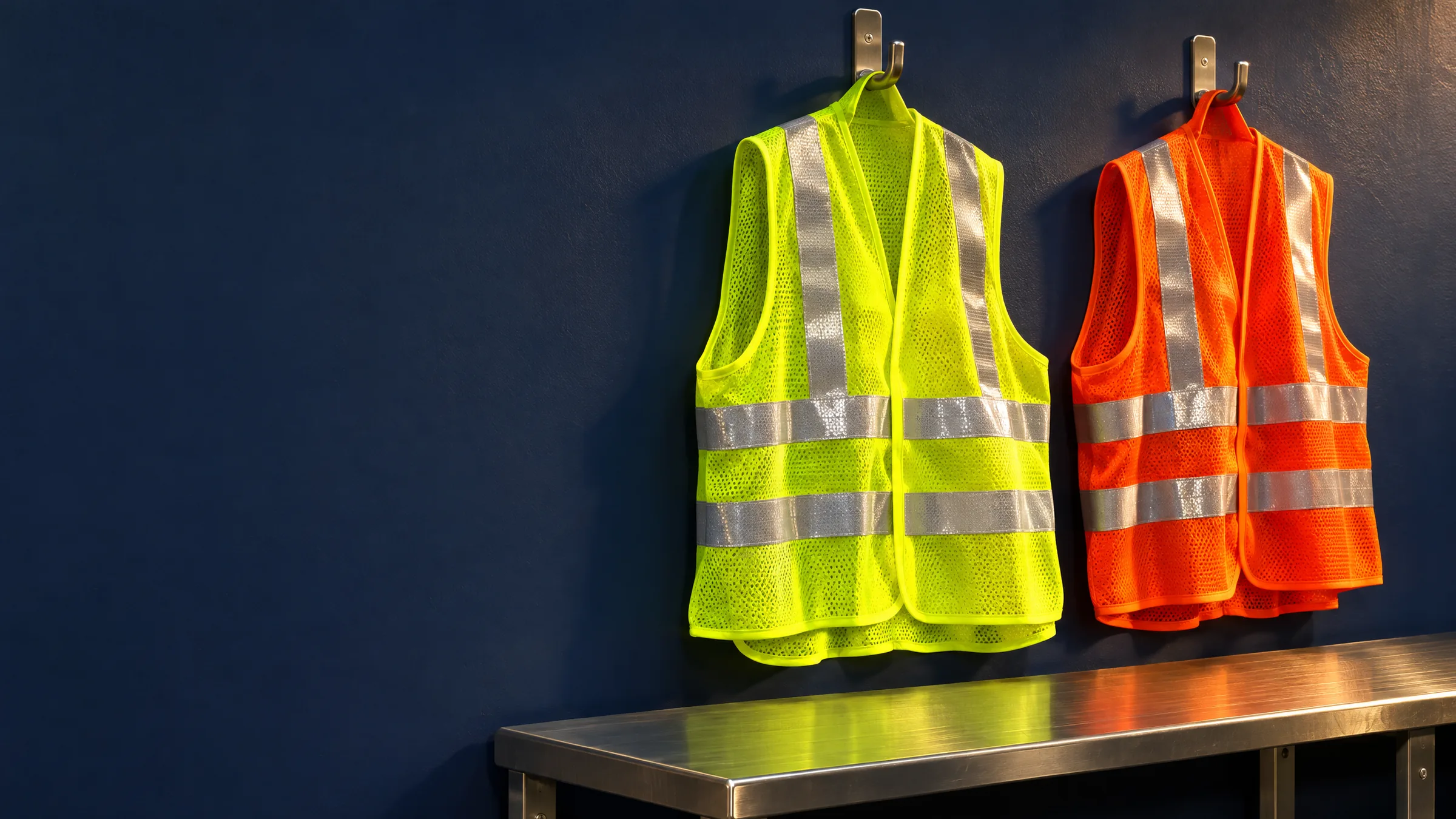
Hi-vis vest classes come from ANSI/ISEA 107, the American National Standard for high-visibility safety apparel: Class 1, 2 and 3 set the minimum area of fluorescent background and reflective material, and Class 3 needs the most. Type O, R and P say where the garment is meant to be worn, and a vest alone can never be Class 3, because Class 3 needs sleeves.[1][3][4]
Edition
107-2026Released October 2026; garments labeled to 2020 stay in use alongside it.[1]
Free. Just your work email.
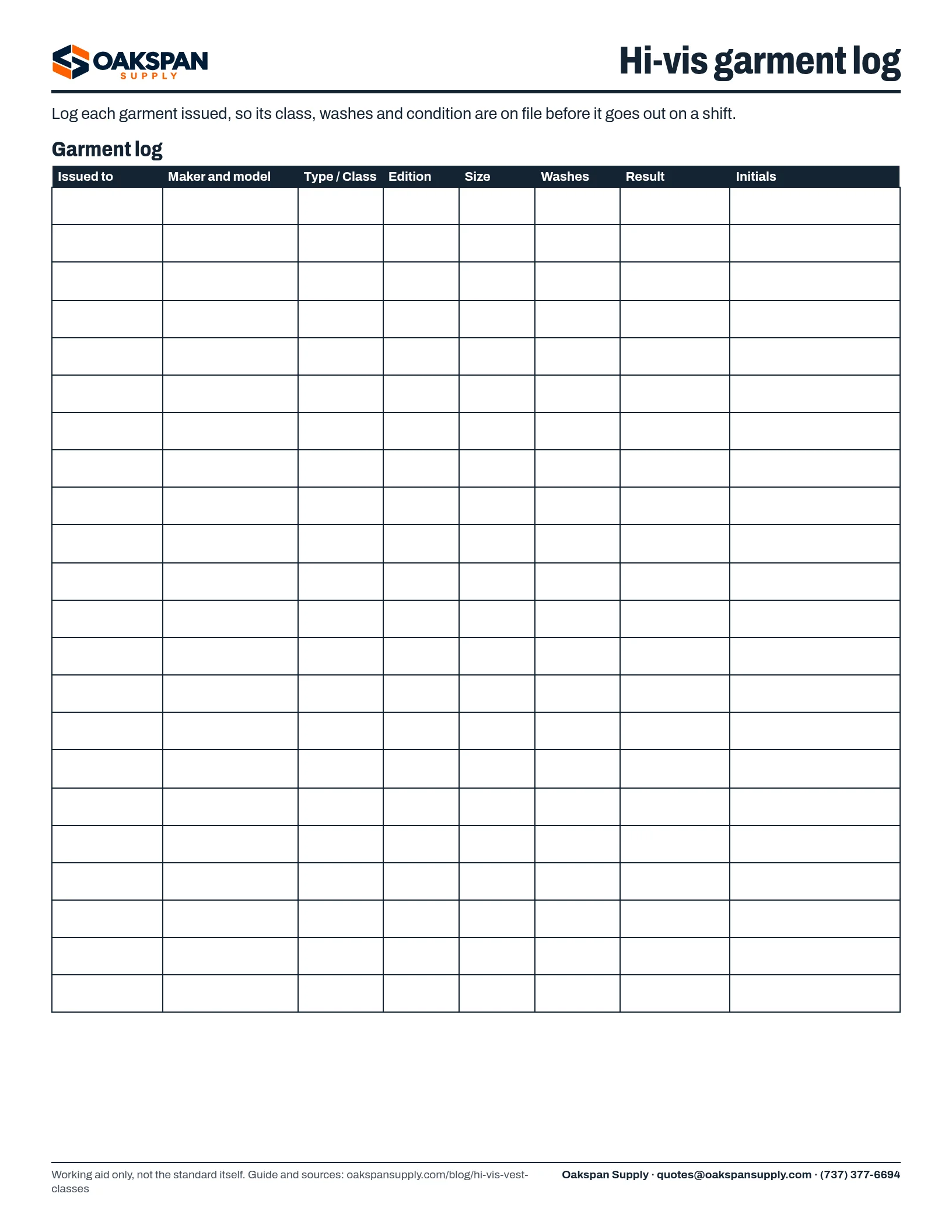
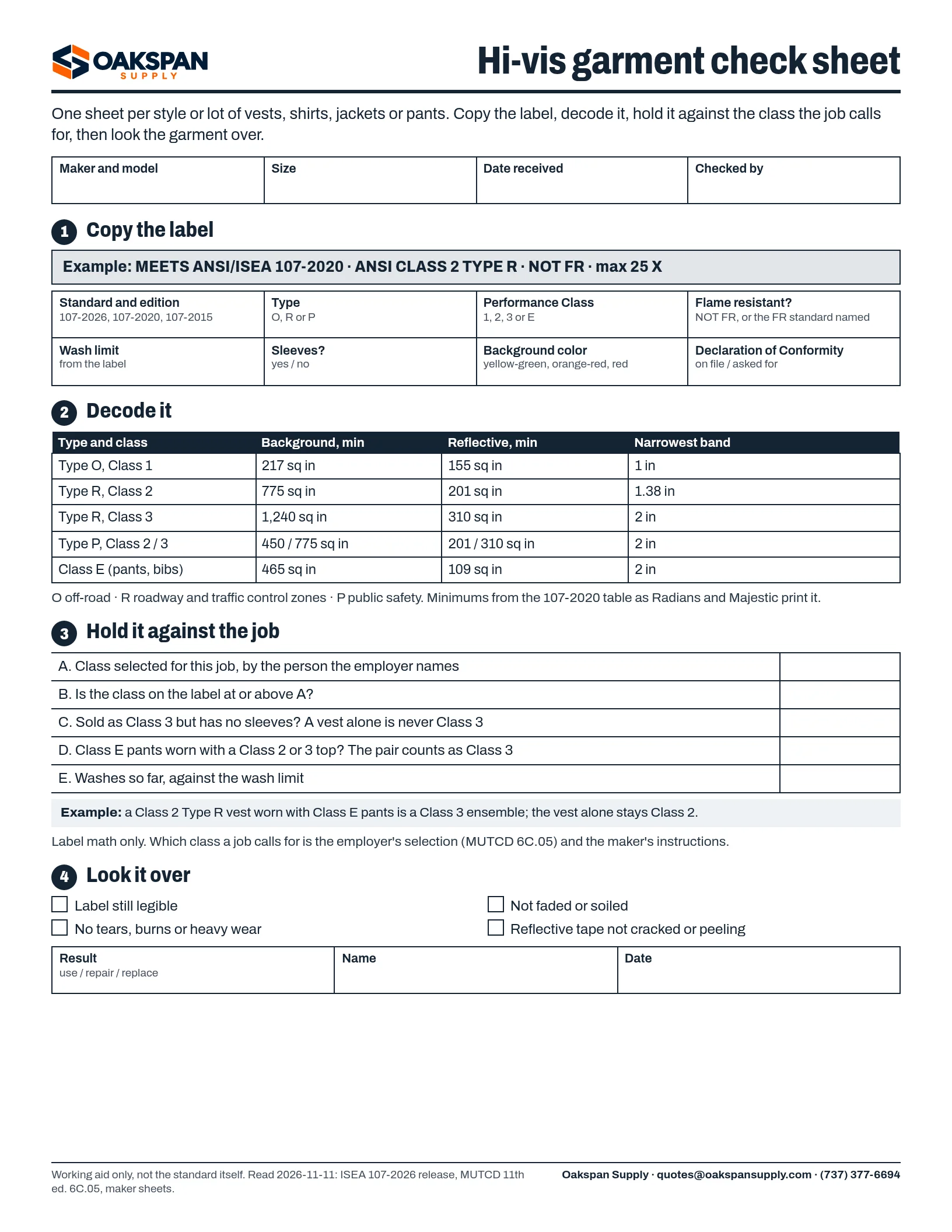
Print the hi-vis garment check sheet
A two-page sheet: copy a vest's label, decode the type and class, hold it against the class the job calls for, and log every garment issued.
- Copy the label: edition, type, class, FR, wash limit
- Decode the minimum areas for each class
- Catch a sleeveless vest sold as Class 3
- Log washes and condition per garment
Two pages, letter size. The sheet downloads right away. We'll send you the occasional supply guide and may use your email to show you our ads. Unsubscribe any time. Privacy policy.
What Class 1, 2 and 3 mean on a hi-vis vest
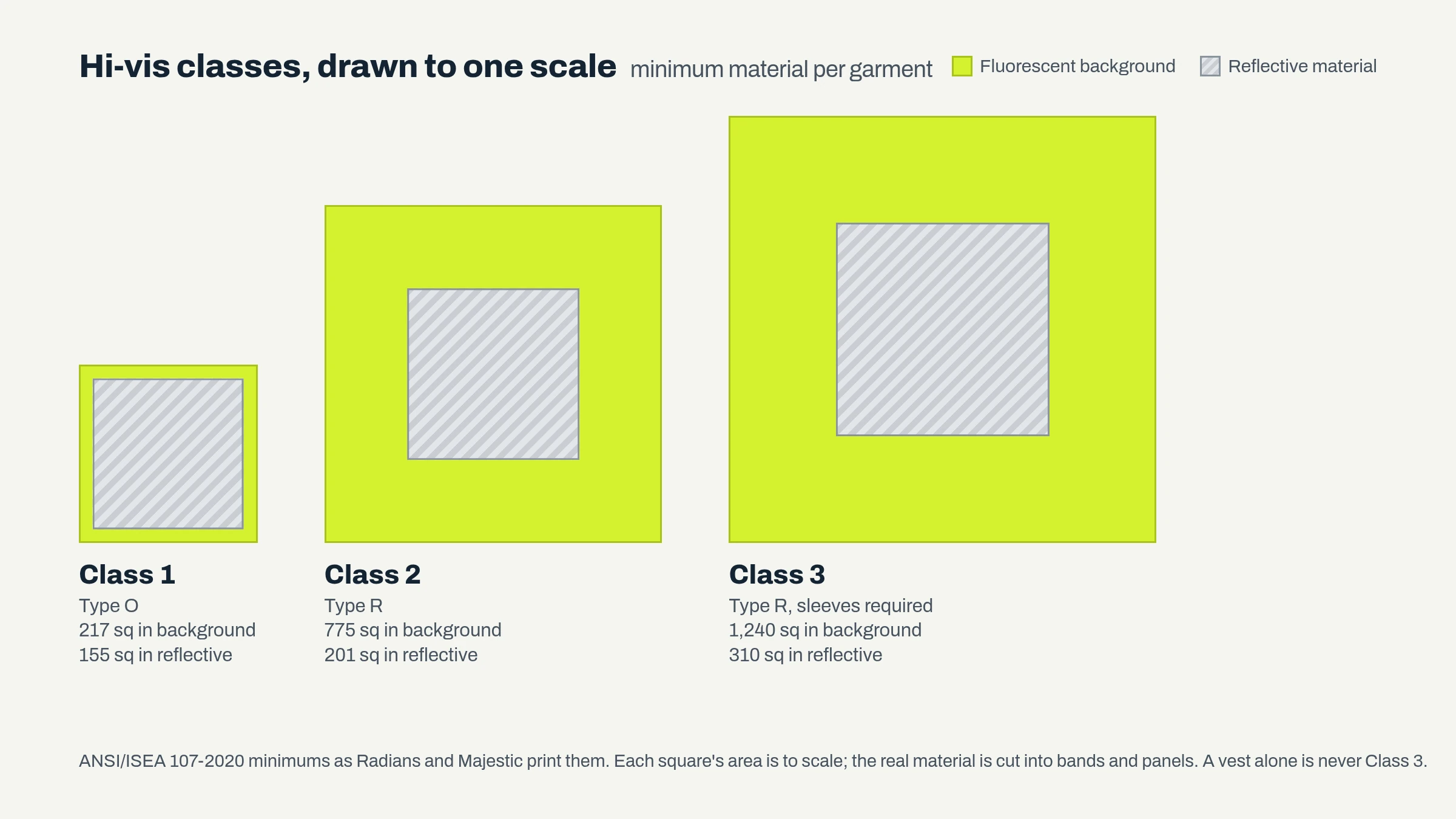
The class on a hi-vis vest is its Performance Class under ANSI/ISEA 107, the American National Standard for High-Visibility Safety Apparel published by the International Safety Equipment Association (ISEA). ISEA says the standard defines garment types and performance classes and sets requirements for background material, retroreflective material, garment design, marking, testing and care. The class sets how much fluorescent background and how much reflective tape a garment must carry: Class 1 the least, Class 3 the most.[2][3]
The 2026 edition kept the system. ISEA's release reads: "The familiar Type O, Type R, and Type P system remains, as do Performance Classes 1, 2, 3, and E. The three approved fluorescent background colors — fluorescent yellow-green, fluorescent orange-red, and fluorescent red — also remain unchanged." The table below is the 107-2020 minimum-area table as Radians and Majestic print it on their own sheets; the 2026 text is sold by ISEA.[1][3][5]
Scroll across to see every column →
| Garment type and class | Fluorescent background | Reflective material | Narrowest reflective band |
|---|---|---|---|
| Type O, Class 1 garment | 217 sq in (0.14 m²) | 155 sq in (0.10 m²) | 1 in (25 mm) |
| Type R, Class 2 garment | 775 sq in (0.50 m²) | 201 sq in (0.13 m²) | 1.38 in (35 mm) |
| Type R, Class 3 garment | 1,240 sq in (0.80 m²) | 310 sq in (0.20 m²) | 2 in (50 mm) |
| Type P, Class 2 garment | 450 sq in (0.29 m²) | 201 sq in (0.13 m²) | 2 in (50 mm) |
| Type P, Class 3 garment | 775 sq in (0.50 m²) | 310 sq in (0.20 m²) | 2 in (50 mm) |
| Class E (pants, bibs, shorts, gaiters) | 465 sq in (0.30 m²) | 109 sq in (0.07 m²) | 2 in (50 mm) |
Type O, Type R and Type P: where the garment is worn
The type says where a garment is meant to be worn. In Radians' summary of the 2020 wording, Type O (off-road) garments are for work around moving vehicles, equipment and machinery, away from traffic on a public road or in a roadway temporary traffic control (TTC) zone; Type O garments come only in Class 1. Type R (roadway) garments cover exposure to public-road traffic, TTC zones and the work vehicles and equipment inside them, in Class 2 or 3. Type P (public safety) garments are for emergency responders and law enforcement, in Class 2 or 3.[3][4]
Radians' sheet describes Class 1 as "the minimum amount of high-visibility materials required to differentiate the wearer visually from non-complex work environments where struck-by hazards will not be approaching at roadway speeds." Radians lists warehouse, mining and petrochemical work as Type O examples, and roadway construction, airline ramp and flagger work under Type R.[3][4]
Why a vest alone is never Class 3
A Class 3 garment puts background and reflective material on the sleeves. Radians quotes the standard: "Regardless of the area of materials used, a sleeveless garment or vest alone shall not be considered Performance Class 3." Radians dates the sleeve requirement for every Class 3 garment to the 2004 edition. A garment sold as Class 3 is a sleeved vest, a T-shirt, a jacket or a coverall.[3][4]
Class E garments are the other route to a Class 3 ensemble. Pants, bib overalls, shorts and gaiters are Class E, which is never worn alone to meet the requirement. For the two garments together, Radians quotes the rule: "When a Class E item is worn with Performance Class 2 or Class 3, the overall classification shall be Performance Class 3." A Class 2 vest worn with Class E pants is a Class 3 ensemble.[4][5]
How to read the label inside a hi-vis vest
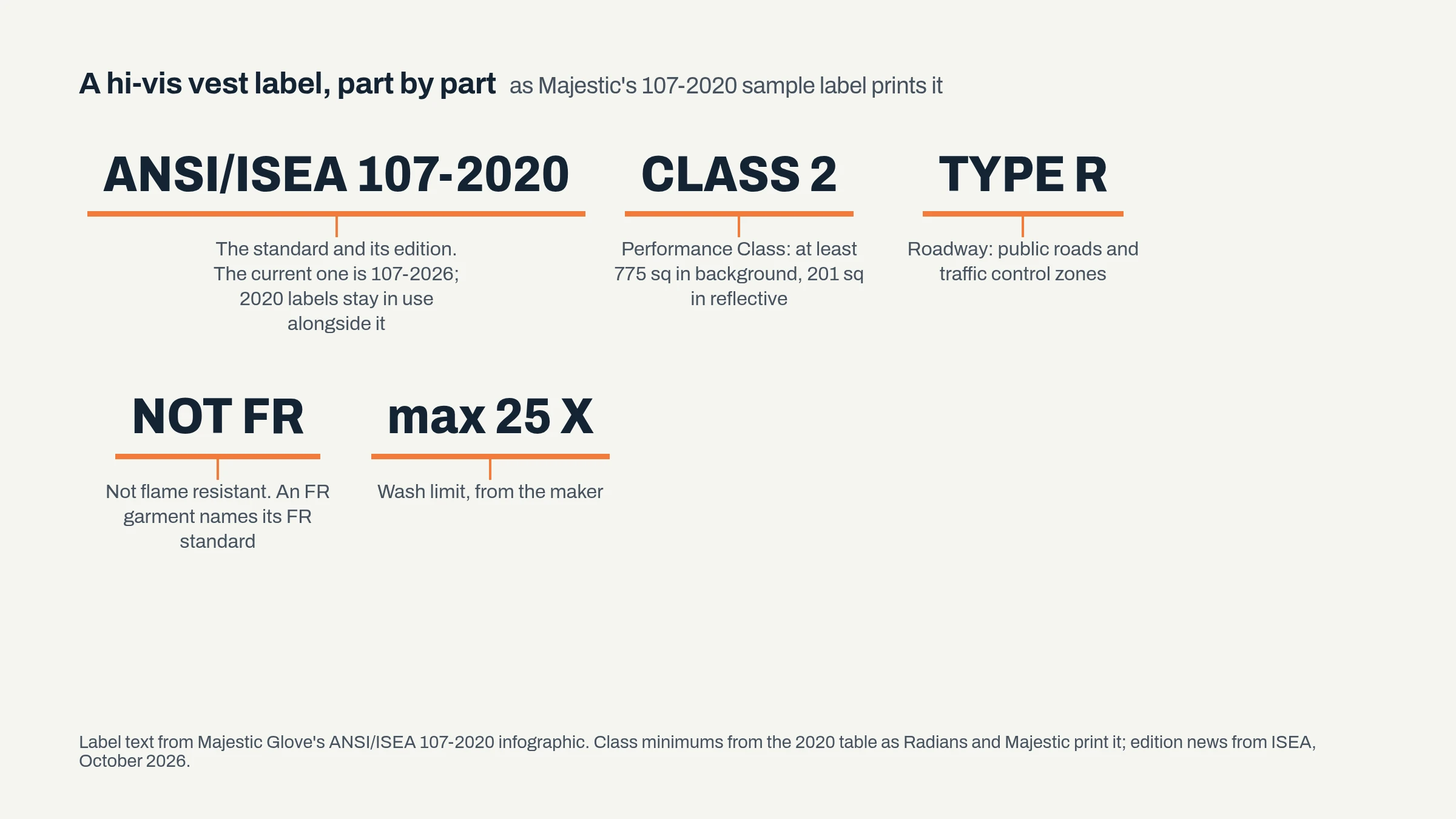
The label names the standard, the type and the class. Majestic's sample label for its 2020 vests reads "MEETS ANSI/ISEA 107-2020" with a badge reading "ANSI CLASS 2 TYPE R", and "NOT FR" with the line "This garment is not flame resistant as defined by ANSI/ISEA 107-2020 section 10.5." Radians' SV2 sheet prints the marking as TYPE R / CLASS 2 over ANSI/ISEA 107-2020. A garment sold for flame-resistant use carries its FR standard on the label as well; ISEA's 2026 update cites NFPA 1950-2025 and NFPA 2112-2023.[1][5][6]
The label also carries the wash limit. Majestic's reads "Wash Warm -- max 25 X", Radians' SV2 sheet lists a 25-wash maximum, and Ergodyne's instructions say its garments "may be washed up to 25 cycles unless noted differently on garment label." Under the 2026 edition the markings must stay legible for the life of the garment, and the maker must provide a Declaration of Conformity for each style or model on request.[1][5][6][8]
A Declaration of Conformity shows the measured areas. Ergodyne's December 2025 declaration for its GloWear 8210HLW women's Type R, Class 2 vest lists 699.3 sq in of background in size S and 777.3 sq in in size M, and 204.3 and 207.3 sq in of reflective material. Size S comes in under 775 sq in; the 2020 table lets the smallest size offered of a Type R Class 2 garment use 540 sq in of background, and ISEA says the 2026 edition extends that allowance to sizes through Medium.[1][5][7]
Which edition the rules cite: MUTCD 6C.05 and OSHA
On roads, the rule is Section 6C.05 of the Manual on Uniform Traffic Control Devices (MUTCD), 11th Edition with Revision 1 (December 2025). It reads: "For daytime and nighttime activity, all workers, including emergency responders, within the right-of-way who are within the TTC zone shall wear high-visibility safety apparel that meets the Performance Class 2 or 3 requirements of the ANSI/ISEA 107–2015 publication entitled 'American National Standard for High-Visibility Safety Apparel and Headwear,' or equivalent revisions." The same paragraph adds: "A person designated by the employer to be responsible for worker safety shall make the selection of the appropriate class of garment."[9]
Section 6C.05 sets the colors: "The apparel background (outer) material color shall be fluorescent orange-red, fluorescent yellow-green, or a combination of the two as defined in the ANSI standard." For flaggers at night it gives guidance (should, not shall): Class 3 apparel "labeled as meeting the ANSI 107-2015 standard performance for Class 3 risk exposure should be worn." Section 7D.02 of the same manual has adult crossing guards wear apparel labeled ANSI 107-2020, Class 2, Type R.[9]
OSHA's construction rules point to the MUTCD. 29 CFR 1926.201(a) reads: "Signaling by flaggers and the use of flaggers, including warning garments worn by flaggers, shall conform to Part 6 of the MUTCD," and 29 CFR 1926.6 incorporates the 2009 MUTCD, not the 11th edition. For excavations, 29 CFR 1926.651(d) reads: "Employees exposed to public vehicular traffic shall be provided with, and shall wear, warning vests or other suitable garments marked with or made of reflectorized or high-visibility material."[10][11][12]
OSHA's letter of interpretation of August 5, 2009 covers construction workers in highway work zones who are neither flaggers nor at excavations. It reads: "high-visibility apparel is required under the General Duty Clause to protect employees exposed to the danger of being struck by public and construction traffic while working in highway/road construction work zones." The letter names no class and no edition of the standard.[19]
The federal rule many older sheets still quote, 23 CFR Part 634, is gone. It required Class 2 or 3 garments to ANSI/ISEA 107-2004 on federal-aid highways from November 24, 2008; the 2009 MUTCD final rule removed Part 634, effective January 15, 2010, and moved the requirement into the MUTCD for all roads open to public travel.[13]
Class and traffic speed: what the rule texts say
Radians' history of the standard says the first edition, ANSI/ISEA 107-1999, "was limited to three classes defined by potential exposure to traffic speed." Radians' sheets for the 2020 edition describe each type by where the work is done and print no miles-per-hour figure. The one speed phrase on them is "roadway speeds," in the Class 1 description.[3][4]
Section 6C.05 of the MUTCD has seven paragraphs, and none of them names a speed. In the whole manual, apparel classes appear only in Section 6C.05 and in Section 7D.02 for crossing guards. The ANSI/ISEA 107 text itself is sold by ISEA and we have not read it; the table below covers the rule texts that are open to read.[9]
Section 6C.05 also sets the stripe colors and two options. "The retroreflective material shall be orange, yellow, white, silver, yellow-green, or a fluorescent version of these colors." Emergency and incident responders and law enforcement personnel in the TTC zone "may wear high-visibility safety apparel that meets the performance requirements of the ANSI/ISEA 207-2006 publication entitled 'American National Standard for High-Visibility Public Safety Vests,' or equivalent revisions." Firefighters "engaged in emergency operations that directly expose them to flame, fire, heat, and/or hazardous materials" may wear retroreflective turnout gear "that is specified and regulated by other organizations, such as the National Fire Protection Association."[9]
Scroll across to see every column →
| Rule text | Who it covers | Class it names | Speed it names |
|---|---|---|---|
| MUTCD 6C.05, paragraph 1 (Standard) | All workers, including emergency responders, within the right-of-way who are within the TTC zone | Performance Class 2 or 3 of ANSI/ISEA 107-2015, or equivalent revisions | None |
| MUTCD 6C.05, paragraph 4 (Option) | Emergency and incident responders and law enforcement personnel within the TTC zone | May wear ANSI/ISEA 207-2006 public safety vests instead | None |
| MUTCD 6C.05, paragraph 7 (Guidance) | Flaggers during nighttime activity | Performance Class 3 "should be worn" | None |
| MUTCD 7D.02, paragraph 1 (Standard) | Adult crossing guards and law enforcement officers supervising school crossings | ANSI 107-2020, Class 2, Type R | None |
| 29 CFR 1926.201(a) | Flaggers on construction work | None in the rule; it points to Part 6 of the MUTCD | None |
| 29 CFR 1926.651(d) | Employees at excavations exposed to public vehicular traffic | None: "warning vests or other suitable garments marked with or made of reflectorized or high-visibility material" | None |
| OSHA letter of interpretation, August 5, 2009 | Construction workers in highway and road work zones | None | None |
Why the colors glow and the stripes light up
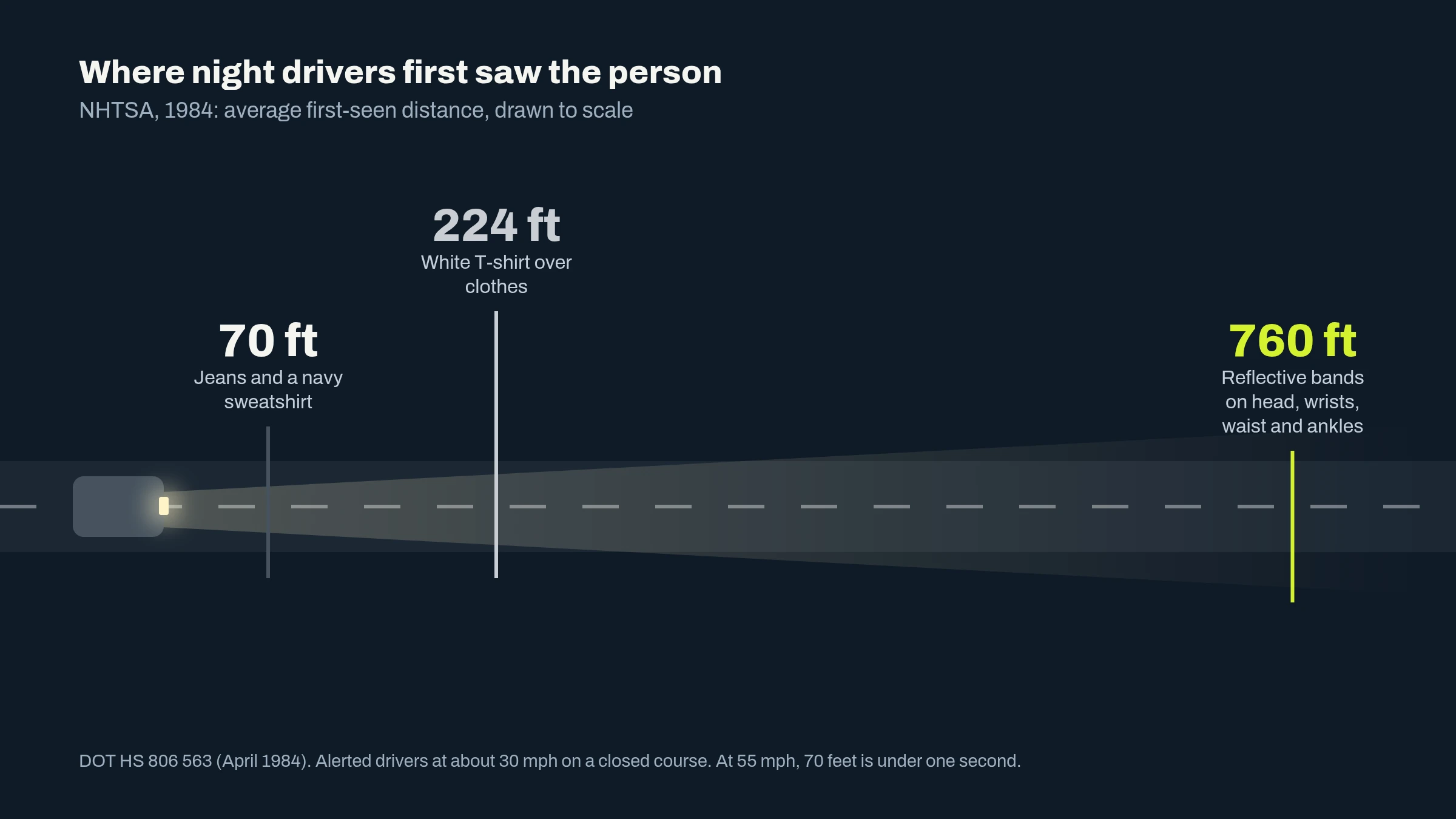
Dark clothes at night are close to invisible. In a 1984 NHTSA test, alerted drivers first saw a person in blue jeans and a navy sweatshirt at an average of 70.33 feet; the report says that at 55 mph "this represents less than one second from detection to target." The same test put reflective bands on the head, wrists, waist and ankles, and the average detection distance rose to 759.56 feet. A 2003 University of Michigan track study of ANSI/ISEA 107 Class 2 and 3 garments found any reflective trim "improved detection distance by as much as a factor of 7.8 when compared with a darkly clad pedestrian."[14][15]
The fluorescent colors started in a pharmacy. The American Chemical Society's landmark page tells how Bob Switzer, recovering from a fractured skull in 1933, and his brother Joe studied fluorescence with a black light among the materials in their family's pharmacy; Joe's magic act with fluorescent costumes won a prize for best illusion in 1934. In World War II, troops in North Africa used DayGlo fluorescent fabric panels to show Allied aircraft they were friendly. The reflective tape started with a failure: 3M writes that its first reflective road marking, laid in Minnesota in 1938, peeled off the road and stuck to a fence post, "and the idea of reflective sheeting was born." 3M dates its reflective material on clothing to 1951.[16][17]
Yellow-green also sits where daylight vision is most sensitive. NIST, the US measurement agency, defines the eye's daylight response as "normalized to unity at its peak, 555 nm," a yellow-green wavelength, and ties the candela, the unit of light intensity, to green light at 555.016 nm.[18]
When a hi-vis vest needs replacing
Ergodyne's instructions read: "High visibility garments should be repaired or replaced such as when they are torn, noticeably faded, soiled, cracked, burned, heavily abraded, or damaged." Majestic's label carries the American Traffic Safety Services Association line that a garment "should be replaced when it becomes faded, torn, dirty, soiled, worn or defaced, or it is not visible at 1,000 feet day or night."[5][8]
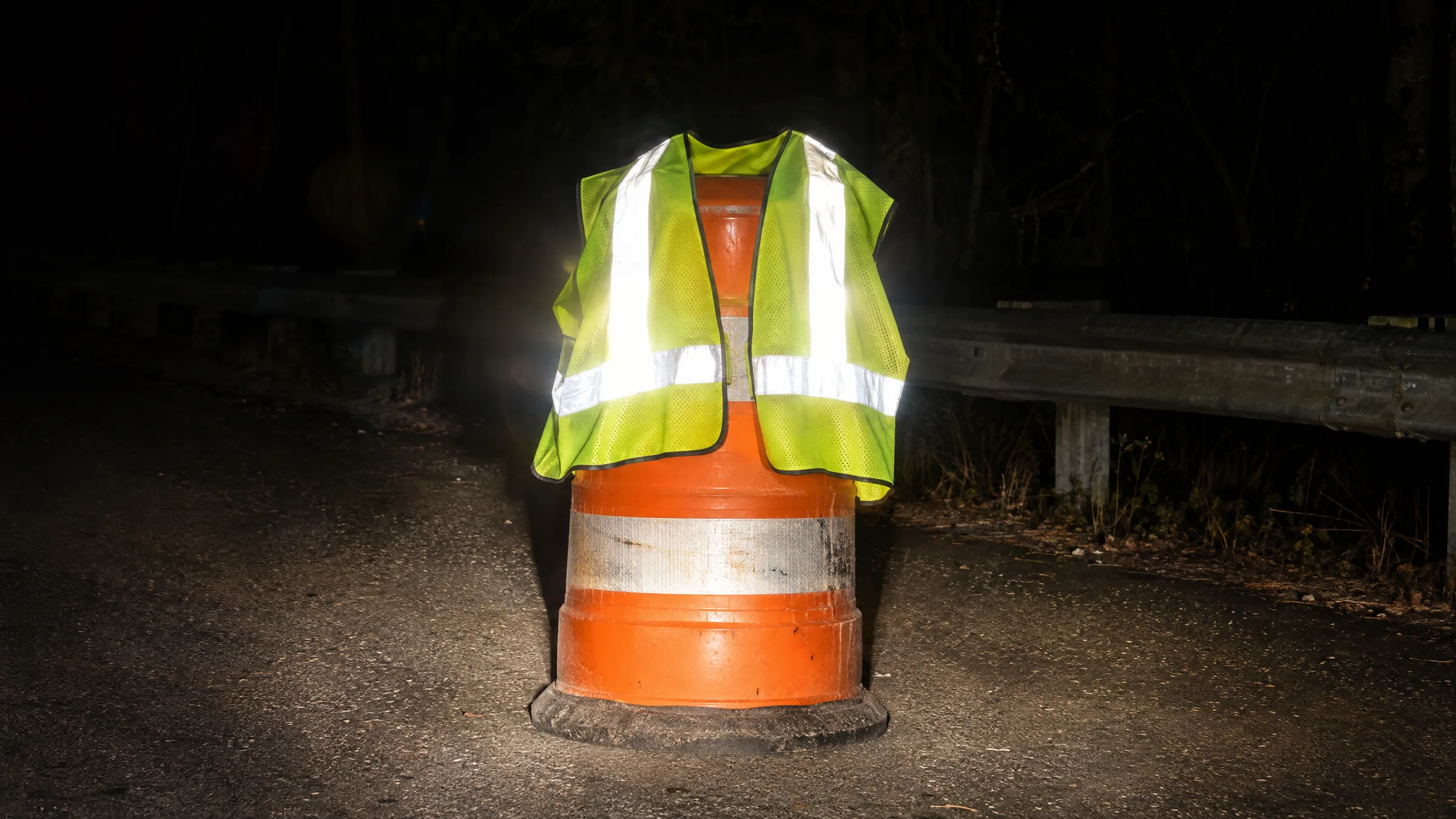
What Oakspan Supply sells
Oakspan Supply sells the supplies on a plant's list (gloves, labels, drums, pails, totes, boxes, tape) and quotes any item a buyer sends, hi-vis vests included. Send the part number, a photo of the label or your last invoice to quotes@oakspansupply.com and our quotes desk prices the exact item.
For gloves, our guide to ANSI/ISEA 105-2024 decodes the A1 to A9 cut levels and EN 388 codes like 4X42D the same way.
For hearing protection, our guide to the NRR explains the number on every earplug and earmuff package and OSHA's 7 dB adjustment.
Questions
Is there such a thing as a Class 3 vest?
Not a vest alone. ANSI/ISEA 107 puts material on the sleeves for Class 3, and the standard, as Radians quotes it, says a sleeveless garment or vest alone shall not be considered Performance Class 3. A sleeved vest, shirt, jacket or coverall can be Class 3, and a Class 2 vest worn with Class E pants makes a Class 3 ensemble.[3][4]
What is the difference between a Class 2 and a Class 3 safety vest?
The amount of material and the sleeves. In the 2020 table a Type R Class 2 garment carries at least 775 sq in of fluorescent background and 201 sq in of reflective material; Type R Class 3 carries 1,240 and 310 sq in, with material on the sleeves.[3][5]
What does Type R mean on a safety vest?
Type R is the roadway type: garments for work exposed to traffic on public roads, in temporary traffic control zones, or from work vehicles and equipment inside those zones. Type R garments come in Class 2 or Class 3.[4]
What is the current edition of ANSI/ISEA 107?
ANSI/ISEA 107-2026, released by ISEA in October 2026. It kept Types O, R and P, Classes 1, 2, 3 and E and the three background colors, and ISEA says garments labeled to the 2020 edition coexist with it during a transition period. MUTCD Section 6C.05 still cites the 2015 edition "or equivalent revisions."[1][9]
How many times can a hi-vis vest be washed?
The label says. The vests on Majestic's, Radians' and Ergodyne's sheets give a 25-wash maximum, and Ergodyne's instructions say up to 25 cycles unless the garment label says otherwise.[5][6][8]
How many classes of hi-vis clothing are there?
Four performance classes: 1, 2, 3 and E. ISEA's 2026 release lists "Performance Classes 1, 2, 3, and E" alongside Types O, R and P. Class E covers pants, bib overalls, shorts and gaiters, and Radians' sheet shows a Class 2 garment plus a Class E item as a Class 3 ensemble.[1][3]
Does the class of a hi-vis vest depend on traffic speed?
No rule text we could open sets a class by miles per hour. MUTCD Section 6C.05 names Performance Class 2 or 3 for workers in a temporary traffic control zone and names no speed. Radians writes that the 1999 edition of ANSI/ISEA 107 defined its three classes by exposure to traffic speed; Radians' sheets for the 2020 edition print no miles-per-hour figure. The ANSI/ISEA 107 text is sold by ISEA and we have not read it.[3][4][9]
What colors can a hi-vis vest be?
ISEA lists three approved fluorescent background colors: yellow-green, orange-red and red. MUTCD Section 6C.05 names two for workers in a temporary traffic control zone: fluorescent orange-red, fluorescent yellow-green, or a combination of the two. OSHA's excavation rule, 29 CFR 1926.651(d), names no color: "warning vests or other suitable garments marked with or made of reflectorized or high-visibility material."[1][9][12]
Where do OSHA's rules mention hi-vis vests?
In two construction rules. 29 CFR 1926.201(a) covers flaggers' warning garments by pointing to Part 6 of the MUTCD, and 29 CFR 1926.651(d) covers employees at excavations who are exposed to public vehicular traffic. For other construction workers in highway work zones, OSHA's letter of August 5, 2009 says high-visibility apparel "is required under the General Duty Clause."[10][12][19]
Have a list of what you need? Our quotes desk prices the exact items.

Written by Anastasiia Kuziak, Manager and President of Oakspan Supply. She has a business degree, owns a small business of her own, and has more than five years in medical and pharmaceutical sales. How we write and check our guides.
Sources
- Updated High-Visibility Safety Apparel Standard (ANSI/ISEA 107-2026), October 26, 2026. International Safety Equipment Association. Accessed 2026-11-17.
- ANSI/ISEA 107-2026, American National Standard for High-Visibility Safety Apparel. International Safety Equipment Association. Accessed 2026-11-17.
- HV FastFacts: ANSI/ISEA 107-2020 types, classes and minimum areas. Radians. Accessed 2026-11-17.
- White paper: ANSI/ISEA 107-2020 changes. Radians. Accessed 2026-11-17.
- ANSI/ISEA 107-2020 infographic and sample label. Majestic Glove. Accessed 2026-11-11.
- SV2 Economy Type R Class 2 safety vest, spec sheet. Radians. Accessed 2026-11-11.
- Declaration of Conformity to ANSI/ISEA 107-2020, GloWear 8210HLW-S women's hi-vis vest, December 19, 2025. Ergodyne. Accessed 2026-11-11.
- GloWear high-visibility user instructions. Ergodyne. Accessed 2026-11-11.
- Manual on Uniform Traffic Control Devices, 11th Edition with Revision 1, December 2025 (Sections 6C.05 and 7D.02). Federal Highway Administration. Accessed 2026-11-17.
- 29 CFR 1926.201, Signaling. Electronic Code of Federal Regulations. Accessed 2026-11-17.
- 29 CFR 1926.6, Incorporation by reference. Electronic Code of Federal Regulations. Accessed 2026-11-17.
- 29 CFR 1926.651, Specific excavation requirements. Electronic Code of Federal Regulations. Accessed 2026-11-17.
- National Standards for Traffic Control Devices; the MUTCD, final rule, 74 FR 66730, December 16, 2009. Federal Register. Accessed 2026-11-11.
- Experimental Field Test of Proposed Pedestrian Safety Messages, DOT HS 806 563, April 1984. National Highway Traffic Safety Administration. Accessed 2026-11-11.
- The Effect of Color and Retroreflective Trim on Pedestrian Conspicuity, UMTRI-2003-29. University of Michigan Transportation Research Institute. Accessed 2026-11-11.
- DayGlo Fluorescent Pigments, National Historic Chemical Landmark. American Chemical Society. Accessed 2026-11-11.
- 3M Scotchlite Reflective Material: our history. 3M. Accessed 2026-11-11.
- Realization of the candela. National Institute of Standards and Technology. Accessed 2026-11-11.
- Letter of interpretation: Whether use of high-visibility warning garments by construction workers in highway work zones is required, August 5, 2009. Occupational Safety and Health Administration. Accessed 2026-11-17.
Written from the sources above under our editorial policy. Published November 11, 2026, last updated November 17, 2026. Spot an error? Send us a correction and we fix it and note the date.
- Safety and cleanup supplies: gloves, arm sleeves, paper towels
- What Z87 and Z87+ mean on safety glasses
- Labels and printing
- Cut-resistant glove levels: A1 to A9 explained
- Earplug NRR explained: what the number means
The photos on this page are AI images of generic vests, not a specific product. The diagrams are drawn from the figures in the sources.