





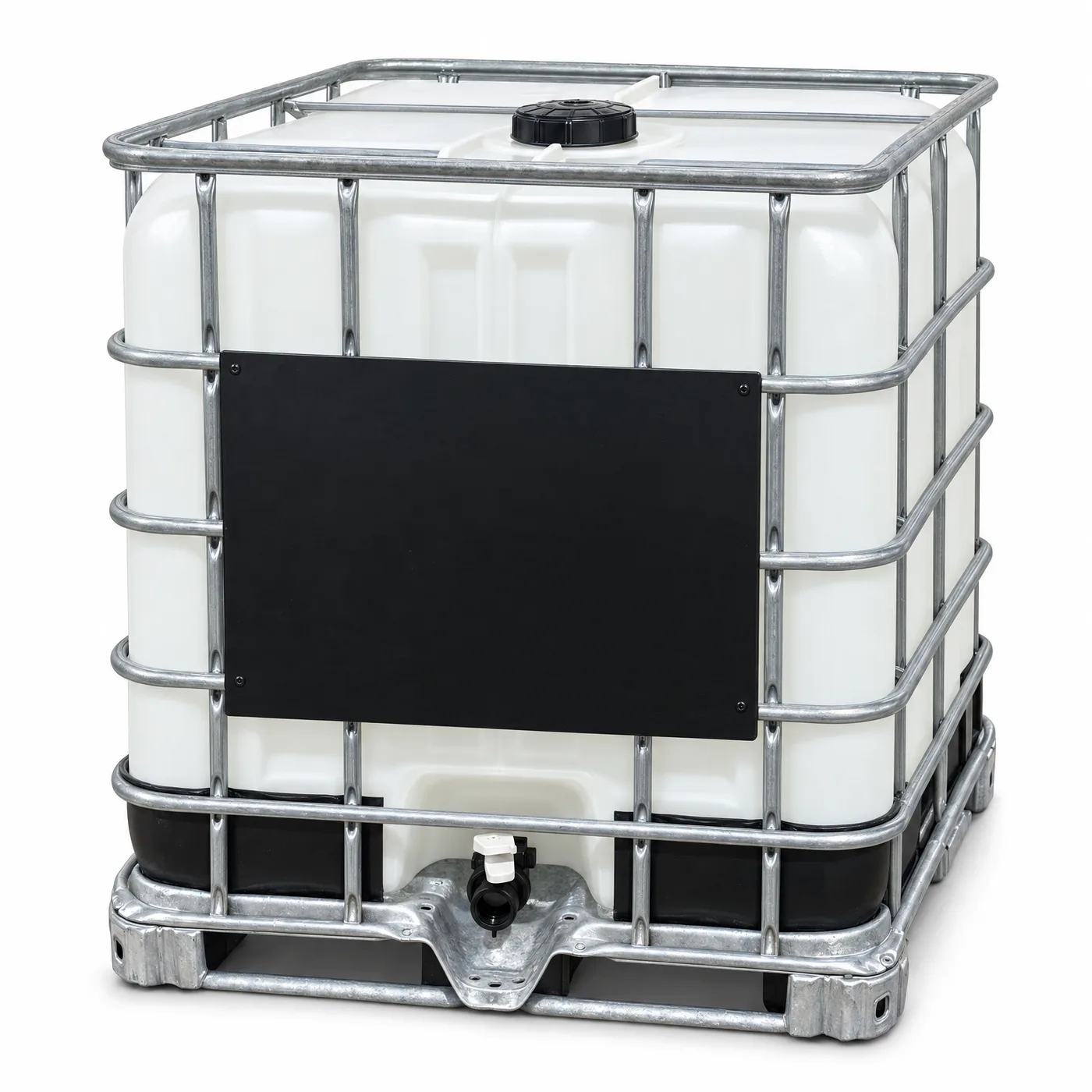

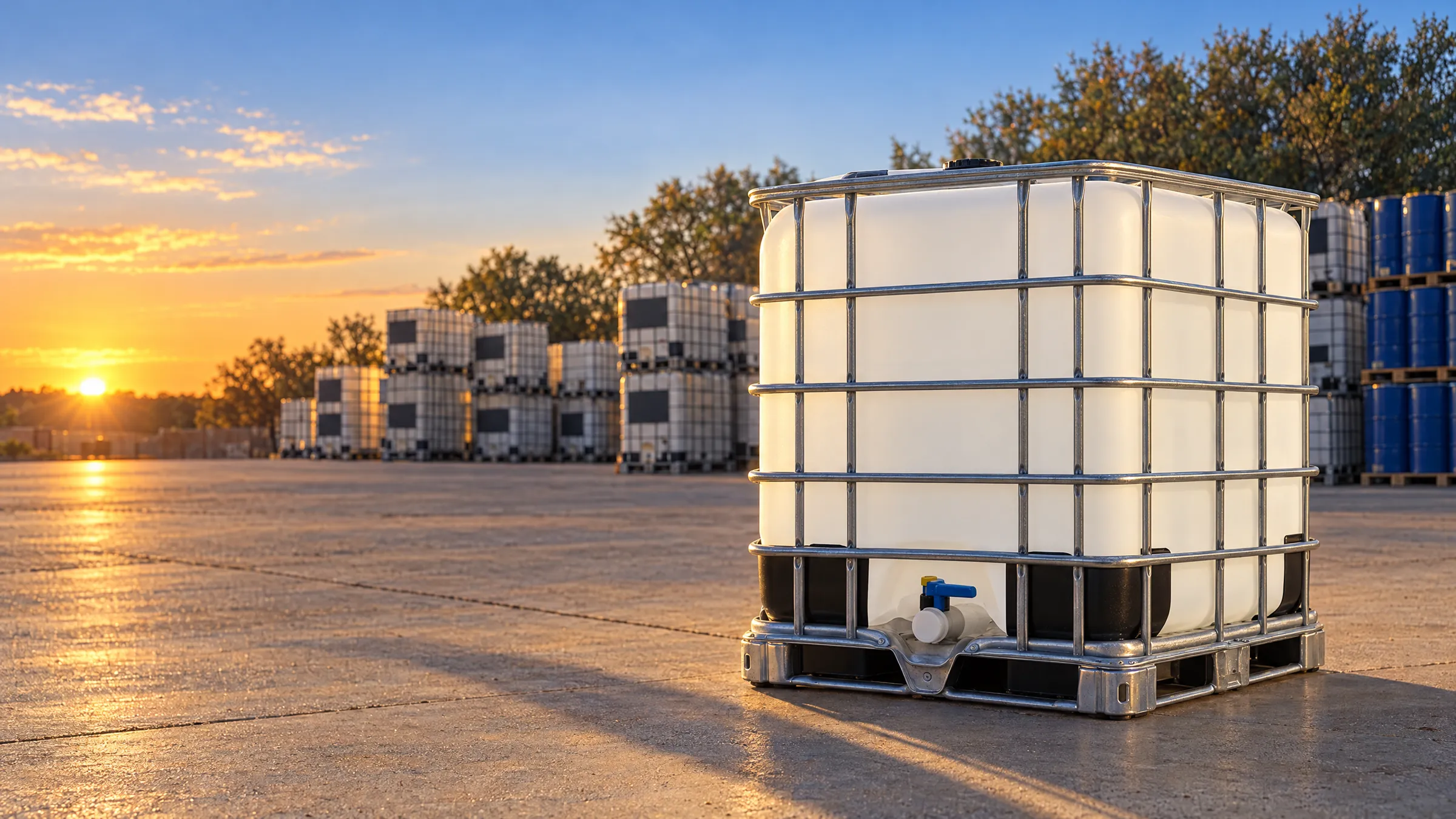
A 275-gallon IBC tote is about 47.2 in long, 39.4 in wide and 45.7 in tall, and weighs about 123 to 130 lb empty. A 330-gallon IBC tote has the same footprint, stands about 53.1 in tall and weighs about 143 to 150 lb empty.[1]
275 gallon
47.2 x 39.4 x 45.7 in1,200 x 1,000 x 1,160 mm with the pallet. Often listed as 48 x 40 x 46 in.[1][2]
330 gallon
47.2 x 39.4 x 53.1 in1,200 x 1,000 x 1,350 mm. Schütz's US sheet rounds it to 48 x 40 x 53 in.[1][14]
Empty weight
123 to 150 lb275 gal: 123 to 130 lb. 330 gal: 143 to 150 lb. The pallet type sets the number.[1]
Pick a size. The drawing is to scale.
- Holds
- 170 gal (640 L)
- Empty
- 106 lb
- Full of water
- About 1,524 lb
- Holds
- 220 gal (820 L)
- Empty
- 112 to 119 lb
- Full of water
- About 1,950 lb
- Holds
- 275 gal (1,000 L)
- Empty
- 123 to 130 lb
- Full of water
- About 2,420 lb
- Holds
- 330 gal (1,250 L)
- Empty
- 143 to 150 lb
- Full of water
- About 2,900 lb
Free. Just your work email.
Print the IBC tote check sheet
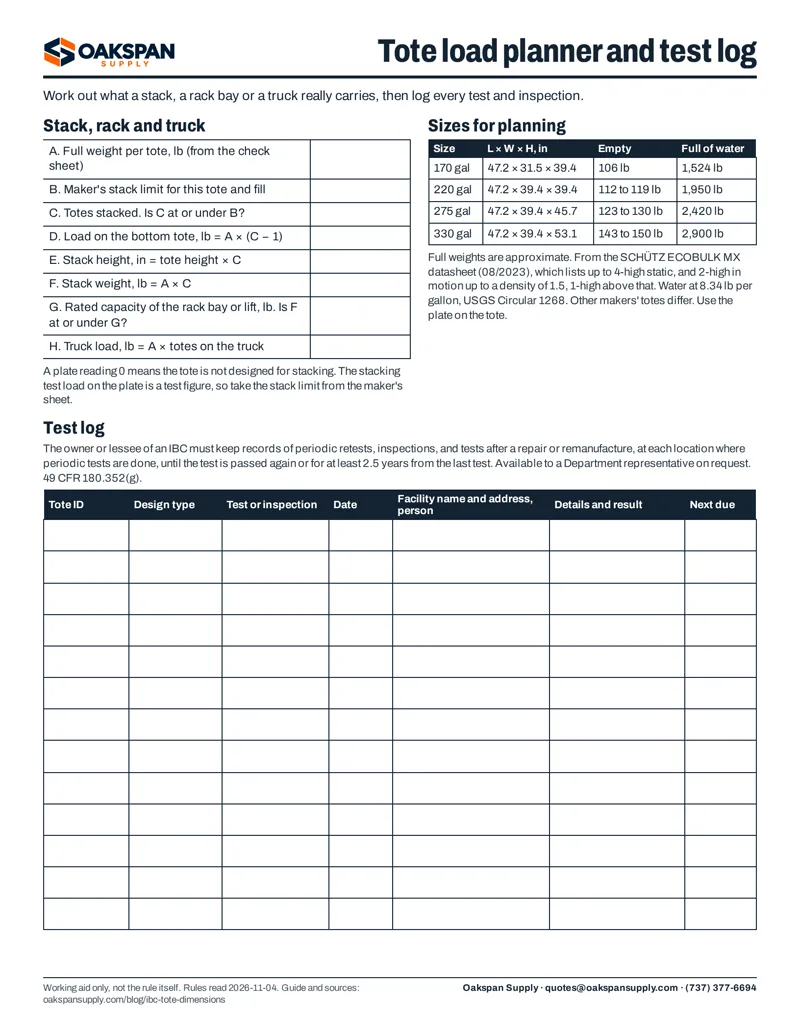
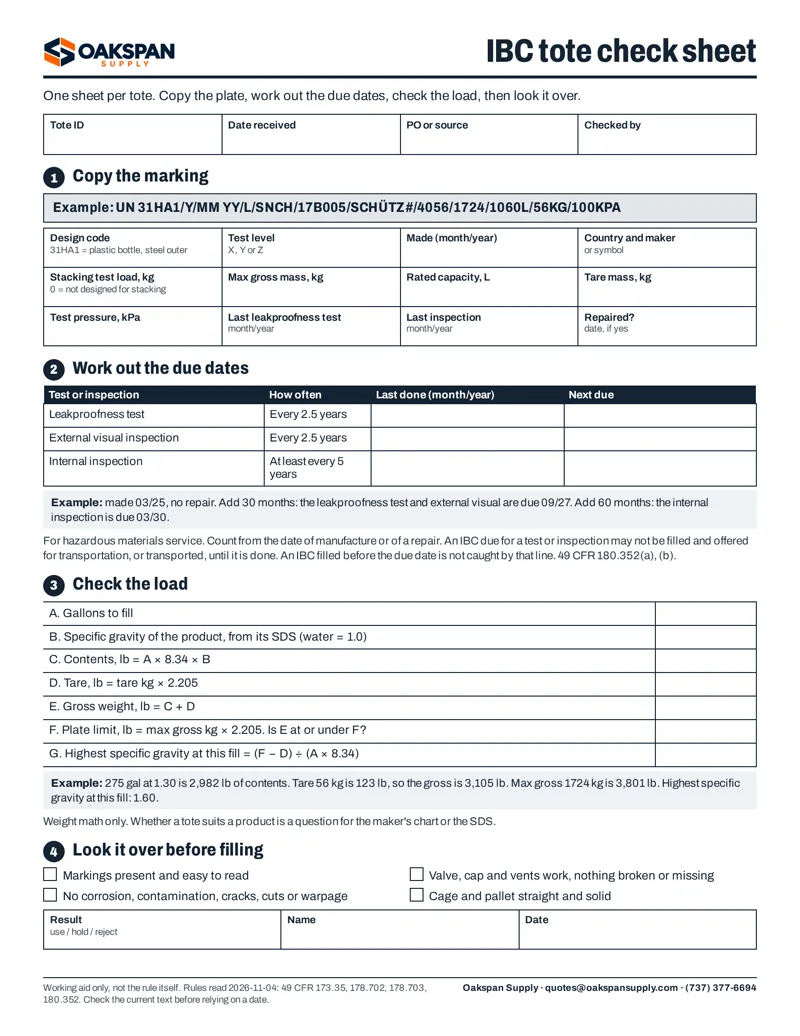
A two-page sheet for your receiving desk. It turns this page into something you can fill in at the tote.
- Copy the marking plate field by field
- Work out leakproofness and inspection due dates
- Check the fill weight against the plate limit
- Plan stack, rack and truck loads, and keep the test log
Two pages, letter size. The sheet downloads right away. We'll send you the occasional supply guide and may use your email to show you our ads. Unsubscribe any time. Privacy policy.
IBC tote dimensions and empty weights, by size
The table lists the four caged IBC sizes on Schütz's ECOBULK MX datasheet. Inches are converted from the sheet's millimeters, and pounds from its kilograms. The empty weight depends on the pallet under the tote, so each row shows the weights the sheet gives.[1]
The 275-gallon and 330-gallon totes share a footprint, so the extra 55 gallons comes from about 7.5 in of added height.[1]
Scroll across to see every column →
| Size | Length x width x height (mm) | Length x width x height (in) | Empty weight |
|---|---|---|---|
| 170 gal (640 L) | 1,200 x 800 x 1,000 | 47.2 x 31.5 x 39.4 | 48 kg (106 lb), plastic skid |
| 220 gal (820 L) | 1,200 x 1,000 x 1,000 | 47.2 x 39.4 x 39.4 | 51 kg (112 lb) steel pallet, 54 kg (119 lb) plastic skid |
| 275 gal (1,000 L) | 1,200 x 1,000 x 1,160 | 47.2 x 39.4 x 45.7 | 56 kg (123 lb) steel pallet, 59 kg (130 lb) plastic skid |
| 330 gal (1,250 L) | 1,200 x 1,000 x 1,350 | 47.2 x 39.4 x 53.1 | 65 kg (143 lb) steel pallet, 68 kg (150 lb) plastic skid |
Source: [1]
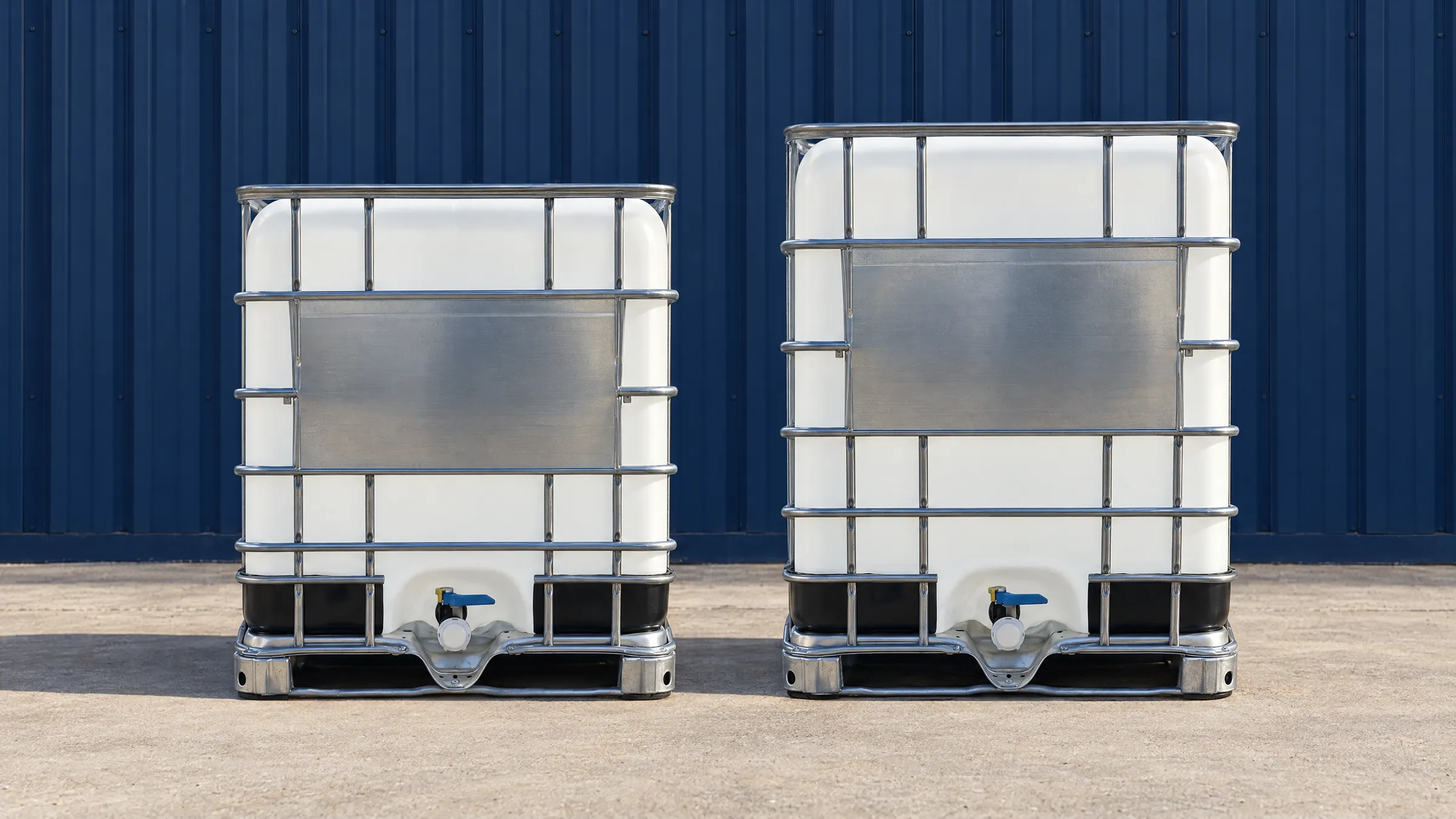
Why listings say 48 by 40 inches
A 1,200 by 1,000 mm footprint is 47.24 by 39.37 in, which rounds up to the 48 by 40 in figure many listings use. Schütz's US sheet for its 275-gallon tote gives 47.240 in, 39.370 in and 45.670 in tall with the pallet.[2]
Other makers' totes can differ from these numbers, and pallet type changes both height and weight. For a rack bay, a trailer plan or a doorway, take the number from the sheet for the exact tote on the order.[1]
Schütz's own US sheet for an MX 330 rounds the same way. The MX 330 sheet lists 48 in long, 40 in wide and 53 in tall with the pallet, a rated volume of 330 gal, an overflow volume of 334 gal, a fork opening 3.5 in high and a weight of about 146 lb on a steel frame pallet.[14]
Not every 275-gallon tote has the 48 by 40 in footprint. Mauser's all-plastic stackable IBC, a rigid plastic tote approved as UN 31H2/Y, is listed at 45 in long, 45 in wide and 56 in tall with a tare weight of 235 lb. The 330-gallon version is listed at 45 by 45 by 64 in and 255 lb. Mauser marks those tare weights and dimensions as approximate.[17]
How many gallons an IBC tote holds
The common caged sizes are 170, 220, 275 and 330 gallons. Federal rules allow a much wider range: 49 CFR 178.707(d) says composite IBCs "may not have a volumetric capacity greater than 3,000 L (793 gallons) or less than 450 L (119 gallons)."[1][7]
The 275-gallon label needs a second look. Schütz's US sheet lists the same tote as 1,000 L and 275 gal nominal, with a brimful capacity of 1,060 L (280 gal). At 3.785 liters to the gallon, 1,000 L is about 264 gallons and 275 gallons is about 1,041 L. So a tote sold as 1,000 L and a tote sold as 275 gallons can be the same container, and the gap between the two numbers is room below the brim.[2][11]
The same two limits apply to the other rigid kinds of IBC. 49 CFR 178.705(d) sets 450 L (119 gallons) to 3,000 L (793 gallons) for metal IBCs and 178.706(d) sets the same range for rigid plastic IBCs. 49 CFR 178.700(c)(1) defines the body of an IBC as a receptacle "that has a volumetric capacity of not more than 3 cubic meters (3,000 L, 793 gallons, or 106 cubic feet)." A 110-gallon container is below the 450 L minimum in those three sections.[7][19][20][21]
Makers label the common size in different ways. Schütz lists 1,000 L nominal as 275 gal. Greif says the most common size of its GCUBE "is the 275-gallon IBC tote (1,040 liters)." 49 CFR 171.10 gives 1 L as 0.2641720 gal, so 1,040 L is 274.7 gallons and 1,250 L is 330.2 gallons.[2][18][22]
How much a full IBC tote weighs
A full tote weighs the tote plus the contents. USGS lists 1 gallon of water at 8.34 pounds, so 275 gallons of water is about 2,294 lb and 330 gallons is about 2,752 lb. A product heavier than water weighs more, so use the density on the product's SDS for the real number.[11]
A tote filled to 1,000 liters holds 264.2 gallons, which is about 2,203 lb of water. With a 123 to 130 lb tote, a 1,000-liter IBC full of water weighs about 2,326 to 2,333 lb.[1][11][22]
Scroll across to see every column →
| Size | Water alone | Empty tote | Full of water |
|---|---|---|---|
| 275 gal | 2,294 lb | 123 to 130 lb | About 2,417 to 2,424 lb |
| 330 gal | 2,752 lb | 143 to 150 lb | About 2,895 to 2,902 lb |
One size, five Schütz spec sheets
A size chart gives one line per size. A maker's specification sheet gives one line per build. The table sets five Schütz sheets side by side: four 275-gallon totes and one 330-gallon tote. The four 275-gallon totes share one outside size, and their listed weights run from 114.0 lb to 130.049 lb.[2][3][14][15][16]
All five sheets list a 6 in (DN 150) fill opening and a 2 in (DN 50) outlet valve. The outlet connection differs: camlock on the two US sheets and a metric thread on the three Australian sheets. Our guide to IBC valve threads and fittings shows how to tell those outlets apart.[2][3][14][15][16]
Scroll across to see every column →
| Sheet | Size | Pallet | Length x width x height | Listed weight | Outlet |
|---|---|---|---|---|---|
| Article 4020528 (US, 2020) | 275 gal (1,000 L) | Plastic skid | 47.240 x 39.370 x 45.670 in | 130.049 lb (58.989 kg) | DN 50 butterfly valve, camlock |
| Article 4018060 (Australia, 2021) | 275 gal (1,000 L) | Steel frame | 47.240 x 39.370 x 45.670 in | 121.7 lb (55.2 kg) | DN 50 butterfly valve, metric thread |
| Article 4042296 (Australia, 2019) | 275 gal (1,000 L) | Steel frame | 47.240 x 39.370 x 45.670 in | 121.940 lb (55.311 kg) | DN 50 butterfly valve, metric thread |
| Article 4041970 (Australia, 2020) | 275 gal (1,000 L) | Steel frame | 47.240 x 39.370 x 45.670 in | 114.0 lb (51.7 kg) | DN 50 butterfly valve, metric thread |
| Material MX 1208233 (US, 2018) | 330 gal | Steel frame | 48 x 40 x 53 in | About 146 lb | 2 in ball valve, male camlock |
How to read the marking plate on a tote
UN 31HA1/<wbr>Y/<wbr>MM YY/<wbr>L/<wbr>SNCH/<wbr>17B005/<wbr>SCHÜTZ#/<wbr>4056/<wbr>1724/<wbr>1060L/<wbr>56KG/<wbr>100KPA
The plate on a UN-marked tote gives its exact numbers. Under 49 CFR 178.703, a composite IBC must show its rated capacity in liters of water and its tare mass in kilograms, along with the stacking test load and maximum permissible gross mass. Here is the marking from one Schütz 1,000 L specification: UN 31HA1/Y/MM YY/L/SNCH/17B005/SCHÜTZ#/4056/1724/1060L/56KG/100KPA.[3][6]
A plate reading 0 for the stacking test load means the IBC is not designed for stacking. Schütz's datasheet lists up to 4-high for static storage, and 2-high in motion for a filling density up to 1.5, or 1-high above that. Those figures apply to that maker's tote, so go by the plate on the tote in front of you.[1][6]
Scroll across to see every column →
| Part of the marking | Meaning | Rule |
|---|---|---|
31 | Rigid IBC for liquids | 49 CFR 178.702(a)(1) |
HA | Composite: plastic inner receptacle (H), steel outer packaging (A) | 49 CFR 178.702(b) |
1 | Category numeral | 49 CFR 178.702(a) |
Y | Performance standard: the design passed the two lower of three test levels | 49 CFR 178.703(a)(1)(iii) |
MM YY | Month and year of manufacture | 49 CFR 178.703(a)(1)(iv) |
4056 | Stacking test load, kg | 49 CFR 178.703(a)(1)(vii) |
1724 | Maximum permissible gross mass, kg | 49 CFR 178.703(a)(1)(viii) |
1060L | Rated capacity, liters of water (the same 1,060 L as the maker's brimful figure) | 49 CFR 178.703(b)(1)(i) |
56KG | Tare mass, kg | 49 CFR 178.703(b)(1)(ii) |
Three 275-gallon totes, three weight limits
Three of the sheets above print the tote's UN marking, and the three markings do not match. All three are Schütz 275-gallon totes coded 31HA1/Y. Article 4018060 is the marking decoded above. Article 4042296 reads UN 31HA1/Y/MM YY/L/SNCH/17B001/SCHÜTZ#/4056/2037/1060L/55KG/100KPA. The US article 4020528 reads UN31HA1/Y/MM YY/USA/+AA2572/~3671/2033/1040L/60KG/100KPA SCHUETZ#.[2][3][15]
49 CFR 178.700(c)(4) defines the number that limits a full tote: "Maximum permissible gross mass means the mass of the body, its service equipment, structural equipment and the maximum net mass." Subtracting the tare mass leaves 1,668 kg, 1,982 kg and 1,973 kg on these three markings, which is 3,677 lb, 4,370 lb and 4,350 lb. For scale, 275 gallons of water is about 2,294 lb.[2][3][11][15][19][22]
The stacking number has its own rule. Under 49 CFR 178.703(b)(7)(iv), the mass shown above the stacking symbol "must not exceed the load imposed during the design test, as indicated by the marking in paragraph (a)(1)(vii) of this section, divided by 1.8." A stacking test load of 4,056 kg divided by 1.8 is 2,253 kg, and 3,671 kg divided by 1.8 is 2,039 kg.[2][3][6][15]
The rated capacity differs too: 1,060 L on the two Australian markings and 1,040 L on the US marking. Three totes of one nominal size carry three sets of limits, so each tote's own plate gives its numbers.[2][3][15]
Scroll across to see every column →
| Line | Article 4018060 | Article 4042296 | Article 4020528 (US) |
|---|---|---|---|
| Stacking test load | 4,056 kg (8,942 lb) | 4,056 kg (8,942 lb) | 3,671 kg (8,093 lb) |
| Most the stacking symbol may show (test load divided by 1.8) | 2,253 kg (4,968 lb) | 2,253 kg (4,968 lb) | 2,039 kg (4,496 lb) |
| Maximum permissible gross mass | 1,724 kg (3,801 lb) | 2,037 kg (4,491 lb) | 2,033 kg (4,482 lb) |
| Tare mass | 56 kg (123 lb) | 55 kg (121 lb) | 60 kg (132 lb) |
| Gross mass minus tare mass | 1,668 kg (3,677 lb) | 1,982 kg (4,370 lb) | 1,973 kg (4,350 lb) |
| Rated capacity | 1,060 L (280.0 gal) | 1,060 L (280.0 gal) | 1,040 L (274.7 gal) |
| Gauge test pressure | 100 kPa | 100 kPa | 100 kPa |
New, reconditioned or rebottled
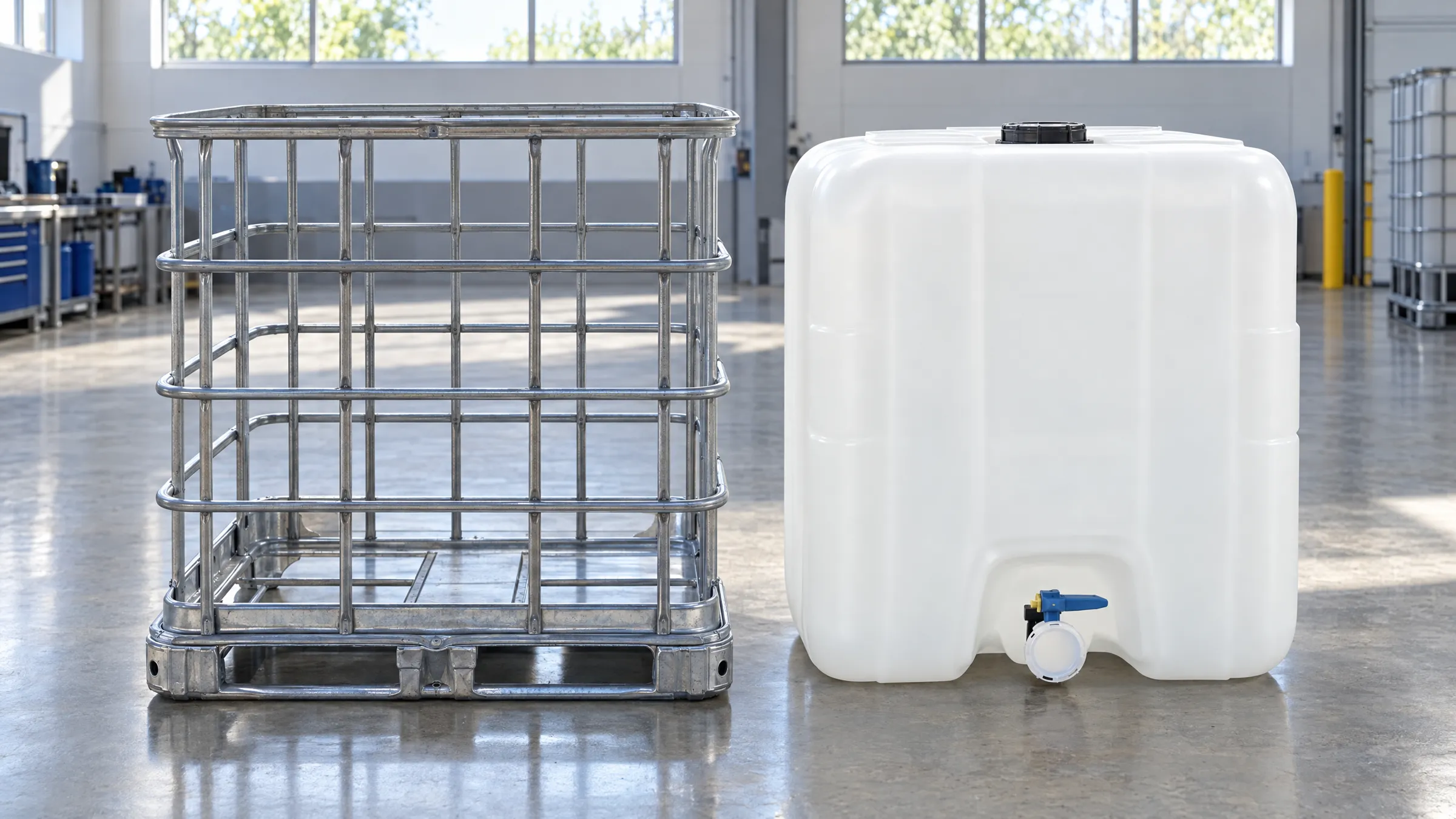
A new tote has a new bottle and a new cage. A reconditioned tote has been cleaned and inspected, and in the trade it usually keeps its bottle. A rebottled tote keeps a used cage and pallet and gets a new inner bottle. Schütz's sheet for its RMX 1250 describes the idea: the "inner tank, screw cap, valve and label plate" are replaced, and the grid and pallet "may show marks from the prior use."[4]
The federal rule uses different words. 49 CFR 180.350 sorts this work into routine maintenance, repair and remanufacture. Cleaning is routine maintenance. It also says "the replacement of the rigid inner receptacle of a composite IBC with one from the original manufacturer is considered a repair," and that "the inner receptacles of composite IBCs are not repairable." Sellers use reconditioned and rebottled in their own ways, so read what the listing says was replaced.[8]
Inspection dates on a reused tote
Under 49 CFR 173.35(b), an IBC other than a multiwall paper one "may be reused." For hazardous materials service, 49 CFR 180.352 requires a leakproofness test and an external visual inspection every 2.5 years, and an internal inspection at least every five years. The most recent retest date goes on the IBC, so check that date against the rule before filling a used tote for that service.[9][10]
PHMSA's proposed rule HM-215S, published October 27, 2026, would reword the stacking line on the IBC marking from "stacking test load" to "superimposed stacking test mass"; PHMSA says the marking and the test stay the same. Our news page on the HM-215S proposal sets the current and proposed text side by side.[12]
Empty totes going back for reconditioning have their own rule since September 3, 2026: HM-268P added 49 CFR 173.29(d), which excepts an IBC from shipping papers when no more than 0.3 percent by weight of its total capacity remains and the other conditions are met. Our news page on HM-268E lists those conditions.[13]
The IBC totes Oakspan Supply lists
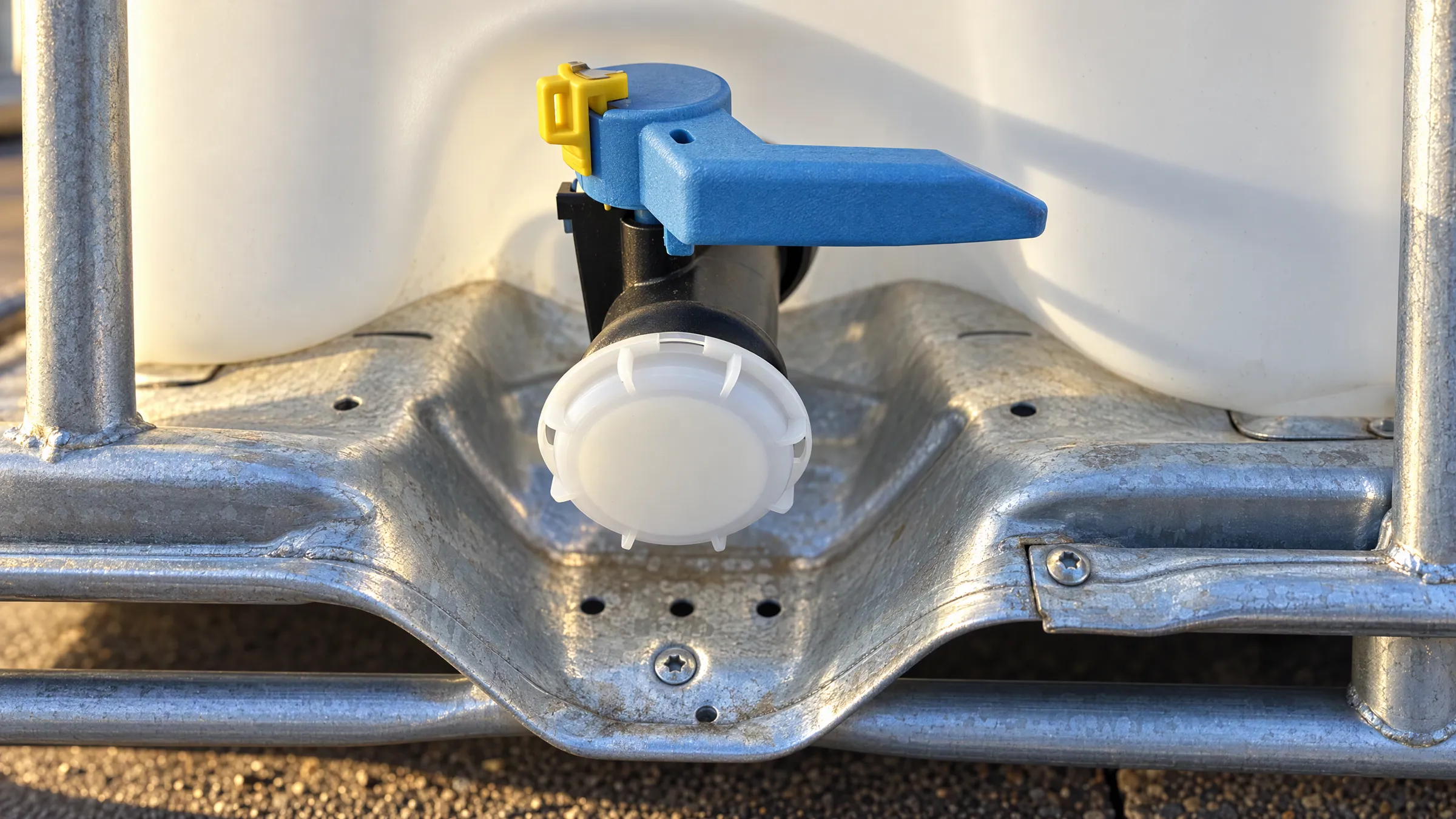
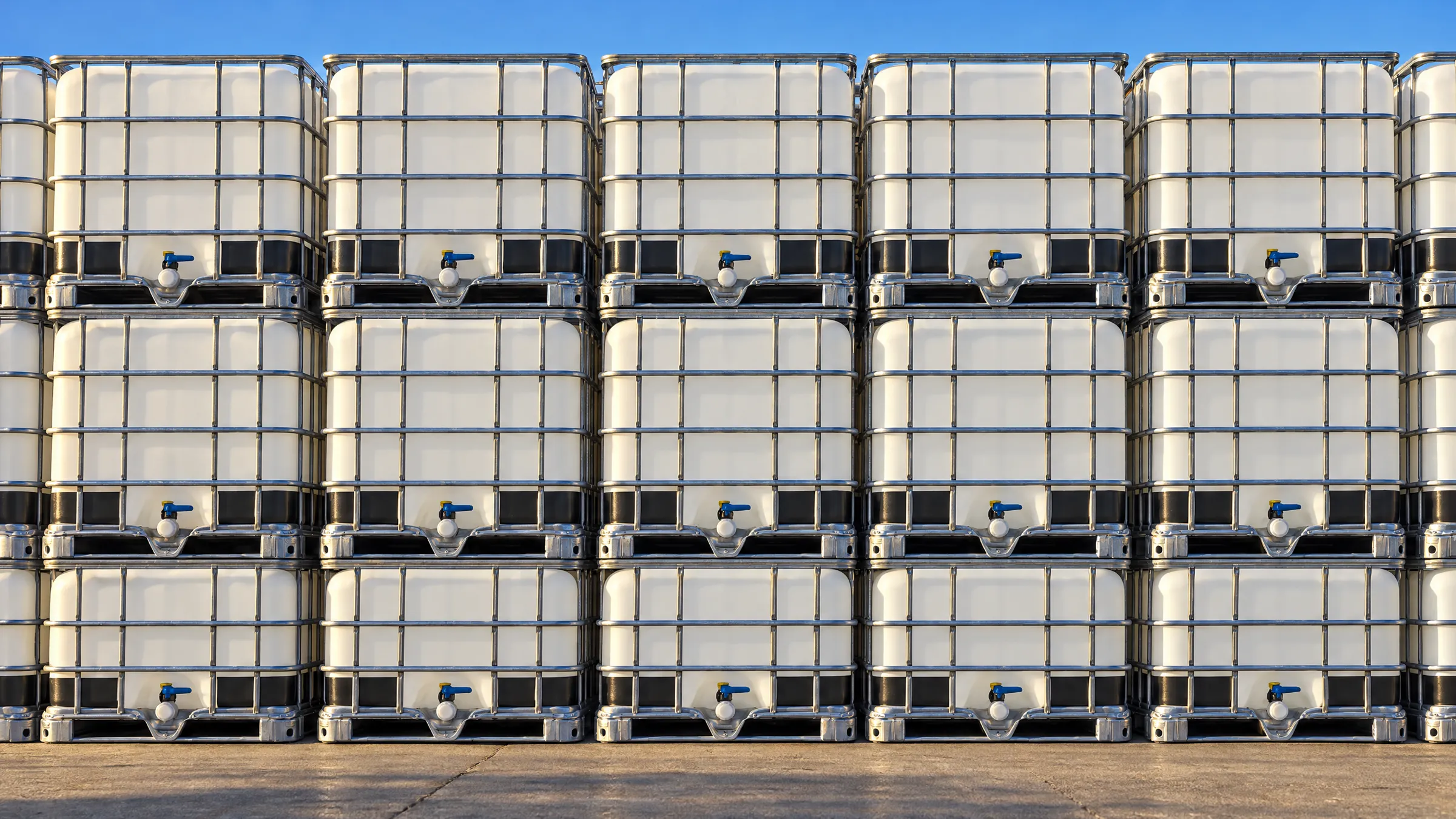
Oakspan Supply sells plants, labs and warehouses the supplies on their list, from labels and drum closures to packaging. Our reconditioned totes have an HDPE bottle in a galvanized steel cage. The valve varies by tote, so your quote confirms it, and each tote has its own part number below. On our listing, reconditioned means cleaned and inspected.
The Schütz sheets above are published examples, and they are not the spec for these part numbers. Exact configuration and availability are confirmed in the quote. Send your list to our quotes desk at quotes@oakspansupply.com. Which tote or valve material suits a product is a question for the maker's chart or the SDS.
On our shelves

Questions
How tall is a 275-gallon IBC tote?
Schütz's sheet lists 1,160 mm with the pallet, which is 45.67 in. A 330-gallon tote is 1,350 mm, about 53.1 in.[1][2]
How much does an empty IBC tote weigh?
Schütz's datasheet lists a 275-gallon tote at 56 to 59 kg (123 to 130 lb) and a 330-gallon tote at 65 to 68 kg (143 to 150 lb), depending on the pallet.[1]
Is a 1,000-liter tote the same as a 275-gallon tote?
Often, yes. Schütz's US sheet lists one tote as 1,000 L and 275 gal nominal, with a brimful capacity of 1,060 L (280 gal).[2]
What is the difference between a reconditioned and a rebottled IBC tote?
A rebottled tote gets a new inner bottle in a used cage. A reconditioned tote has been cleaned and inspected, and usually keeps its bottle. Under 49 CFR 180.350, replacing the inner receptacle with one from the original manufacturer counts as a repair.[8]
What are the dimensions of a 330-gallon IBC tote?
Schütz's datasheet lists 1,200 x 1,000 x 1,350 mm, which is 47.2 x 39.4 x 53.1 in. Schütz's US sheet for the MX 330 rounds that to 48 x 40 x 53 in and lists about 146 lb on a steel frame pallet.[1][14]
How much does a full 275-gallon IBC tote weigh?
About 2,417 to 2,424 lb full of water: 2,294 lb of water plus a 123 to 130 lb tote. The maximum permissible gross mass on the plate is higher. Three Schütz 275-gallon markings show 1,724 kg, 2,033 kg and 2,037 kg, which is 3,801 lb, 4,482 lb and 4,491 lb.[1][2][3][11][15][22]
How much does a full 1,000-liter IBC weigh?
About 2,326 to 2,333 lb full of water. One thousand liters is 264.2 gallons, about 2,203 lb of water, and Schütz lists the empty tote at 123 to 130 lb.[1][11][22]
What are the smallest and largest IBC totes?
For UN-marked metal, rigid plastic and composite IBCs, 49 CFR 178.705(d), 178.706(d) and 178.707(d) set the range at 450 L (119 gallons) to 3,000 L (793 gallons). Schütz's ECOBULK MX datasheet lists four sizes inside that range, from 170 to 330 gallons.[1][7][20][21]
Buying near Austin? Get a Central Texas freight quote.

Written by Anastasiia Kuziak, Manager and President of Oakspan Supply. She has a business degree, owns a small business of her own, and has more than five years in medical and pharmaceutical sales. How we write and check our guides.
Sources
- ECOBULK MX datasheet, 08/2023. SCHÜTZ. Accessed 2026-11-17.
- Packaging specification, ECOBULK 275 gal, MX275, article 4020528. Schuetz Container Systems. Accessed 2026-11-17.
- Packaging specification, ECOBULK 1000 ltr, article 4018060. SCHÜTZ Australia. Accessed 2026-11-17.
- Packaging specification, ECOBULK RMX 1250 UN, article 4007156. SCHÜTZ GmbH & Co. KGaA. Accessed 2026-11-04.
- 49 CFR 178.702, IBC codes. Legal Information Institute (Cornell Law). Accessed 2026-11-04.
- 49 CFR 178.703, Marking of IBCs. Legal Information Institute (Cornell Law). Accessed 2026-11-04.
- 49 CFR 178.707, Standards for composite IBCs. Legal Information Institute (Cornell Law). Accessed 2026-11-04.
- 49 CFR 180.350, Applicability and definitions. Legal Information Institute (Cornell Law). Accessed 2026-11-04.
- 49 CFR 180.352, Requirements for retest and inspection of IBCs. Legal Information Institute (Cornell Law). Accessed 2026-11-04.
- 49 CFR 173.35, Hazardous materials in IBCs. Legal Information Institute (Cornell Law). Accessed 2026-11-04.
- USGS Circular 1268, Conversion Factors. U.S. Geological Survey. Accessed 2026-11-17.
- Hazardous Materials: Harmonization With International Standards (HM-215S), proposed rule, 91 FR 67720, October 27, 2026. Federal Register. Accessed 2026-11-08.
- Hazardous Materials: Adoption of Department of Transportation Special Permit 21478 (HM-268P), final rule, 91 FR 49335, August 4, 2026. Federal Register. Accessed 2026-11-10.
- Packaging specification, MX 330 UN, material MX 1208233, September 17, 2018. SCHÜTZ. Accessed 2026-11-17.
- Packaging specification, ECOBULK 1000 ltr, article 4042296. SCHÜTZ Australia. Accessed 2026-11-17.
- Packaging specification, ECOBULK 1000 ltr, article 4041970. Schütz Container Systems Pty Ltd. Accessed 2026-11-17.
- All-Plastic, Stackable and Reusable IBC. Mauser Packaging Solutions. Accessed 2026-11-17.
- GCUBE intermediate bulk containers. Greif. Accessed 2026-11-17.
- 49 CFR 178.700, Purpose, scope and definitions. Electronic Code of Federal Regulations. Accessed 2026-11-17.
- 49 CFR 178.705, Standards for metal IBCs. Electronic Code of Federal Regulations. Accessed 2026-11-17.
- 49 CFR 178.706, Standards for rigid plastic IBCs. Electronic Code of Federal Regulations. Accessed 2026-11-17.
- 49 CFR 171.10, Units of measure. Electronic Code of Federal Regulations. Accessed 2026-11-17.
Written from the sources above under our editorial policy. Published November 4, 2026, last updated November 17, 2026. Spot an error? Send us a correction and we fix it and note the date.
- Drums, totes and pails
- OKS-CTR-IBC-275-RECON: 275 gal, reconditioned
- OKS-CTR-IBC-330-RECON: 330 gal, reconditioned
- OKS-PKG-MAU-TOTEBUNG: Vented bung for poly tote cap, 2 in
- PHMSA HM-215S proposed rule: IBC stacking mark wording, comments close Dec 28, 2026
- PHMSA HM-268E: the RQ list moves to 40 CFR 302.4 on December 2, 2026
- IBC tote valve threads and fittings: S60x6, 2 in NPS or camlock
- How to read UN markings on drums, pails and boxes
Pictures on this page are AI images made from our warehouse photos. Exact part and markings are confirmed in your quote.